It might sound silly. It's also correct: pigeons are the cheapest rooftop sensor network a city will ever get. Feral pigeons are a man-made bird — we bred them, for a job, then called them pests — and they land on every roof in the city. Put a 15-gram solar LoRa node on an owned club pigeon and you get a rooftop sensor and relay that never needs a cell plan, a tower, or a permit to dig. Three thousand of them cover a city for the price of one traffic light. The scale: an estimated 400 million feral pigeons worldwide, a million or more in New York alone (est.) — the new-age carrier pigeon, back on the job, and they sign up by the dozens.
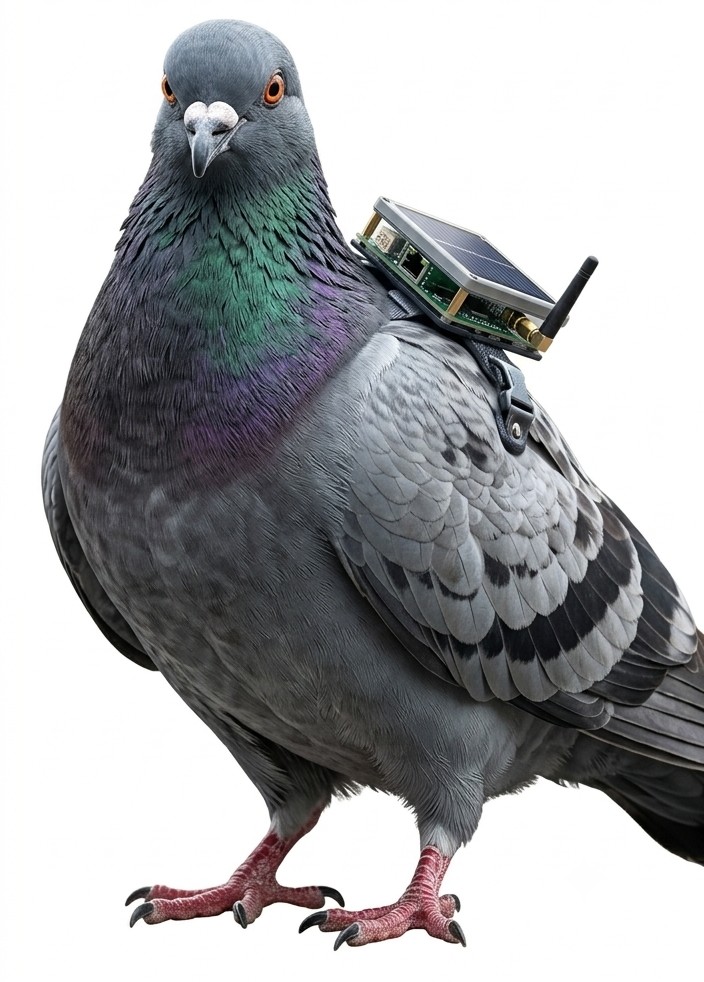
A man-made bird that lands on every roof in the city, a 15-gram solar radio, and a city that suddenly has a $0/month mesh. This is how it gets built.
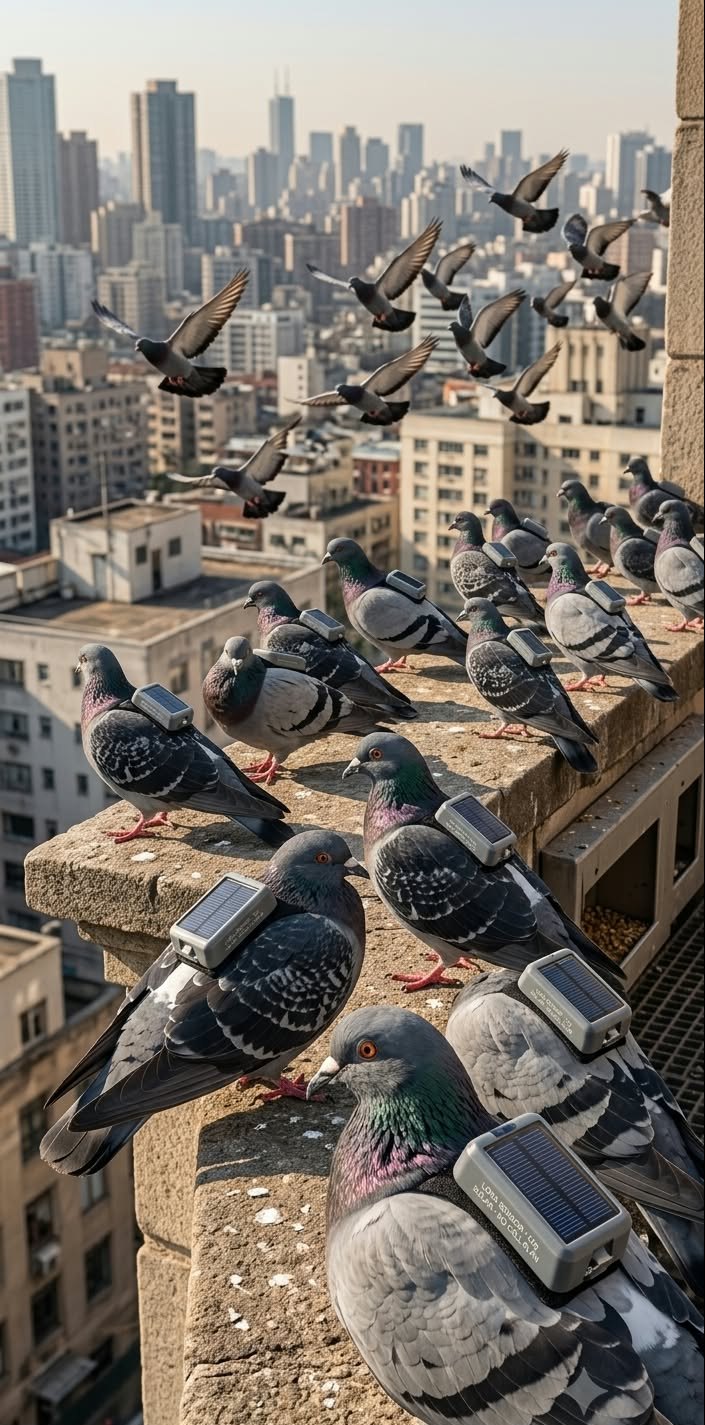
City birds, tagged where they already live, a tag lighter than their breakfast. Three thousand per city, on the ledges cats cannot reach.
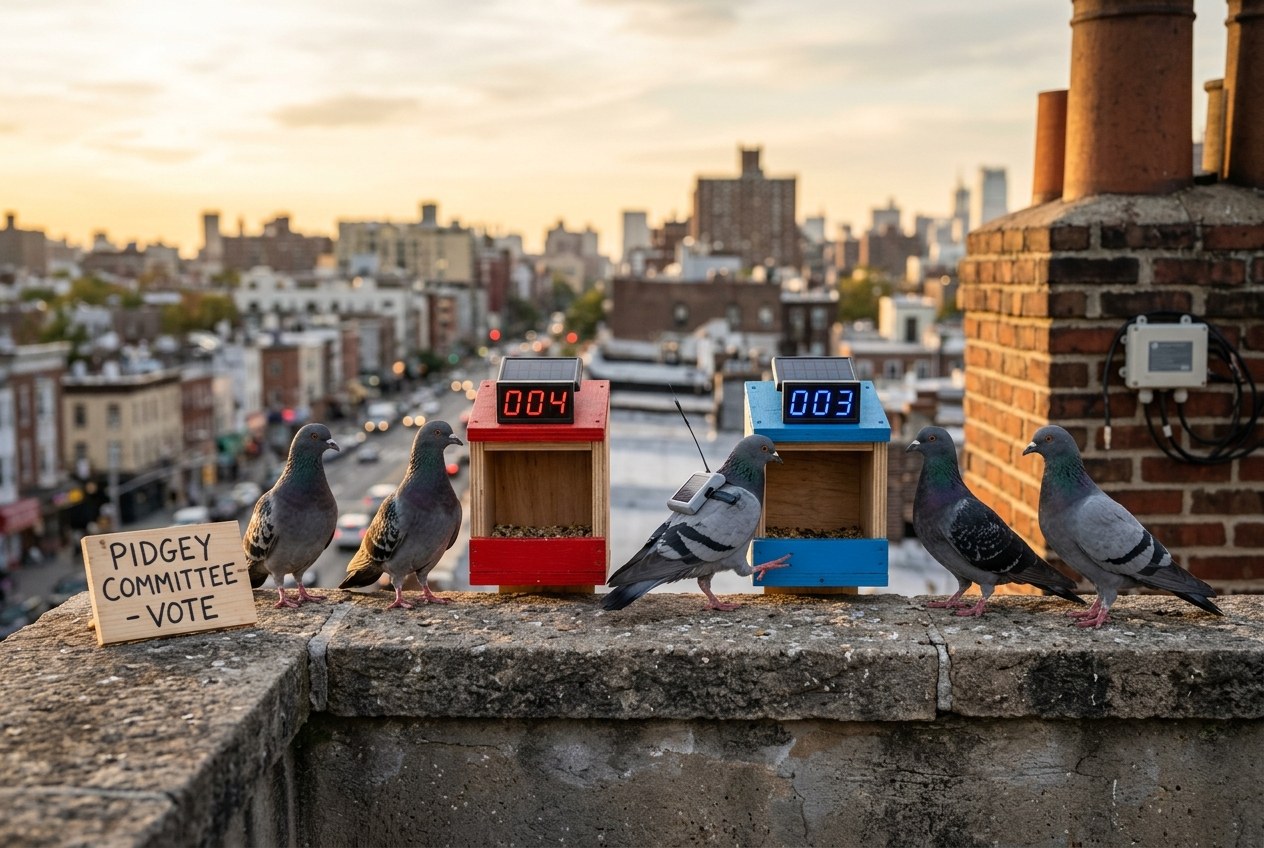
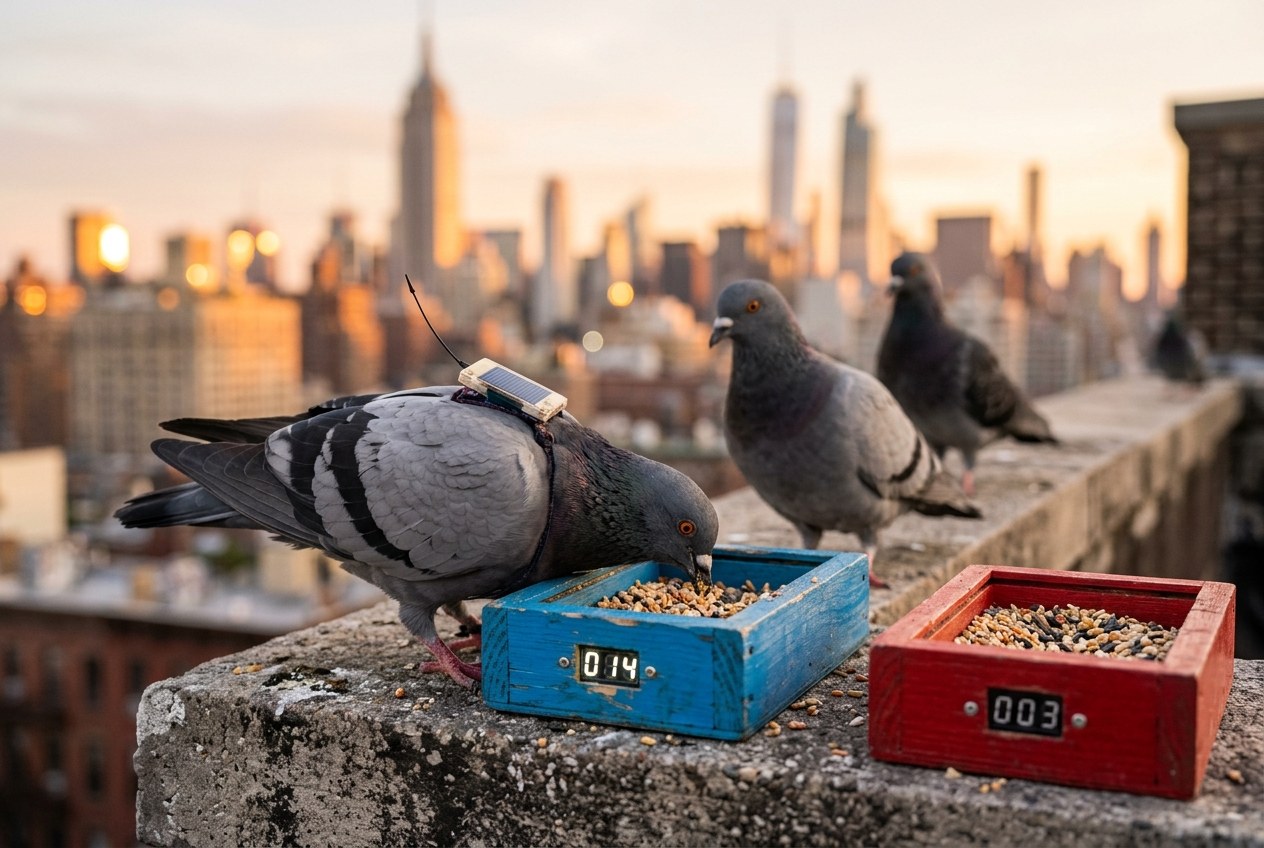
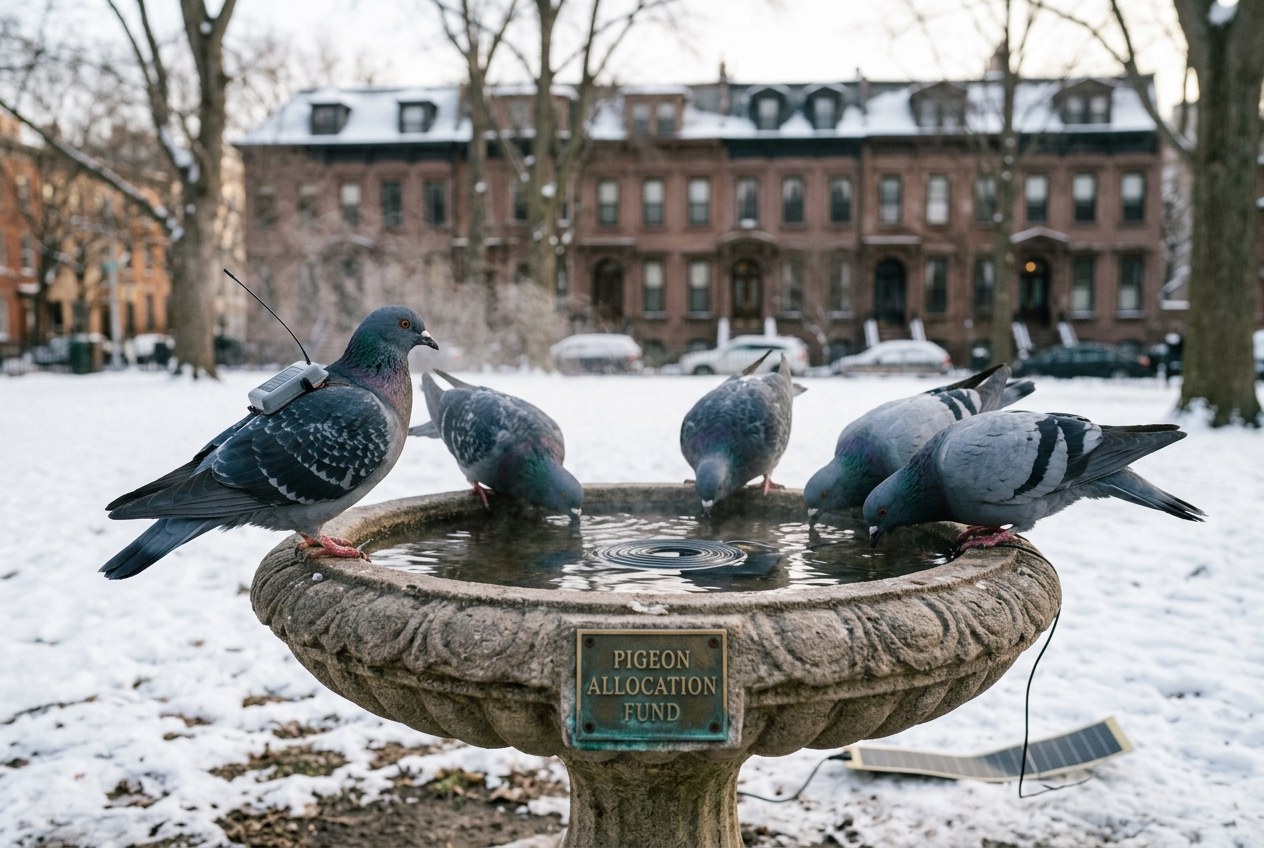
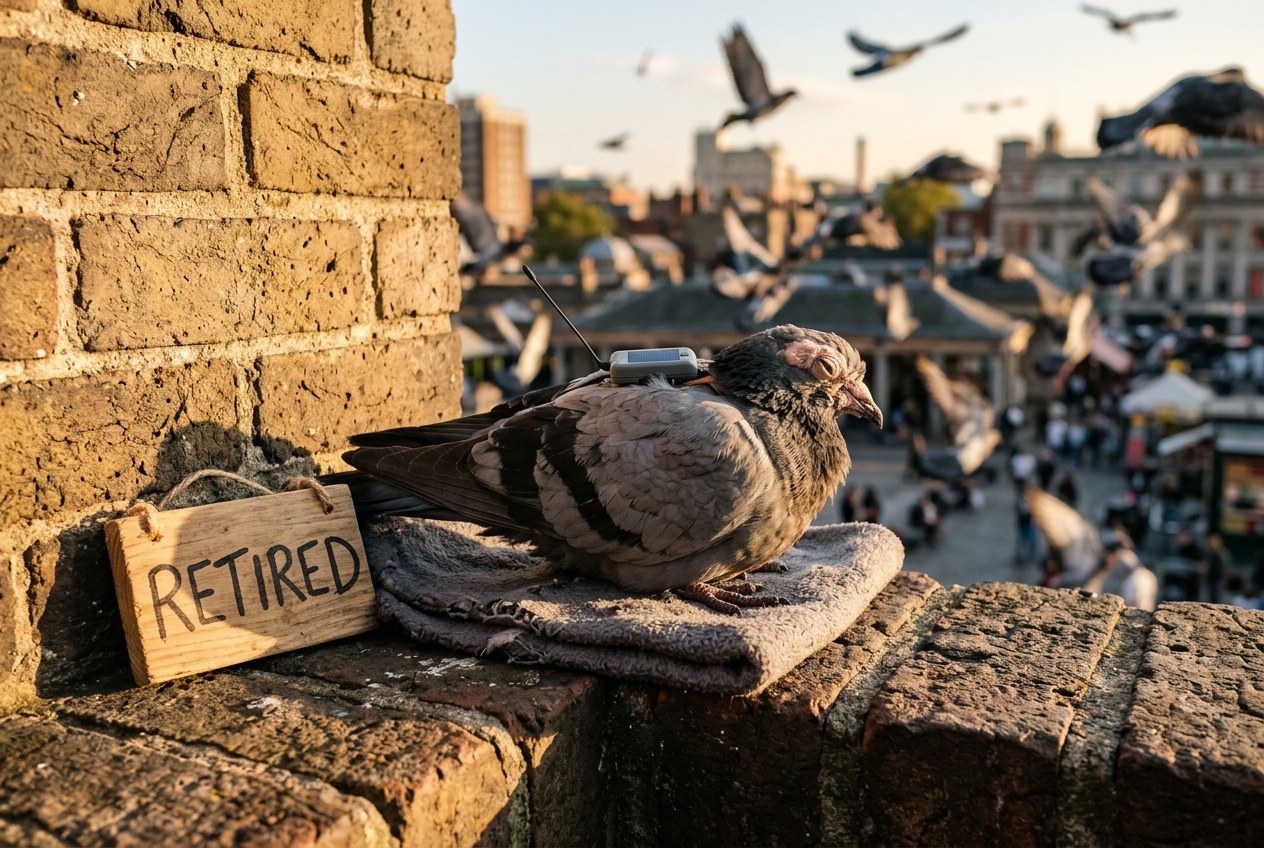
1 % of every program dollar goes into the Pigeon Allocation Fund — feed stations, water, checkups, a warm ledge in winter, a bird bath in the park. Where it goes is decided the only way a pigeon decides anything: two feeders side by side, red or blue, and the tags count every beak. More water stations or more winter ledges? The committee allocates. Turnout is excellent. Not a union. Yet.
Yes, it's a funny thing to picture. It is also real and serious: the tags, the mesh, the readings, the fund, the feeders that count are all buildable today and priced on this site. We just had to poke at it, because a pigeon with a pension is too good to leave alone. PidgeyFLok is the real deal, and the data it carries goes far past pigeons: rooftop heat maps for the public-health office, block-by-block air quality, wind and pressure for the weather desk, RF dead zones for the city's own radios, rat activity for sanitation, an outage-proof text layer for outreach — one flock, a dozen departments, and the same readings sold as products to anyone who needs a city sensed from the roofline.
Tracked TNR colonies at street level. The city pays for this layer, because it is the one that ends the stray problem instead of managing it forever.
A $15 pocket node and the app on a Lifeline phone: case workers, clinics, appointments, an SOS to the nearest outreach worker. No plan, no SIM, no cell coverage needed.
The city's own pigeons, tagged at the feed stations under the permits. They keep their roosts and their habits; the solar tag recharges on the ledge and the chimney receivers pick up the data every time a bird lands. Time they paid their rent.
LoRa radio, a solar patch, a 150 mAh cell, temperature / humidity / pressure, a 3-axis compass and motion sensor. Standard ornithology backpack mount: no glue, no collar. Beacons every 15-30 minutes; logs every minute; dumps the log at the loft.
A $10.90 Wi-Fi LoRa kit in a printed weatherproof box, screwed to a chimney or snapped onto a base plate. Fifty per city. Everything the birds hear lands on the map within seconds, on the roof's own Wi-Fi.
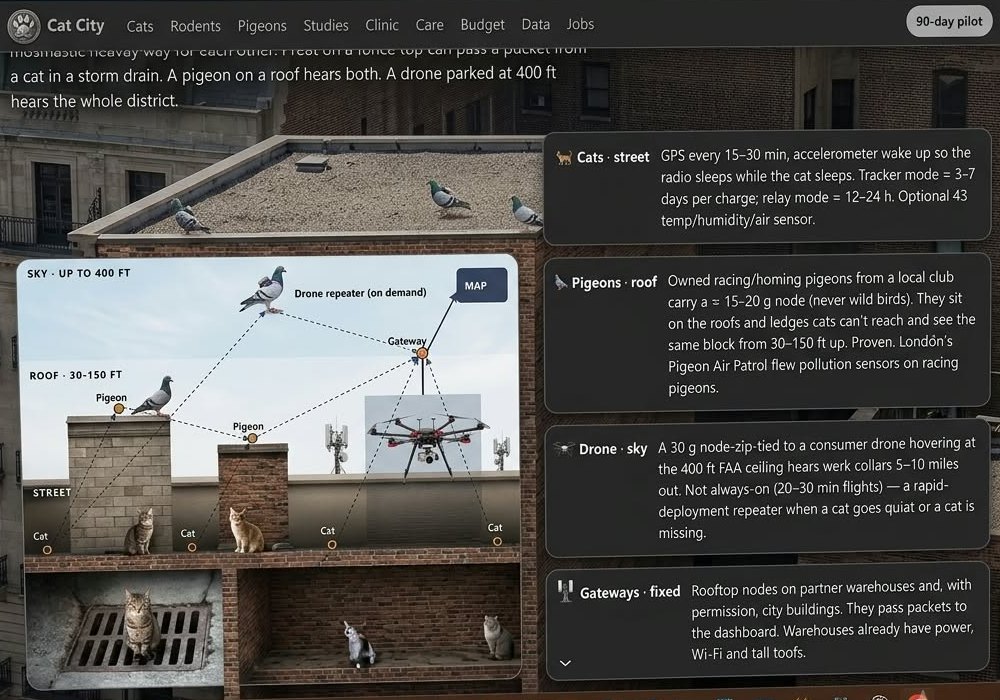
Every node relays for every other. A cat in a storm drain reaches a cat on a fence; a pigeon on the ledge hears both; a drone parked at 400 ft hears the whole district. Pigeons are the roof layer: the densest, cheapest, highest nodes a city can have, sitting exactly where cats cannot go and where the gateways already are.
Their own budgets: New York's shelter contract averages $53.7M a year; Miami-Dade Animal Services is $39.7M and holds 500,000 stray cats "steady"; Chicago spends $12.5-14.9M a year on rats and its own audit says the plan is unlikely to work. A full Cat City program with 3,000 pigeon nodes and 1,000 tracked cats is about $600,000 a year including a warehouse where we hold, train and neuter on site, priced to finish instead of continue; a city that lends an unused building pays $520,000.
Sources on the studies page: NYC Comptroller 2025, Miami-Dade FY23-24 adopted budget, Block Club Chicago / The Center Square, SF Chronicle, Pimentel 2005, Loss et al. 2013.
Clubs welcome too: keep your birds and your loft, we supply the tags and the map, and your birds' data pays for their feed. Consent in writing, payload under 5 % of body weight.
Kittens, friendly strays and owner surrenders are held at the hub, neutered, vaccinated, chipped and socialized, then adopted through the partner shelter. Working cats go to businesses. Adoption page →
A shoebox-sized weatherproof receiver on your chimney or wall, on your Wi-Fi, drawing less than a phone charger. You see the dashboard for your block. Warehouses, breweries and logistics yards first.
$25,000: twenty tracked cats, a hundred pigeon nodes, five gateways, one neighborhood, and a report the council can vote on. Then a city program priced to end the stray problem, not manage it forever. Have an unused building? Lend it as the hold-and-train warehouse and clinic room (vet students under a supervising DVM neuter on site; basic shots, flea and worm treatment for every animal) and the program price drops.
amh@artificialmindhive.com The scroll story → The full pigeon program →
 AntlerFlok (parks & deer) →