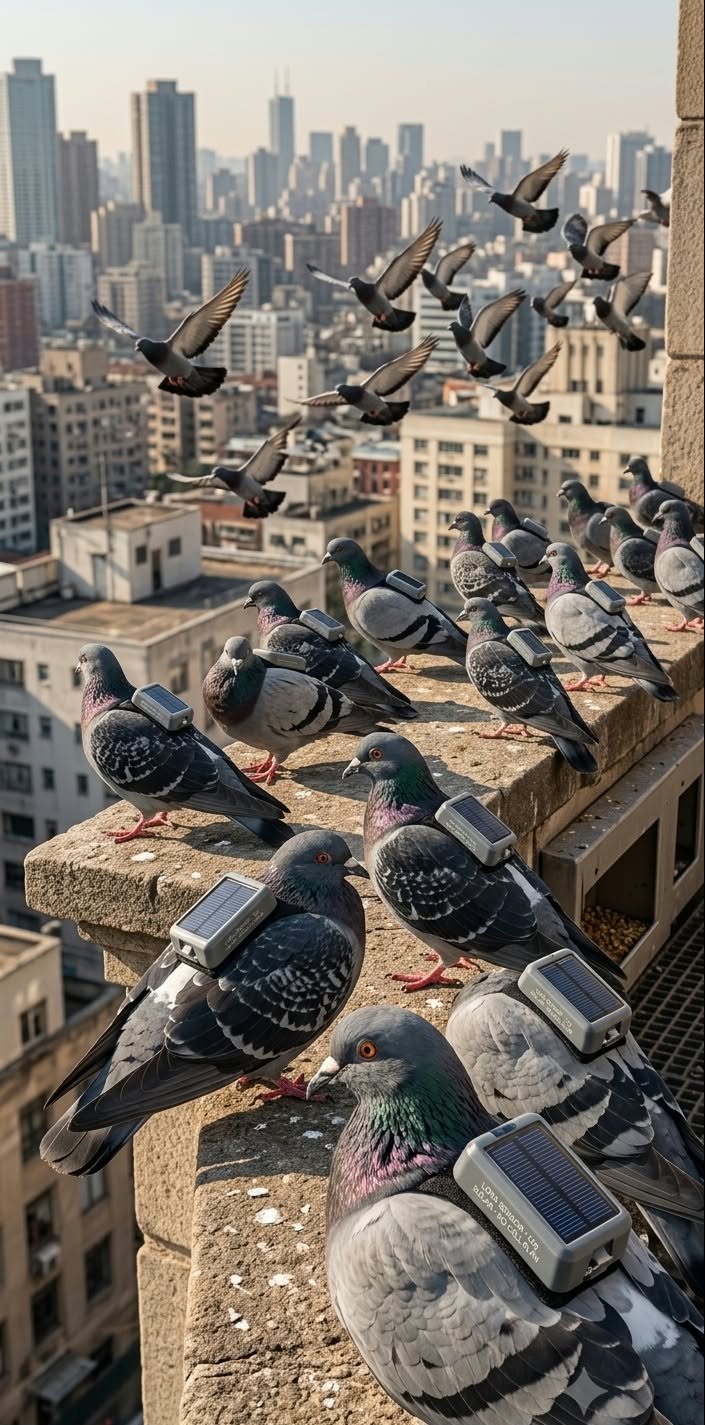
Feral pigeons are not wildlife. They're the descendants of domesticated rock doves humans bred for thousands of years — a man-made bird that lives on our buildings, eats our waste, roosts in the same spot every night, and lands on every roof in the city. Put a 12-gram solar tag on one and it becomes a rooftop-height sensor that never needs a cell plan. Feed it, check it, and give it a safe loft, and it comes back to you every day.
A LoRa node at rooftop height reaches other rooftops 2–5 km away in a city. One bird on a roof covers ~10–30 km² of usable radio footprint. A mid-size city is roughly 200–250 km². A few dozen rooftop nodes cover the city; 3,000 is a hundred-fold surplus.
Meshtastic's LoRa link is slow (~1 kbit/s). One position packet burns about a second of air. A single frequency slot comfortably carries ~100 nodes reporting every 15 minutes. 3,000 birds all relaying on one slot would jam it in minutes. So birds must never relay, and they must not all share one slot.
Birds are quiet trackers (Meshtastic "client mute"): they transmit rarely and relay nothing. Lofts and rooftop gateways do the relaying. Flocks are sharded across the 100+ frequency slots in the 915 MHz band, one loft per slot. And the heavy data never touches the air at all — it rides home on the bird.
A tag logs temperature, humidity, pressure, position and air quality every minute all day — far more than LoRa could carry. When the bird lands at its loft to feed, the tag dumps the day's log over short-range radio to the dock in seconds. This is how researchers tracked zebras and albatrosses long before there were meshes. 3,000 birds × 1,440 samples a day = 4.3 million rooftop-level readings per city per day, at zero airtime.
Feral pigeons range 1–3 km from their roost and come back every night. One loft per ~20k residents — twelve for a city of 250,000 — with ~250 tagged birds each gives 3,000 birds whose daily flights naturally tile the city with overlapping 2–3 km circles. The lofts are 3 km apart; the flocks meet in the middle. Every neighbourhood, every day, without planning a single flight.
Pair it with the cats at street level and the drone column: the ground-to-roof heat profile becomes a live citywide layer, not a one-block experiment. Where the heat island is worst, where a cool roof would matter, where a park cools its neighbours — measured, not modelled.
PM2.5 and VOC on a $10 sensor, sampled every minute across the whole city. Wildfire smoke, freeway plumes, refinery drift — seen arriving, block by block, hours before a fixed monitor updates.
A flying bird's GPS track drifts with the wind. Thousands of tracks a day give a rooftop-level wind map of the city — the missing input for smoke dispersion, drone corridors, and how heat and pollution move between neighbourhoods.
Every tagged bird gets a checkup at tagging and on recapture; sick birds stop moving and stop coming to the loft, and the tag shows it. A monitored urban flock is a sentinel for avian influenza and other bird disease a county health department currently learns about from dead birds on sidewalks.
Cities already spend on pigeon mitigation: netting, spikes, roost cleanup, dropping damage. The loft is where the flock eats — so it's where EPA-registered pigeon contraceptive feed goes. Fewer birds over time, no poison, no culling, and a count that proves it.
Twelve battery-and-solar lofts on rooftops across a city on a fault line, already talking to each other, already mapped by the birds. When cell service goes, that's a text-message network for Emergency Management that was paid for by pigeons.
A weatherproof loft on a partner rooftop — warehouse, parking structure, city building — with perches, shade and shelter from hawks. Feral pigeons adopt a reliable roost fast; a loft with food is home within days.
Grain at the same time every day, from a caretaker on the same rounds as the cat sites. That's the recall: the flock returns at feeding time, which is when tags dock and dump their logs.
Birds are caught at the loft, not chased. First visit: health check by an avian-experienced vet or trained tech, weight, band, harness fit. Every recapture: weight, feather and foot condition, tag inspection. Sick or underweight birds aren't tagged; injured ones get treated.
The loft holds a solar Meshtastic gateway (the relay the birds don't do), a short-range dock that pulls each tag's log as the bird feeds, and a charging perch pad so tags top up beyond what the solar patch gives.
Loft rounds are 20 minutes on the same route as the cat sites: feed, water, check the dock light, note any bird that didn't show. It's one more line on the care schedule and one more site for the caretaker roles.
EPA-registered pigeon contraceptive bait is a feed, and the loft is the feeder. Cities use it today to shrink flocks without killing. Ours comes with a tagged count that proves the flock is shrinking — the same "show the number going down" the cat program promises.
Feral rock pigeons are non-native and are exempt from the federal Migratory Bird Treaty Act, so no federal permit is needed to handle or tag them. State and city rules still apply and are checked per site.
Tag + harness under 15 g on a 300 g+ bird. Underweight, juvenile or moulting birds aren't tagged. Harness fit is checked at every recapture; a tag that's rubbing comes off.
Pigeon droppings can carry organisms that affect people. Loft caretakers get gloves, masks and training; lofts are cleaned on schedule; droppings are contained at the loft instead of on the city's ledges — which is a public-health improvement over the status quo, not a new risk.
The FAA discourages anything that attracts birds near runways. No lofts within the recommended separation from any airport. Every city has plenty of rooftop that qualifies.
Some cities restrict feeding pigeons in public. Lofts sit on private or city-approved rooftops under a written agreement — controlled feeding at a managed loft is what those ordinances are trying to encourage instead of sidewalk feeding.
Phase one runs on racing or homing pigeons from a local club, with the owners' consent, to prove the tag, the loft dock and the data. Feral flocks come in phase two, one loft at a time, with a vet on the first tagging day.
The pigeon layer should stand on its own without a single public dollar. It can, because three groups already spend money on pigeons and rooftop data — they just don't get anything humane, or anything measurable, for it today.
Property managers, parking structures, transit stations and warehouses already pay for netting, spikes, shock strips and dropping cleanup — every year, forever, and the birds just move to the next ledge. We offer the opposite: a managed loft that pulls the flock off their building, contraceptive feed that shrinks it, tagged birds that prove it's working, and cleanup that happens at one loft instead of on their façade. Same model as working cats for rats: they pay monthly, we mesh the birds and treat them.
Racing pigeon clubs are a real, organized, hardware-buying community — they already pay for electronic timing systems and GPS loggers they can only read after the bird lands. A mesh tag gives live position during a race, on a phone, over lofts and gateways along the course. Fanciers become the phase-one birds, the first paying customers, and the people who teach us pigeon husbandry.
Air districts and climate labs buy hyperlocal readings. Insurers model heat and wildfire-smoke exposure by block. Solar and HVAC firms want rooftop temperature and irradiance. Drone-delivery operators need the urban wind field at rooftop height — which nobody sells, and which thousands of flying birds measure for free every day.
A rooftop loft with a company's name on it is a visible, photogenic sustainability story: humane wildlife management, climate data for the city, jobs for the caretakers. Twelve lofts, twelve sponsors, one per district.
A loft on a school roof is a live STEM lab: the students see their own rooftop's temperature, air and bird tracks on a dashboard. Education grants and PTA budgets fund lofts the city never touched.
Tag, harness, loft plans, dock, dashboard. Once one city's flock is live, every other city with pigeons — all of them — is a customer for the kit and the playbook, whether or not their council ever votes on it.
Order of operations if the city passes: sign three building owners for humane pigeon control (that funds three lofts), sell race-tracking kits to one club (that funds the tags and teaches us the birds), and sell the rooftop data once it exists. The city can buy in later — the network will already be there.
| Line | Basis | Est. |
|---|---|---|
| Tags | 250 per loft × $25–40 (XIAO + LoRa + GNSS + sensors + solar + harness) | $6,000–10,000 per loft |
| Loft build | Weatherproof rooftop loft, perches, dock, solar gateway, charging pad, camera | $3,000–6,000 per loft |
| Feed + contraceptive bait | 250 birds | $250–450 / mo per loft |
| Vet checks | Avian-experienced vet or tech, tagging days + quarterly | $2,000–4,000 / yr per loft |
| Caretaker time | 20 min/day on the existing round | $300–500 / mo per loft |
| One city, 12 lofts, 3,000 birds — year one | ≈ $190,000–300,000 | |
For comparison, that is the price of a small handful of conventional fixed air-quality monitoring stations — which would give the city a handful of points instead of three thousand moving ones. Pilot: one loft, 50 owned birds, one rooftop, 90 days, alongside the cat pilot.
One rooftop for a loft, one pigeon club willing to lend 50 birds, and a vet for the first tagging day. Ninety days later: a rooftop climate map of one district and a tag-and-loft design any city can copy.