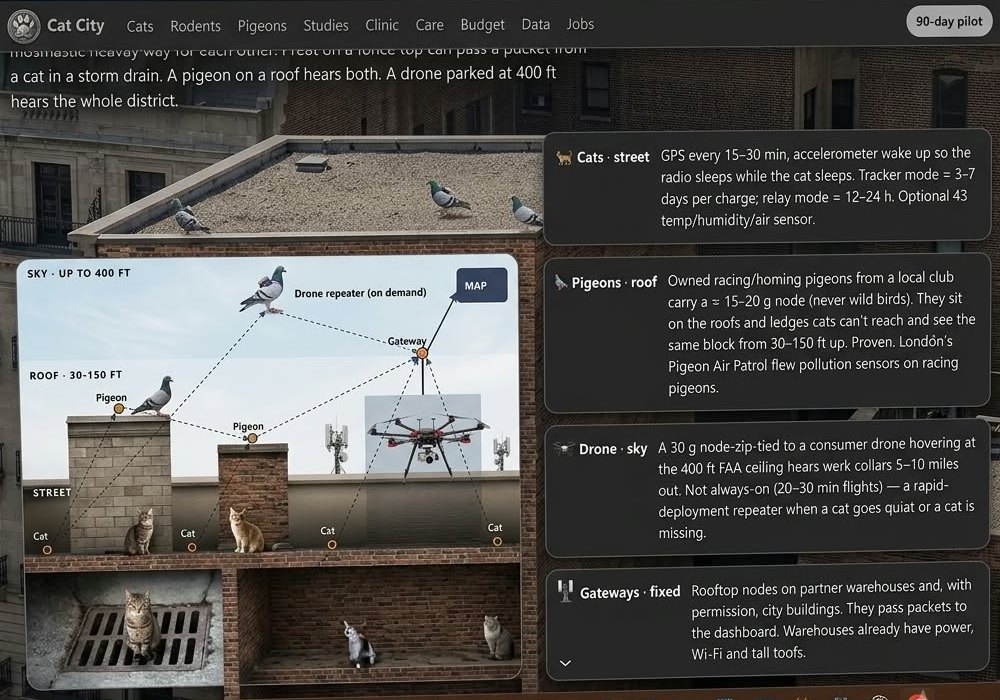
Cat City fixes and tracks the city's outdoor cats on a $0/month LoRa mesh, maps every rat burrow with thermal drones, treats them with licensed methods, and staffs the whole thing through the city's own job programs. Every piece has its own page with the full details.

Fix 80 % of a colony and it ages out in ~12 years, no euthanasia. Breakaway LoRa collars, rooftop gateways, vibration recall, a base litter station, and a dashboard that shows the count going down.
Thermal drone night sweeps find every burrow. Licensed treatment (CO injection, smart traps, exclusion — no poison broadcast, no gimmicks). Working cats and re-sweeps keep it empty.
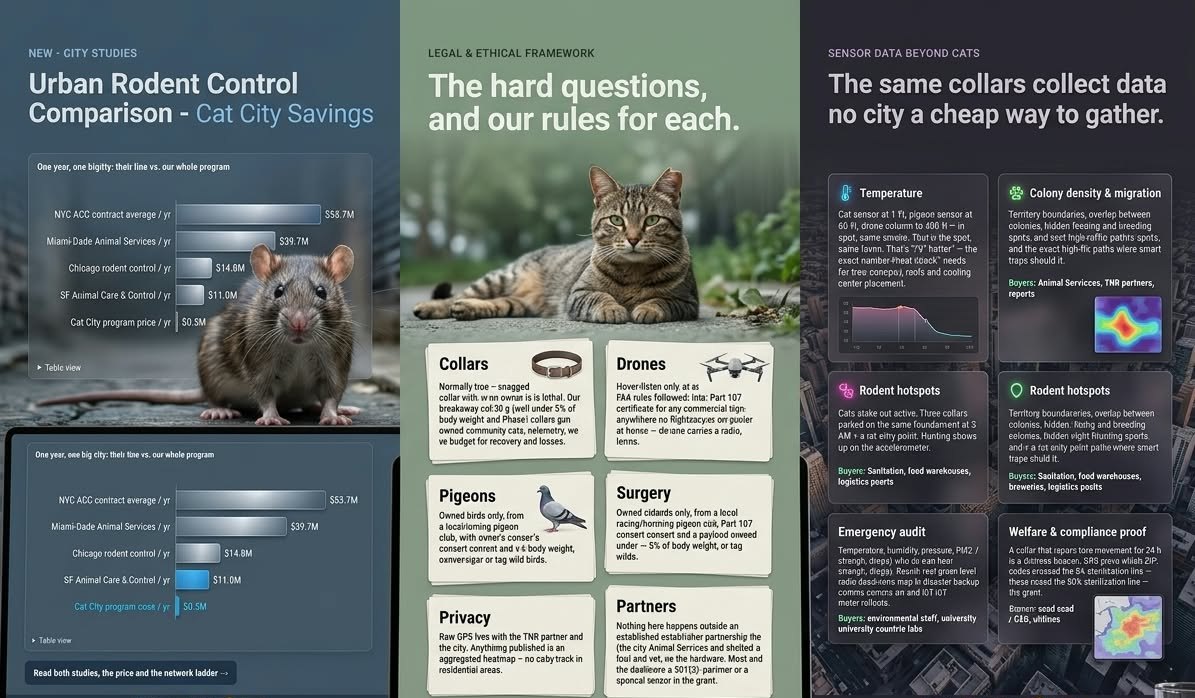
Ground-to-roof temperature on the same block, street-level air quality, rodent hotspots, an RF dead-zone map for emergency comms, and welfare alerts. Data no city has a cheap way to gather today.
Caretakers, collar builders, field techs and data checkers hired through Human Services, CalWORKs, recovery and autism / neurodivergent employment programs.
NYC $53.7M/yr, Miami-Dade $39.7M/yr, Chicago $14.85M/yr on rats, SF $11M/yr — the cities' own numbers, charted, next to a Cat City program priced to end the problem. Plus the network ladder: pigeons → cats → pets → people.
Feral pigeons are a man-made bird that lands on every roof in the city. A 12-gram solar tag, a loft that feeds, checks and docks them, and the math on what 3,000 birds per city actually gives you.
The pigeon layer as its own scroll-story landing: the Pidge tag, the loft, registration day, DeerFlok and the trail search.
The rural sensor mesh on deer, elk and the park's wildlife: corridors, crossings, bear alerts, drone-hung tree nodes, ranger flocks and free trailhead tags.
Final-year vet students earn their surgical hours fixing colony cats under a supervising DVM in a fully equipped mobile clinic. The van, the doctor, the grant stack, and how clinic days start before the van exists.
The 3-week crate acclimation, buzz-before-food and litter-station training, the daily/weekly/monthly care schedule, and what a colony costs per month.
Year-one org chart, every salary and day rate, and the funding source lined up against each role: animal grants, workforce grants, sponsor subscriptions, city contract.
IPM metrics instead of kill counts, the California licenses involved, and a phased path that starts with mapping the city can buy tomorrow.
Collars on ferals, vet-student surgery, drones, pigeons, privacy — the hard questions answered before anyone asks them.
Feral cats can't be adopted as house pets. At a municipal shelter that makes them unadoptable — and unadoptable means the kill list, usually within days of intake. California shelters created working-cat programs precisely so those cats could go to a barn or a warehouse instead of being put down. Every cat we sterilize, collar and place is a cat that was scheduled to die, now earning its keep as rodent control and a sensor node. That is the program in one sentence.
One colony, ten collars, two gateways, one thermal sweep, one smart trap, weekly clinic days. Then a report.
Artificial Mind Hive is a California software shop already running computer vision and edge infrastructure in production. The founder has watched these colonies work parks, lots and warehouse yards for 30 years.