
Fix and track the outdoor cats on a $0/month LoRa mesh, put pigeons on the roofs and receivers on the chimneys, map every rat burrow and hand it to a licensed operator, run the clinic out of a warehouse the city already owns, and staff the whole thing through the city's own job programs. Every piece has its own page.

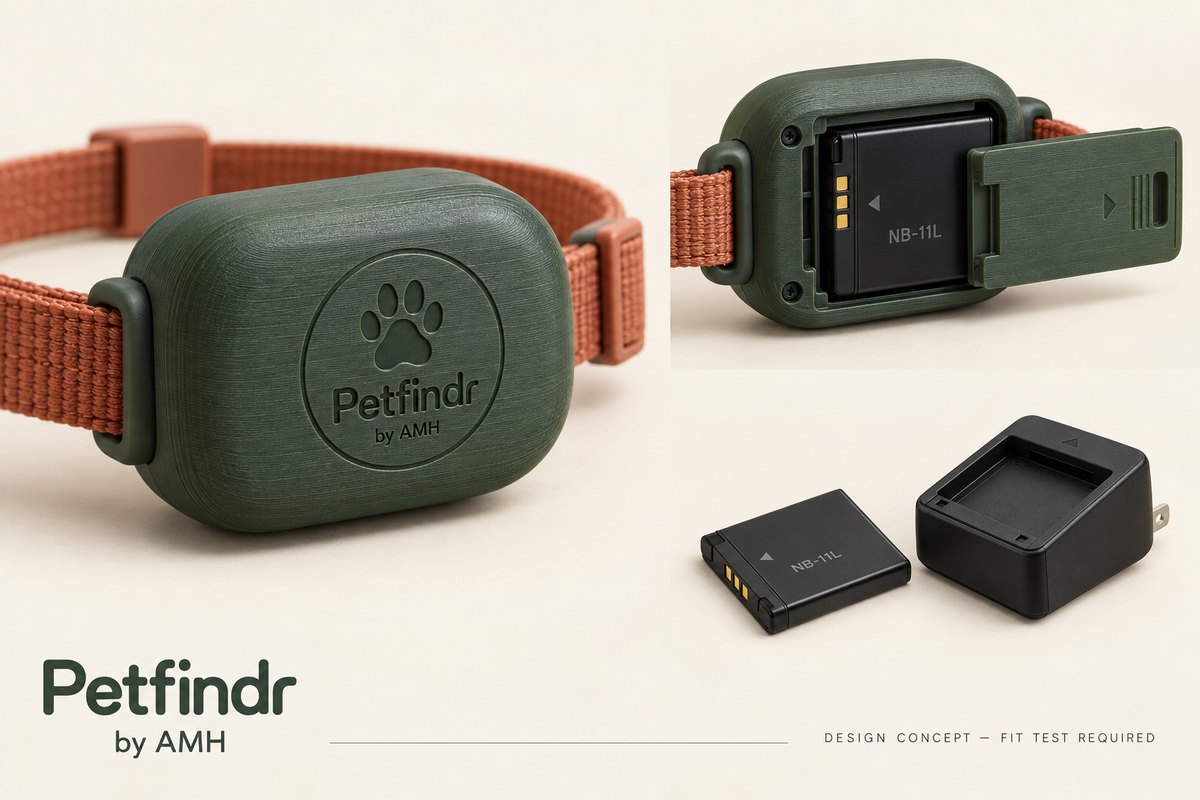
The colony collar has a consumer twin. Petfindr is a 30-gram LoRa tag on a normal collar — no cell plan, no subscription — and every Cat City node, pigeon and drone in town is already listening for it. Your cat wanders; the mesh says where. Pet owners fund the network the strays ride on. And no — you don't have to tag the silly ones (the pigeons, the deer, the bear). Your own cat sits for it. Mostly.
Every city funds stray-cat control today. None of them can see the result. Cat City is the map, the mesh and the crew that makes the number go down.

Ear-tip is the ID, the collar is the radio. Breakaway only. Buzz-before-food means we never trap the same cat twice: we call it.

Breakaway strap, a solar strip, a LoRa radio the size of a thumbnail, a buzz motor for recall. Under 30 grams. It talks to every other collar, every pigeon and every chimney box in range.

Five cats is a mesh. A thousand is a city that can see itself. Every collar relays for the others, so the map fills in from the edges.
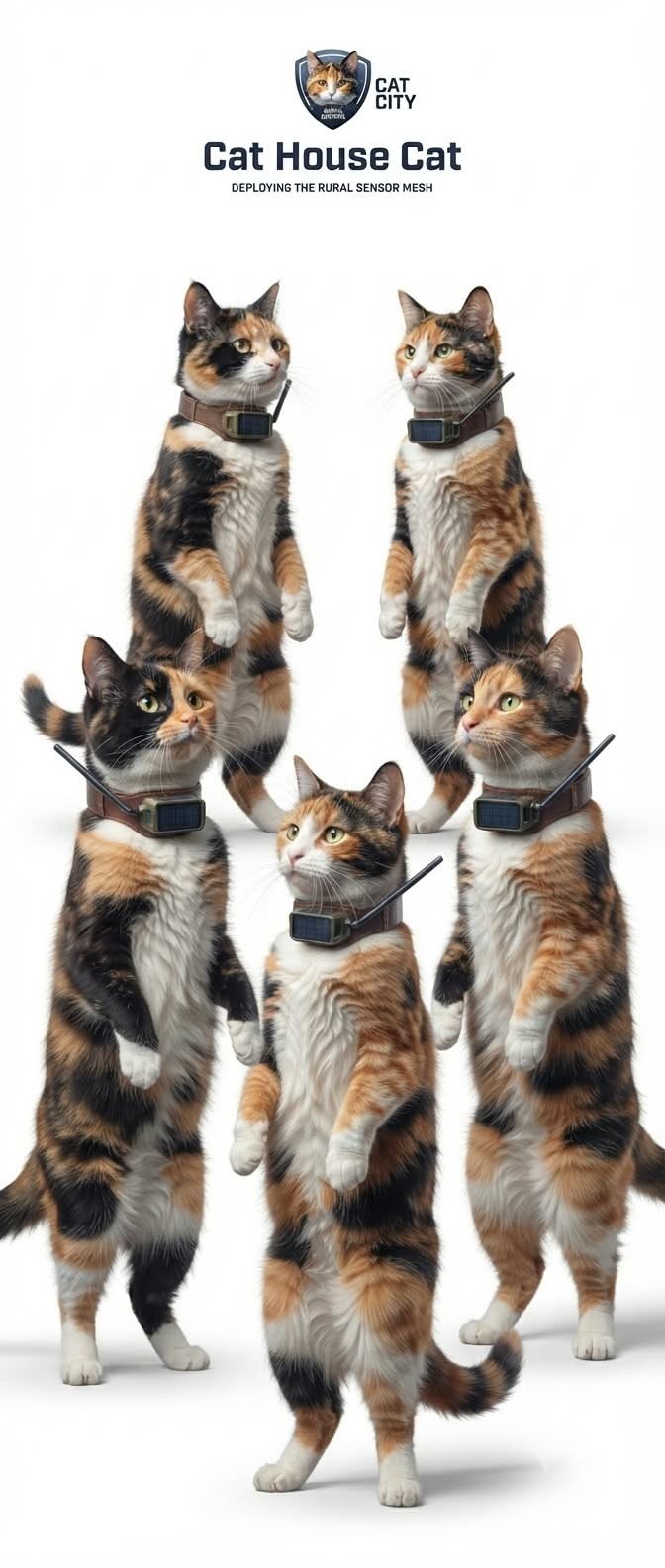
Tracked TNR colonies at street level, breakaway collars, buzz-before-food recall so no cat is ever trapped twice. The layer the city pays for, because it is the one that ends the problem.
Thermal drone sweeps find every burrow. A licensed operator eliminates; working cats and re-sweeps keep it empty. Chicago spends $12.5-14.9M a year losing this fight.
Owned club birds with 15-gram solar nodes on the ledges cats cannot reach. Three thousand per city, a relay blanket nobody can switch off.

Caretakers, field techs and builders hired through the city's own programs; a free text network on Lifeline phones for the unhoused; pet food and basic care for owners who need it; every cat we find adoptable.
TNR + tracking pilot + a report the council can vote on. Breakaway collars, vibration recall, ear-tip ID, litter stations. Cats →
Thermal drone night sweeps, licensed treatment subcontracted, working cats and re-sweeps. Rodents → · Thermal · Contracts
12-15 g solar tags, a loft that feeds and checks them, the math on 3,000 birds per city. Pigeons → · PidgeyFlok
Final-year students earn surgical hours fixing colony cats under a supervising DVM; basic shots and treatment for every animal. Clinic →
Crate acclimation, buzz-before-food, the daily/weekly/monthly schedule, pet food for owners who need it. Care →
Every role, its cost and its funder: animal grants, workforce grants, sponsors, the city. Budget → · Careers
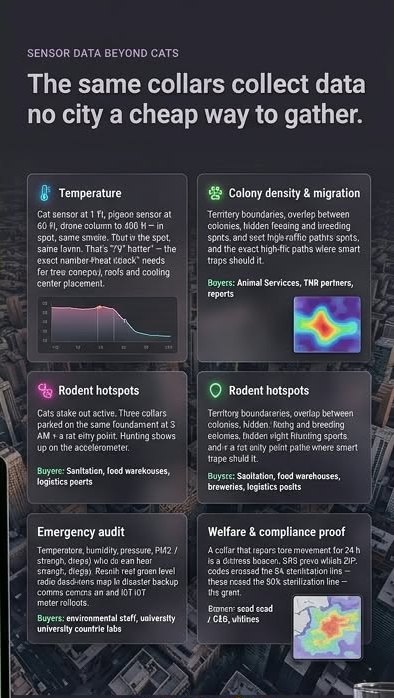
Ground-to-roof temperature, air, rodent hotspots, RF dead zones, welfare alerts. Data →
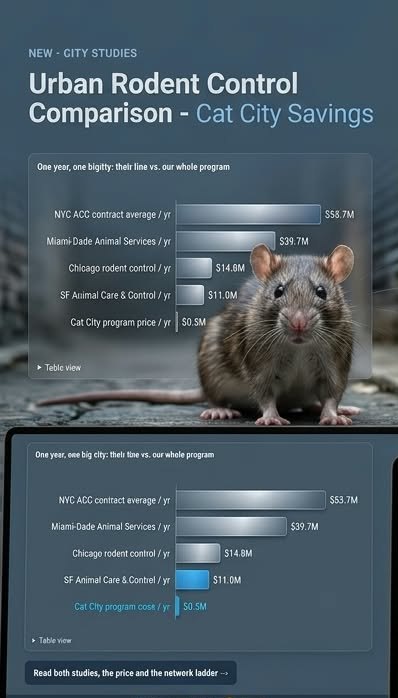
NYC $53.7M/yr, Miami-Dade $39.7M/yr, Chicago $14.85M/yr on rats, SF $11M/yr, the cities' own numbers, charted. Studies →
Caretakers, builders, field techs, data checkers through Human Services, CalWORKs, recovery and neurodivergent employment. Jobs →
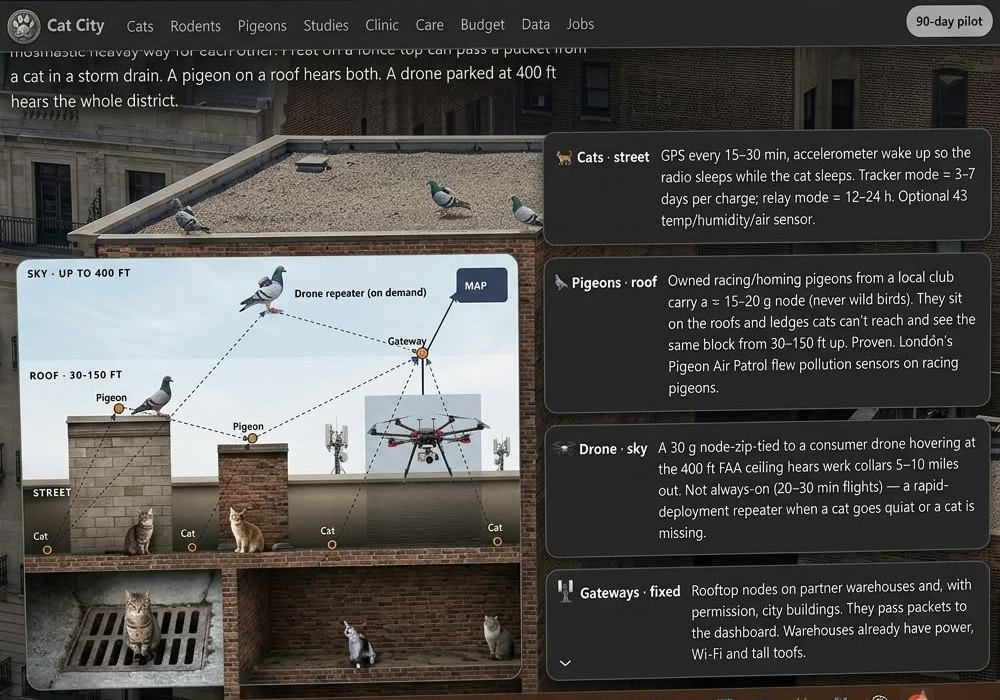
Every node relays for every other. A cat in a storm drain reaches a cat on a fence; a pigeon on the ledge hears both; a chimney receiver on Wi-Fi puts it on the map; a drone parked at 400 ft hears the whole district.
New York's shelter contract averages $53.7M a year; Miami-Dade Animal Services is $39.7M and holds 500,000 stray cats "steady"; Chicago spends $12.5-14.9M a year on rats and its own audit says the plan is unlikely to work; San Francisco runs Animal Care & Control on $11M. Targeted, tracked TNR has a published end-state: intake down 66 %, euthanasia down 95 % in two years in the treated area.
Sources on the studies page: NYC Comptroller 2025, Miami-Dade FY23-24 adopted budget, Block Club Chicago / The Center Square, SF Chronicle, Levy et al. 2014.
20 collars, 5 gateways, one neighborhood, a TNR partner, and a report the council can vote on.
1,000 tracked cats, 3,000 pigeon nodes, 50 gateways, the map, the monthly report, a warehouse that holds, trains and neuters on site. $520,000 if the city lends an unused building.
Fully loaded, warehouse included. The shelter line works out to ~$1,400 per animal handled. We are not competing with the shelter; we make it smaller.
A letter of support, an intro to Animal Services, one city roof for a gateway, and the name of the grant program. Have an unused building? Lend it as the hub and the price drops.
Warehouses, breweries and logistics yards: working cats against rats, a chimney receiver on your Wi-Fi, a dashboard for your block.

 Check out Petfindr