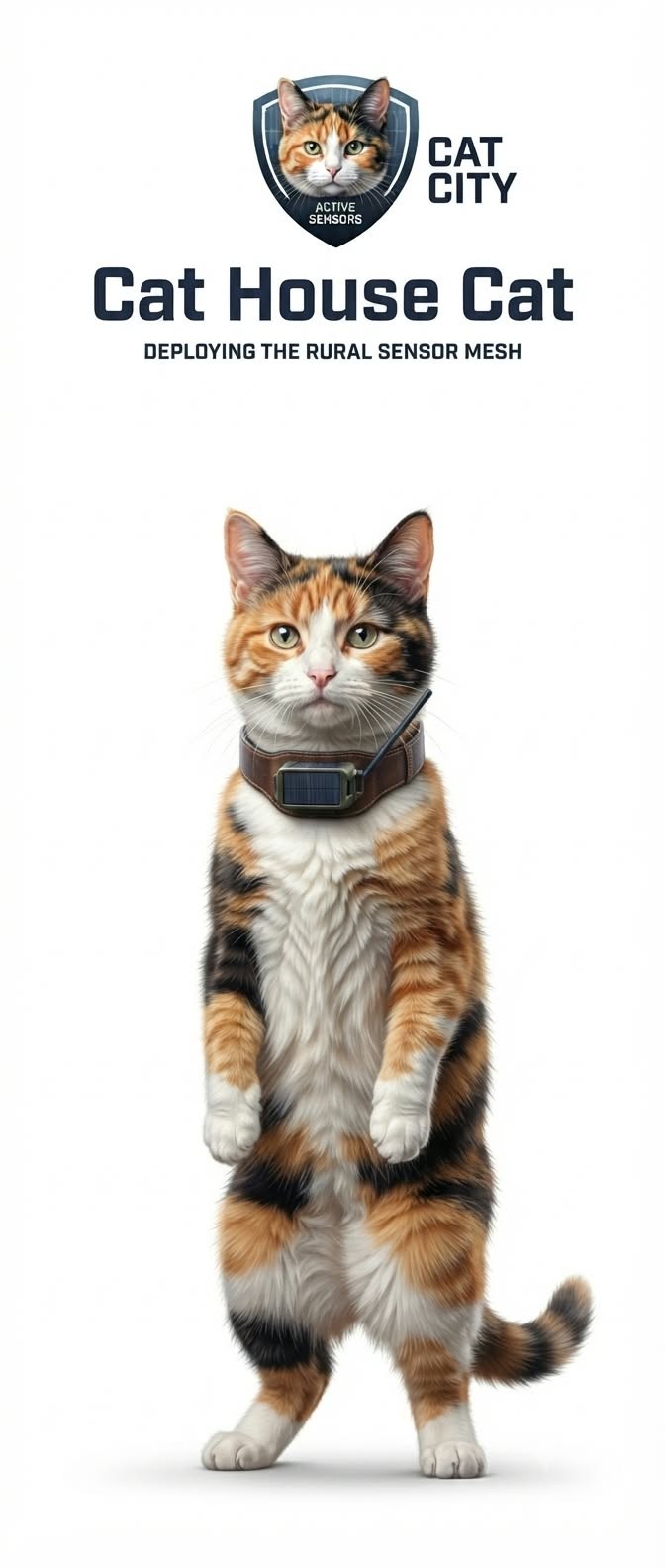


A calico community cat standing, wearing the Cat City collar node
Cat City · colony mesh · any city

The city has cats. Now it has a map.

Every city funds stray-cat control. None of them can see the result. Scroll — look at her collar.

The collar

Under 30 grams. Breakaway. Talks to the whole city.

A Meshtastic LoRa node on a breakaway strap: solar strip, GPS on schedule, a buzz motor. Every collar relays for every other collar, pigeon and chimney box in range.

Recall

We don't re-trap collared cats. We call them.

Buzz-before-food. Three weeks of crate acclimation and the buzz means dinner. No cat is trapped twice. The colony comes to the clinic van on its own.

And another

Every cat we fix gets a collar and a name on the map.

Ear-tip is the ID, the collar is the radio. Neutered, vaccinated, chipped, fed, tracked. The number goes down because for once somebody can count.

The colony

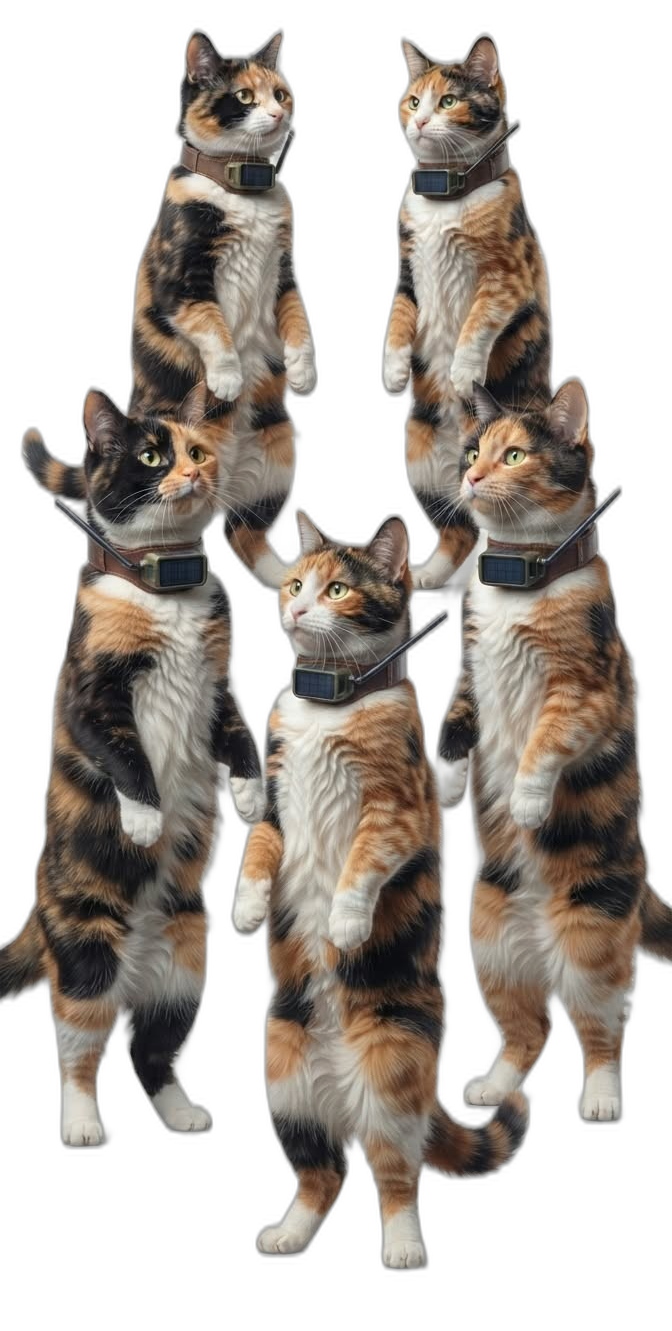
Five cats is a mesh. A thousand is a city that can see itself.

Rats get mapped and handed to a licensed operator. Pigeons hold the roofs. People get the jobs, the free text network, and every cat we find is adoptable.

Solar strip · LiPoweeks of power, topped up in the sun
LoRa 915 MHz · Meshtasticrelays for cats, pigeons, pocket nodes
Buzz motor · recallthe cue that means dinner, never a shock
Breakaway strap · under 30 gsnags release; ear-tip stays the ID
scroll

Cat City · by Artificial Mind Hive · PidgeyFlok and AntlerFlok are its programs

One program that empties a city of strays and rats. Humanely, legally, with numbers the council can check.

Fix and track the outdoor cats on a $0/month LoRa mesh, put pigeons on the roofs and receivers on the chimneys, map every rat burrow and hand it to a licensed operator, run the clinic out of a warehouse the city already owns, and staff the whole thing through the city's own job programs. Every piece has its own page.

$25k
90-day pilot: 20 collars, 5 gateways, a report
$600k
per city per year, priced to finish ($520k with a city building)
$102
per tracked animal per year vs ~$1,400 at the shelter
$0/mo
915 MHz LoRa mesh, no plan, no tower
A calico community cat standing upright wearing a collar with a solar tracker node
Cat City

The city has cats. Now it has a map.

Every city funds stray-cat control today. None of them can see the result. Cat City is the map, the mesh and the crew that makes the number go down.

Cat House Cat: a calico with a collar node, with the Cat City shield
And another

Every cat we fix gets a collar and a name on the map.

Ear-tip is the ID, the collar is the radio. Breakaway only. Buzz-before-food means we never trap the same cat twice: we call it.

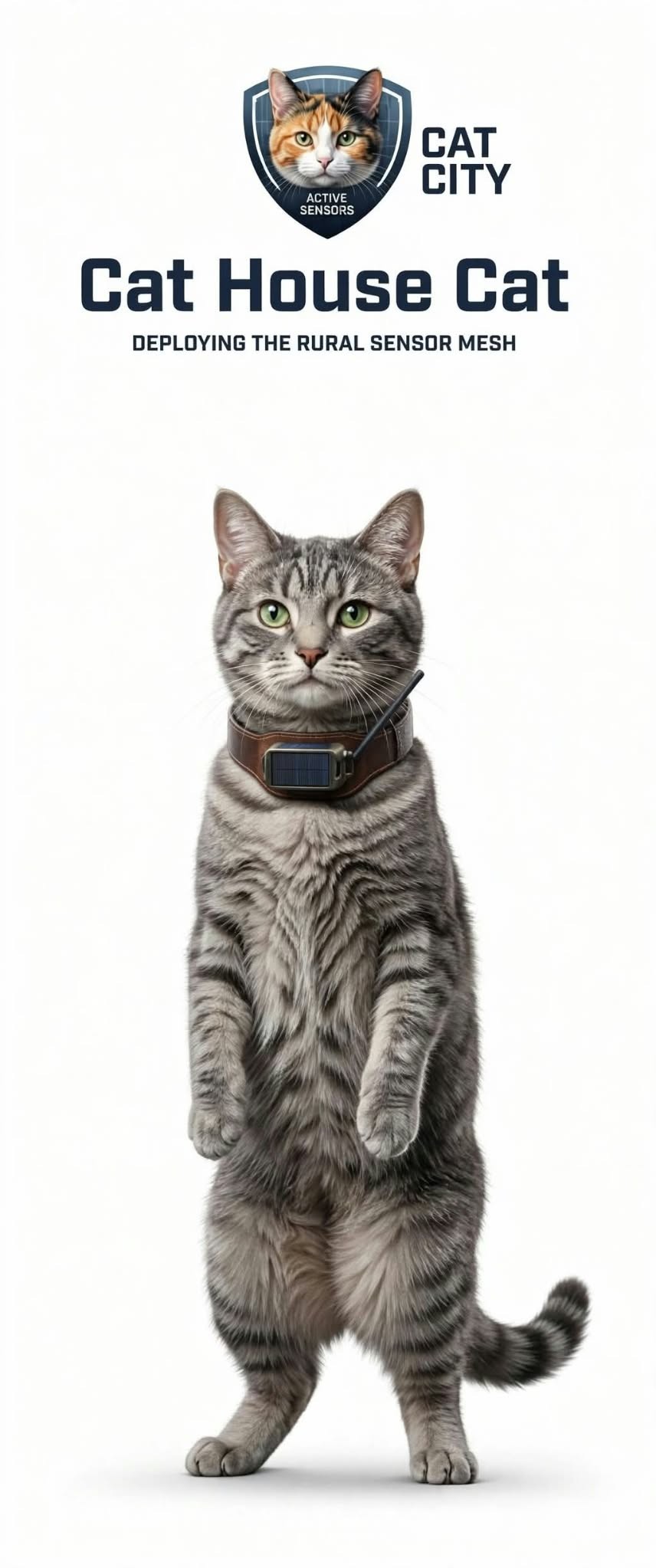
Cat House Cat: a grey tabby standing with a collar node, with the Cat City shield
Close up

The collar is the whole product.

Breakaway strap, a solar strip, a LoRa radio the size of a thumbnail, a buzz motor for recall. Under 30 grams. It talks to every other collar, every pigeon and every chimney box in range.

Close-up of the collar node on the cat
All of them

A colony is a network.

Five cats is a mesh. A thousand is a city that can see itself. Every collar relays for the others, so the map fills in from the edges.

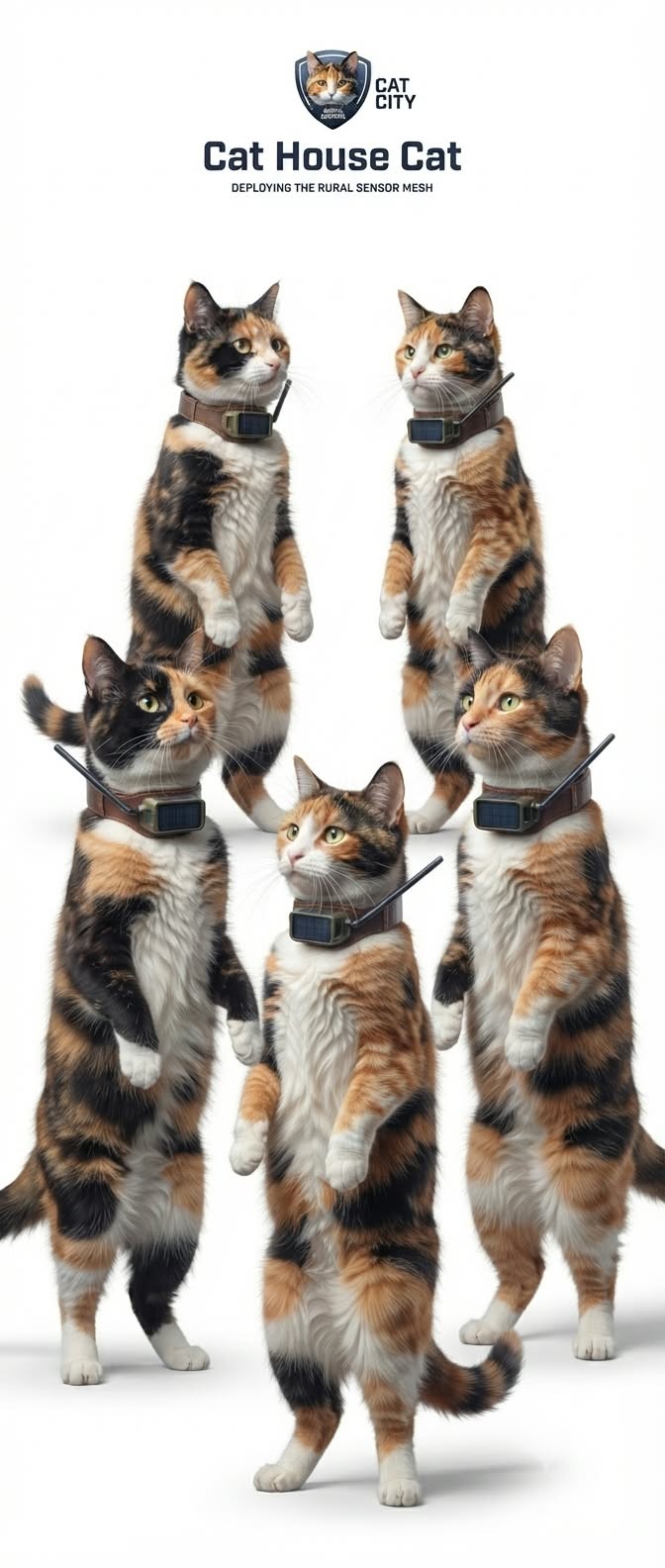
Five calico cats standing, each wearing a collar node
01 · Cats

Cats take the streets.

Tracked TNR colonies at street level, breakaway collars, buzz-before-food recall so no cat is ever trapped twice. The layer the city pays for, because it is the one that ends the problem.

The cat program →

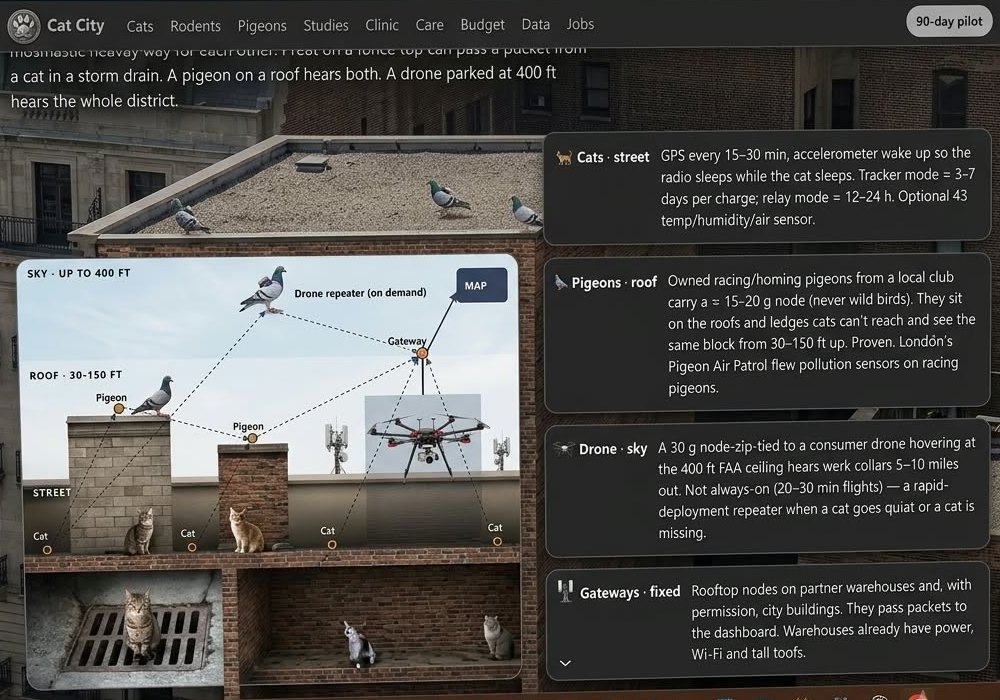
Street, roof and sky layers of the mesh
02 · Rats

Rats get mapped, then handed off.

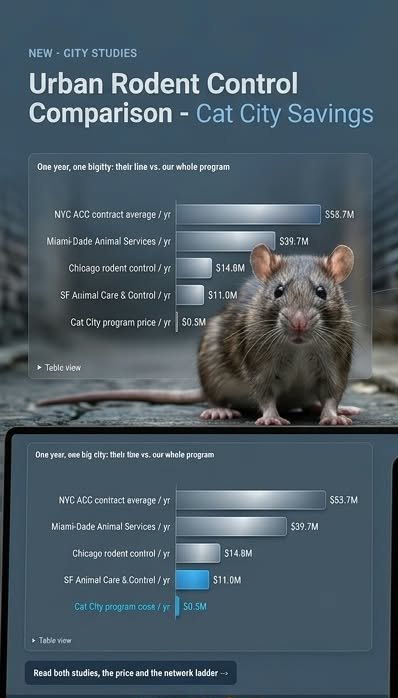
Thermal drone sweeps find every burrow. A licensed operator eliminates; working cats and re-sweeps keep it empty. Chicago spends $12.5-14.9M a year losing this fight.

The rodent program →

Rodent budgets compared
03 · Pigeons

Pigeons hold the roofs.

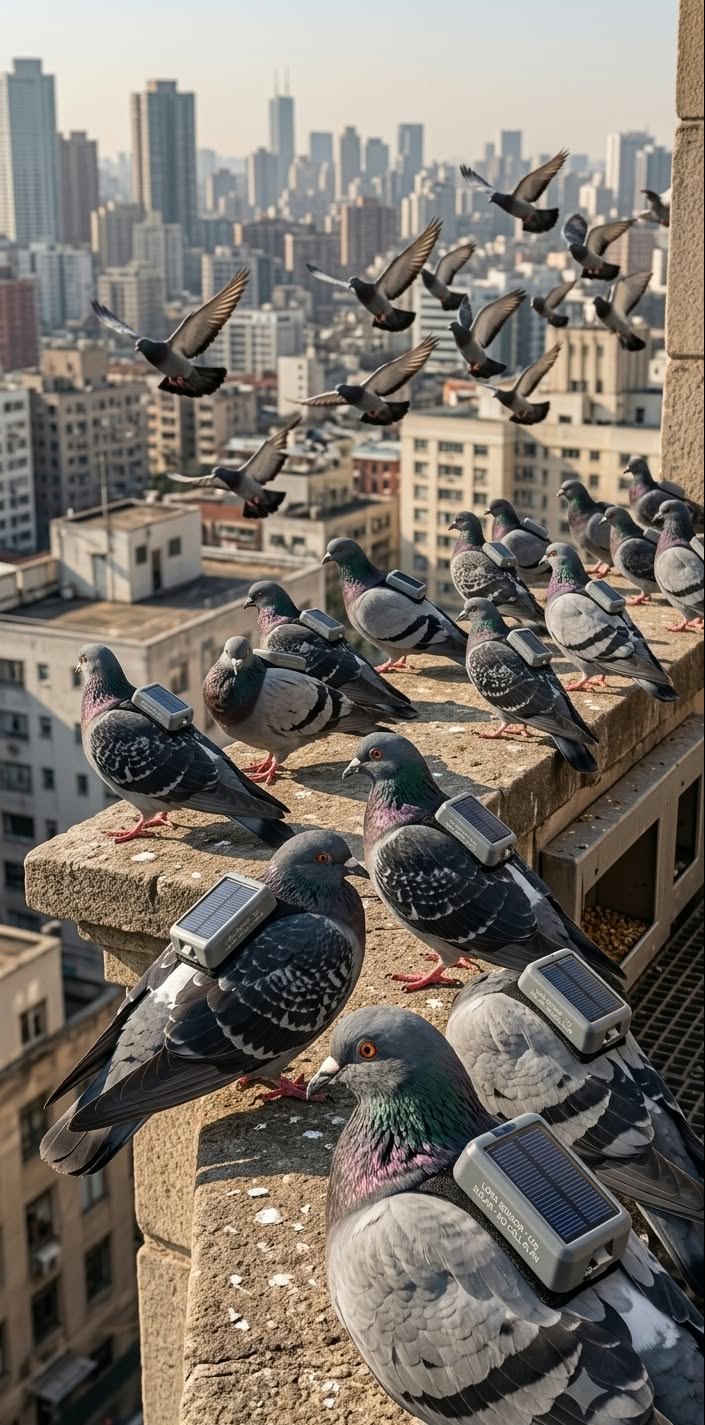
Owned club birds with 15-gram solar nodes on the ledges cats cannot reach. Three thousand per city, a relay blanket nobody can switch off.

PidgeyFlok →

Tagged pigeons on a rooftop ledge
04 · People

People get the jobs and the text.

Caretakers, field techs and builders hired through the city's own programs; a free text network on Lifeline phones for the unhoused; pet food and basic care for owners who need it; every cat we find adoptable.

The four programs ↓ The studies

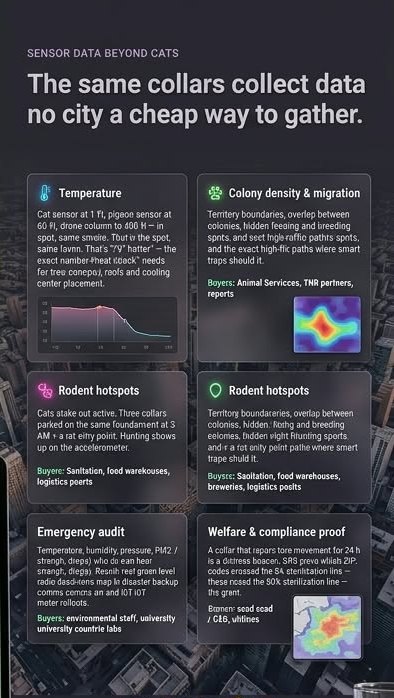
The data the collars collect
Any city with cats, rats and rooftops · $0/month mesh
The four programs

Pick the page you need. Each one stands on its own.

🐈 Cats

Fix, track, recall

TNR + tracking pilot + a report the council can vote on. Breakaway collars, vibration recall, ear-tip ID, litter stations. Cats →

🐀 Rodents

Map · verify · treat · hold

Thermal drone night sweeps, licensed treatment subcontracted, working cats and re-sweeps. Rodents → · Thermal · Contracts

🕊 Pigeons

The rooftop layer

12-15 g solar tags, a loft that feeds and checks them, the math on 3,000 birds per city. Pigeons → · PidgeyFlok

🚐 Clinic

Vet students, a DVM, a warehouse

Final-year students earn surgical hours fixing colony cats under a supervising DVM; basic shots and treatment for every animal. Clinic →

🍽 Care

Training, feeding, daily care

Crate acclimation, buzz-before-food, the daily/weekly/monthly schedule, pet food for owners who need it. Care →

💵 Budget

Staff, employees, who pays

Every role, its cost and its funder: animal grants, workforce grants, sponsors, the city. Budget → · Careers

📡 Data

What the mesh collects

Ground-to-roof temperature, air, rodent hotspots, RF dead zones, welfare alerts. Data →

📊 Studies

What cities spend vs. us

NYC $53.7M/yr, Miami-Dade $39.7M/yr, Chicago $14.85M/yr on rats, SF $11M/yr, the cities' own numbers, charted. Studies →

👷 Jobs

Staffed through city programs

Caretakers, builders, field techs, data checkers through Human Services, CalWORKs, recovery and neurodivergent employment. Jobs →

The mesh

Street, roof, sky: one free network the animals build for you.

Every node relays for every other. A cat in a storm drain reaches a cat on a fence; a pigeon on the ledge hears both; a chimney receiver on Wi-Fi puts it on the map; a drone parked at 400 ft hears the whole district.

1PigeonsRooftop relay blanket. $15 nodes.
2CatsTracked TNR colonies. The city pays for this layer.
3PetsPetfindr collars. Consumer revenue.
4PeopleFree text network on Lifeline phones + a $15 pocket node.
5ServicesAppointments, benefits, shelter beds, SOS to outreach, pet food.
6The city4,000-point sensing; outage-proof messaging.
Sky, roof and street layers on one dashboard
The whole network in one picture. Concept render.
Numbers

Cities already spend eight figures a year on the animals. Cat City costs about one percent of that, and it ends.

New York's shelter contract averages $53.7M a year; Miami-Dade Animal Services is $39.7M and holds 500,000 stray cats "steady"; Chicago spends $12.5-14.9M a year on rats and its own audit says the plan is unlikely to work; San Francisco runs Animal Care & Control on $11M. Targeted, tracked TNR has a published end-state: intake down 66 %, euthanasia down 95 % in two years in the treated area.

Read both city studies →

Sources on the studies page: NYC Comptroller 2025, Miami-Dade FY23-24 adopted budget, Block Club Chicago / The Center Square, SF Chronicle, Levy et al. 2014.

One year, one big city: their line vs. the whole program
NYC shelter contract / yr$53.7M Miami-Dade Animal Services$39.7M Chicago rodent control$14.9M SF Animal Care & Control$11.0M Cat City program$0.60M Blue = the city's own published budget line. Orange = us.
Our cost · what we charge · why it ends

Priced to finish, not to continue.

Pilot · 90 days

$25,000

20 collars, 5 gateways, one neighborhood, a TNR partner, and a report the council can vote on.

City program · per year

$600,000

1,000 tracked cats, 3,000 pigeon nodes, 50 gateways, the map, the monthly report, a warehouse that holds, trains and neuters on site. $520,000 if the city lends an unused building.

Per animal · per year

$102

Fully loaded, warehouse included. The shelter line works out to ~$1,400 per animal handled. We are not competing with the shelter; we make it smaller.

The full cost and price page → Staffing & budget →

Cities & shelters

Start with the 90-day pilot

A letter of support, an intro to Animal Services, one city roof for a gateway, and the name of the grant program. Have an unused building? Lend it as the hub and the price drops.

Businesses

Host cats, a gateway, or both

Warehouses, breweries and logistics yards: working cats against rats, a chimney receiver on your Wi-Fi, a dashboard for your block.

Adopt · foster · work

Every cat we find can go home

Kittens, friendly strays and surrenders are neutered, vaccinated, chipped and socialized at the hub, then adopted through the partner shelter. Adopt → · Careers →

amh@artificialmindhive.com The full hub (12 pages) →

Five calico cats standing, each wearing a collar node

A colony is a network.

The map fills in from the edges: every collar hears every other. This is the layer the city pays for, because it is the one that ends the problem.

Field notes from the colony

Every city funds stray-cat control today. None of them can see the result.NYC $53.7M/yr, Miami-Dade $39.7M/yr and 500,000 strays "holding steady", SF $11M/yr. The cities' own numbers.
Untracked TNR plateaus. Tracked TNR converges.Targeted TNR in the Alachua study: shelter intake −66 %, euthanasia −95 % in two years in the treated area.
Rats get mapped, then handed off.Thermal drone sweeps find the burrows; a licensed operator eliminates; working cats keep it empty. Chicago spends $12.5–14.9M a year losing this fight.
The warehouse is the clinic.Vet students under a supervising DVM neuter on site; every animal leaves with shots, flea and worm treatment, a chip. A city with an empty building pays less.
People get the jobs and the text.Caretakers, field techs and builders through the city's own programs; a free text network on Lifeline phones; pet food for owners who need it.
Working cats retire indoors.Placed at five or younger, retired to a couch around ten. No cat works for life.

Case study · one big city, one year

$600,000 a year to make the number go down. $40,000,000 a year to hold it steady.Miami-Dade Animal Services FY23-24 vs a full Cat City program: 1,000 tracked cats, 3,000 pigeon nodes, 50 gateways, the clinic, the map. $520,000 if the city lends the building.

A 90-day pilot first: 20 collars, 5 gateways, one neighborhood, a TNR partner who traps and fixes, and a report the council can vote on. Then the city program, written to shrink: years four and five are maintenance, because the population work is finished.

LayerWhat it doesWho holds it
CollarsTracked TNR colonies, recall by buzz, welfare alertsTNR partner · shelter
Chimney receiversWi-Fi LoRa boxes on roofs; everything lands on the map in secondsBusinesses · the city
Pigeons3,000 rooftop nodes; the relay blanketPidgeyFLok · a local club
RodentsThermal mapping, licensed elimination, working catsLicensed operator · Cat City
ClinicStudents under a DVM; shots, chips, treatment; adoptionVet school · partner shelter
DashboardColony map, monthly count, the number the council checksThe city · Cat City

Read the city studies → Every figure is the city's own published number or marked as our estimate. Nothing happens to an animal outside a written partner agreement.

One program. One map.

Same radio on the cat at street level, the pigeon on the roof, the deer in the park, the beacon in a hiker's pocket. One network, four couriers, one city that can finally see itself.

Start a pilot · 20 collars, 5 gateways, 90 days

The collar, part by part

Off-the-shelf parts, open firmware. The new part is the recall and the map.

PartJobg
XIAO nRF52840 + Wio-SX1262Brain + LoRa radio, Meshtastic tracker mode6
L76K GNSSPosition on schedule or on request2
Coin vibration motorThe buzz-before-food recall cue1
300 mAh cell + solar stripWeeks of power, sleeps while the cat sleeps8
Shell + breakaway collarSnags release; ear-tip stays the ID9
On the cat≈ 26

Why it ends

Shelters are paid to receive; nobody is paid to work the streets. A tracked colony tells you when it is done, and a done colony is a line item that disappears. Untracked TNR plateaus; tracked TNR converges. That is the whole difference between $40M a year forever and $600k a year for five.

Rules that never bend: no cat trapped or collared outside the partner agreement; breakaway collars only; buzz, never shock; raw GPS stays with the partner and the city; working cats retire indoors around ten.

Colony gallery

Cat House Cat: the calico Cat House Cat: the grey tabby Five cats, five collars