Cat City · Colony Mesh · any city · a proposal for any city with cats, rats and rooftops Prepared by Artificial Mind Hive, California · Sept 2026
Trap · Neuter · Track · Return

End a city's stray-cat cycle without killing a single cat — and prove it with data.

Every colony cat we place came off a shelter euthanasia list. Every fixed, vaccinated, ear-tipped cat goes back where it lives. A subset wears a lightweight breakaway LoRa collar that reports over a $0/month mesh network. The city gets a live map of the colony shrinking — plus street-level heat, air and rodent data it can't get any other way.

The math the city is already paying for

Every city funds stray-cat control today. None of them can see the result.

Animal control round-ups, shelter intake and euthanasia cost money every year and the population comes right back. Trap-Neuter-Return is cheaper per cat and is the only approach that makes a colony smaller for good. We add the missing piece: proof.

75–80 %
of fertile cats in a colony must be sterilized before the population starts to fall. That's the target we track, colony by colony.
~12 yrs
for a fully sterilized colony to age out naturally (outdoor lifespan 5–10 yrs). Stay on it, and the cycle dies.
$0 / mo
airtime. LoRa (Meshtastic) runs on unlicensed 915 MHz — no cellular plan per collar, no subscription, open-source firmware.
How it works

Four steps, repeated until there's nothing left to trap.

Step 1

Trap

Work with an established local TNR group and the city shelter. Cameras and AI smart traps at feeding spots only trigger for cats with no ear-tip — already-fixed cats walk through.

Step 2

Fix

High-volume spay/neuter, rabies vaccine, microchip, ear-tip. Mobile clinic with a partner vet school's students under a licensed DVM (3 tables per DVM, RVTs on anesthesia).

Step 3

Tag

Every cat gets the ear-tip — that's the ID. A chosen subset also gets a <30 g breakaway collar: Seeed XIAO + LoRa radio + L76K GPS + vibration motor + battery in a printed shell.

Step 4

Track & Return

Cats go back to their colony. Rooftop gateways (and a drone when needed) hear the collars. The dashboard shows count, movement, newcomers and any cat that stops moving.

The mesh

Ground, roof, sky — three sensor layers on one free network.

Meshtastic nodes relay for each other. A cat on a fence top can pass a packet from a cat in a storm drain. A pigeon on a roof hears both. A drone parked at 400 ft hears the whole district.
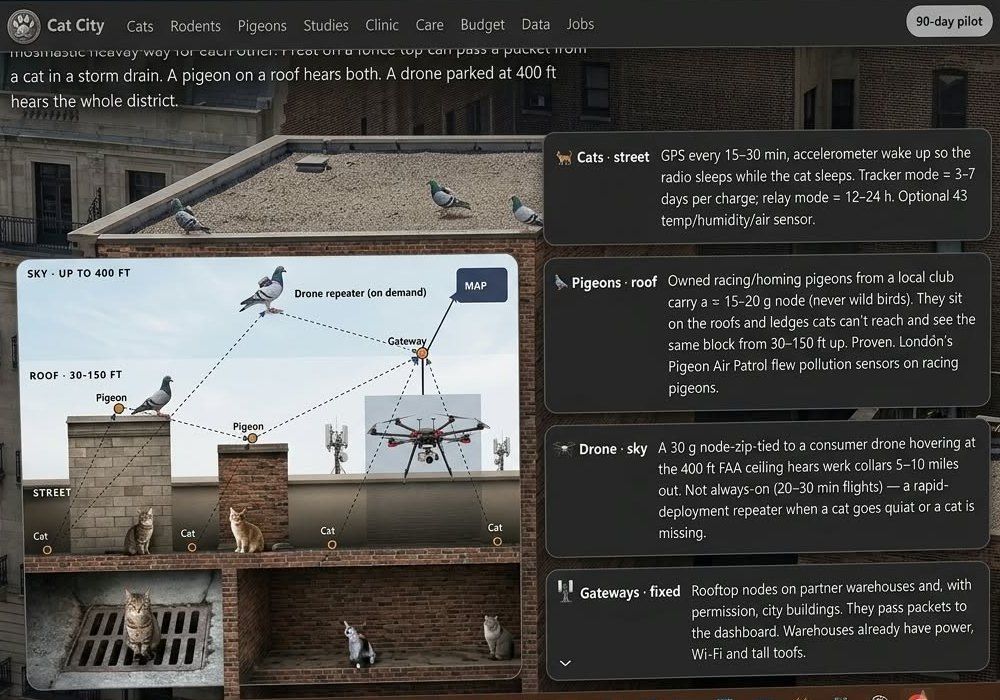
The three layers: cats at street level, pigeons and gateways on roofs, a drone repeater in the sky
Street · roof · sky on one free network (concept render).
SKY · UP TO 400 FT ROOF · 30–150 FT STREET · 0–6 FT Gateway Pigeon Pigeon Cat Cat Cat Cat Drone repeater (on demand) MAP
🐈 Cats · street

GPS every 15–30 min, accelerometer wake-up so the radio sleeps while the cat sleeps. Tracker mode ≈ 3–7 days per charge; relay mode ≈ 12–24 h. Optional $3 temp/humidity/air sensor.

🕊 Pigeons · roof

Owned racing/homing pigeons from a local club carry a ≈ 15–20 g node (never wild birds). They sit on the roofs and ledges cats can't reach and see the same block from 30–150 ft up. Proven: London's Pigeon Air Patrol flew pollution sensors on racing pigeons.

🚁 Drone · sky

A 30 g node zip-tied to a consumer drone hovering at the 400 ft FAA ceiling hears weak collars 5–10 miles out. Not always-on (20–30 min flights) — a rapid-deployment repeater when a cat goes quiet or a cat is missing.

📡 Gateways · fixed

Rooftop nodes on partner warehouses and, with permission, city buildings. They pass packets to the dashboard. Warehouses already have power, Wi-Fi and tall roofs.
Recall

We don't re-trap collared cats. We call them.

Every collar carries a 1-gram vibration motor. During the standard 3-week crate acclimation, the collar buzzes right before every meal (full timeline on the care page). By release day the cat knows: buzz = food. From then on, one message over the mesh brings that cat to its feed station on its own.

Train

Buzz, then food

Three weeks in the acclimation crate, every feeding starts with a short vibration. Classical conditioning — the same thing that makes cats run at the sound of a can opener.

Release

Feed on a schedule

The feed station keeps buzzing before each meal after release, so the link stays strong for years and the cat stays anchored to its colony site instead of drifting.

Recall

One message, one cat

Need cat #7 for a battery swap, a vaccine booster or because it stopped moving? Send it a buzz over the mesh (Meshtastic's built-in external-notification module drives the motor). It walks into the feed station.

Capture

The station closes itself

The feed station is the smart trap. Camera confirms the right cat by collar ID, door latches, phone pings the caretaker. No bait-and-wait, no stressed cat in a wire trap for hours.

Why this matters to the city: breakaway collars, battery swaps and health checks are the reasons collar programs usually fail on outdoor cats. Recall turns each of those from a trapping operation into a ten-minute visit.

Same trick, second habit: the base litter station

Next to the feed station sits a covered litter box with a sensor. When a collared cat uses it, the station drops a treat. Inside a few weeks the colony prefers to "go" at base instead of in neighbours' gardens, sandboxes and planter beds — which is the #1 complaint that gets TNR programs shut down. The waste ends up in one bin the caretaker empties, instead of washing into storm drains (cat-borne toxoplasma in runoff is a documented California water-quality problem).

What the station quietly measures

Every visit is logged per cat: meals eaten, litter use, weight on the platform. A cat that stops eating or stops using the box is flagged days before a human would notice — welfare data the shelter partner has never had on an outdoor colony.

What the city gets beyond cats

The same collars collect data no city currently has a cheap way to gather.

Ground-to-roof temperature profile

Cat sensor at 1 ft, pigeon sensor at 60 ft, drone column to 400 ft — in the same spot, same minute. That's "it's 9° hotter at street level than on the roof on this block" — the exact number urban-heat-island planning needs for tree canopy, cool roofs and cooling-center placement.

Buyers: Climate Action Plan staff, Public Works, county Public Health

Colony density & migration

Territory boundaries, overlap between colonies, hidden feeding and breeding spots, and the exact high-traffic paths where smart traps should sit.

Buyers: Animal Services, TNR partners, grant reports

Rodent hotspots

Cats stake out active nests. Three collars parked on the same foundation corner at 3 AM = a rat entry point. Hunting bursts show up on the accelerometer.

Buyers: Sanitation, food warehouses, breweries, logistics yards

Street-level microclimate & air

Temperature, humidity, pressure, PM2.5 / VOCs from back alleys and industrial lots where fixed weather stations don't reach.

Buyers: environmental staff, university climate labs

Emergency mesh coverage audit

Every node logs who it can hear (signal strength, drops). Result: a real ground-level radio dead-zone map for disaster backup comms and IoT meter rollouts.

Buyers: Emergency Management / OES, utilities

Welfare & compliance proof

A collar that reports zero movement for 24 h is a distress beacon. GPS logs prove which ZIP codes crossed the 80 % sterilization line — the trigger for performance-based grant payouts.

Buyers: county Public Health, welfare foundations
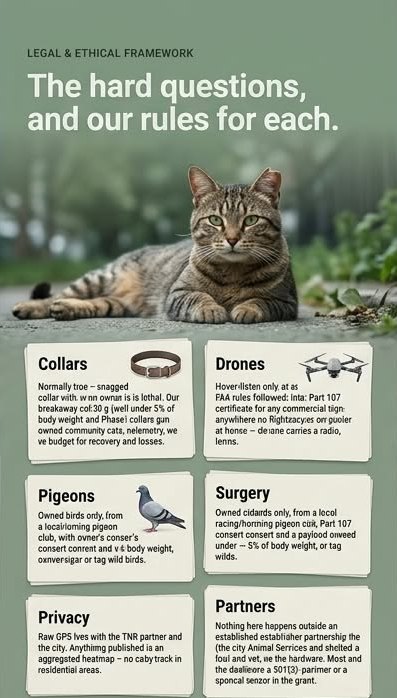
The hard questions and our rules: collars, drones, pigeons, surgery, privacy, partners
Our rules, one card each. Concept render of this section.
Safety & legal — answered up front

The hard questions, and our rules for each.

"You can't put collars on feral cats."

Normally true — a snagged collar with no owner to unclip it is lethal. Our rule: breakaway collars only, total load under 30 g (well under 5 % of body weight), and Phase 1 collars go only on working cats at fenced private sites and on owned community cats, never on a cat we can't recapture. The ear-tip is the ID; the collar is optional telemetry. Yes, breakaways drop hardware — we budget for recovery and losses.

"Who's doing the surgery?"

Only licensed DVMs, or final-year vet students under direct supervision as the California Veterinary Medical Board requires — the DVM physically in the room, one experienced HQHVSN vet per 3 tables, RVTs on prep and anesthesia. Mobile clinics must meet state mobile-clinic rules (power, water, climate control, DEA lockbox) and cats are held 24 h post-op before release.

"Drones over neighbourhoods?"

Hover-and-listen only, at or below 400 ft, FAA rules followed: Part 107 certificate for any commercial flight, LAANC authorization anywhere the city sits under controlled airspace, no flights over people or private yards. No cameras pointed at homes — the drone carries a radio, not a lens.

"Pigeons?"

Owned birds only, from a local racing/homing pigeon club, with the owner's consent and a payload under ~5 % of body weight. We never trap or tag wild birds.

Privacy

Raw GPS lives with the TNR partner and the city. Anything published is an aggregated heatmap — no addresses, no cat-by-cat tracks in residential areas.

Partners, not freelancers

Nothing here happens outside an established TNR / shelter partnership (the city's Animal Services and shelter and a local feral-cat group). They trap and vet; we supply the hardware, the mesh and the dashboard. Most welfare grants require a 501(c)(3) — the partner or a fiscal sponsor holds the grant.

New · City studies with charts

What cities actually spend: NYC $53.7M/yr, Miami-Dade $39.7M/yr, Chicago $14.85M/yr on rats — and what Cat City costs.

One year, one big city: their line vs. our whole program
One year, one big city: their line vs. our whole program NYC ACC contract average / yr: $53.7MNYC ACC contract average / yr$53.7M Miami-Dade Animal Services / yr: $39.7MMiami-Dade Animal Services / yr$39.7M Chicago rodent control / yr: $14.8MChicago rodent control / yr$14.8M SF Animal Care & Control / yr: $11.0MSF Animal Care & Control / yr$11.0M Cat City program price / yr: $0.5MCat City program price / yr$0.5M
Table view
ItemValue
NYC ACC contract average / yr$53.7M
Miami-Dade Animal Services / yr$39.7M
Chicago rodent control / yr$14.8M
SF Animal Care & Control / yr$11.0M
Cat City program price / yr$0.5M

Read both studies, the price and the network ladder →

The ask

A 90-day pilot on one colony. Then a report you can vote on.

One industrial-park colony (working cats on a fenced warehouse or logistics lot), ten collars, two rooftop gateways, one smart trap, weekly TNR sessions. On day 90 the city receives a written report: colony count, sterilization %, movement map, newcomer detections, and the first ground-vs-roof heat data.

Pilot line item est.QtyEst. cost
Breakaway LoRa/GPS collar nodes (XIAO + LoRa + L76K GPS + battery + printed shell)10$600
Rooftop gateway nodes (solar, antenna, enclosure)2$400
Drone repeater kit (node only — consumer drone already owned)1$150
AI smart trap + feed-station camera1$400
Spay/neuter, rabies, microchip via TNR partner (≈ $50–100 per cat)~40 cats$2,000–4,000
Supervising DVM stipend for pilot clinic days4 days$2,000–3,000
Spare collars, breakaway losses, batteries, recovery$500
Dashboard, data pipeline, day-90 report (Artificial Mind Hive)in-kind
Pilot total (estimate, not a quote)≈ $6,000–9,000

Hardware prices are current off-the-shelf estimates and will be firmed up with real quotes before any agreement. Surgery costs depend on the partner clinic's rate.

What we need from the city

Four things. None of them large.

  • A letter of support for the pilot (this unlocks the welfare-foundation grants).
  • An introduction to the city's Animal Services, its shelter, and its TNR contacts.
  • Permission for one gateway node on a city-owned roof near the pilot colony.
  • Pilot funding or co-funding in the range above — or a named city grant program we can apply to.
What the city gets back on day 90
  • Colony count and sterilization % with GPS-backed evidence
  • Movement / territory map and newcomer log
  • First ground-vs-roof temperature dataset for one block
  • A per-cat cost and a scale-up plan to citywide 80 %

Schedule a 20-minute call

Roadmap

From one warehouse to a city that stays fixed.

Phase 0 · now

Partner + 5 test collars

Sign the TNR partner, build 5 collars, test breakaway, weight and battery on working cats at one private site.

Phase 1 · 90 days

The pilot

One colony, 10 collars, 2 gateways, smart trap, weekly clinic days. Day-90 report to the city.

Phase 2 · years 1–2

Citywide push to 80 %

Mobile clinic days with vet-school partner, gateways on city buildings and sponsor warehouses, AI traps at every hotspot. Sponsors (warehouses, breweries, wineries) fund the mesh.

Phase 3 · years 3–12

Hold the line

Newcomers auto-flagged and fixed within days. Annual public report. The colony ages out; the city keeps the sensor network.

Jobs

Every colony needs hands. We hire them from the city's own programs.

Feed-station rounds, litter service, collar assembly, gateway installs and data checks are steady, part-time, low-barrier work. We staff them through the city's Human Services department and county partners — people in housing and homeless services, parents in CalWORKs, people in recovery programs, and adults from autism and neurodivergent employment programs, who are exactly who you want on detail work like collar builds and data QA. Wages come out of the sponsor subscriptions and workforce grants, not the animal budget.

RoleWhat it isHoursPlaced through
Colony caretakerDaily feed-station + litter-station round on one site, log what the dashboard flagged1–2 h/dayHuman Services, CalWORKs, recovery programs
Collar & station builderAssemble, flash, test and repair collar nodes and stations; 3D-print shellsPart-time, flexibleAutism / neurodivergent employment programs, vocational programs
Field techGateway installs, drone-repeater flights, recall visits, trap checksPart-timeWorkforce development, veterans programs
Data checkerReview flagged events, confirm cat IDs on camera, keep the count honest for the city reportRemote, part-timeAutism / neurodivergent employment programs

Every job here is one the city or county already pays someone to place people into. A pilot with real paid placements is easier to fund than a pilot without them.

Where the money comes from

This is a funded problem. We're making each dollar measurable.

SourceWhat they typically fundFit
City / county animal servicesPilot programs that are cheaper than round-ups; TNR supportPilot + Phase 2
Alley Cat Allies · ASPCA · Best Friends · Maddie's Fund · BISSELL Pet FoundationLocal TNR groups, mobile clinic outfitting, community-cat programsCollars, clinic days, vans (via 501(c)(3) partner)
USDA Veterinary Services Grant ProgramVeterinary education, mobile facilitiesMobile clinic with a vet-school partner (e.g. UC Davis)
Commercial sponsors — warehouses, logistics yards, breweries, wineriesPoison-free "working cat" pest control with a dashboard: install + monthly servicePays for the mesh infrastructure itself
Climate / public-health programsHeat-island and air-quality data collectionGround-to-roof temperature dataset
Workforce development — the county Workforce Development Board, CalWORKs subsidized employment, Dept. of Rehabilitation, Regional Center supported-employmentWages and training for placements from housing, recovery, parent and neurodivergent employment programsCaretaker, builder, field tech and data-checker jobs
Who's behind it

Built in California, by someone who's watched these colonies for 30 years.

Artificial Mind Hive is a California software shop. We already run computer-vision and edge infrastructure in production (FieldScan, AI photo scoring, Cloudflare-hosted dashboards). The founder has watched the same cats work parks, parking lots and the warehouse yards of two major automakers for decades. Working-cat programs already exist at California shelters — we're putting the tracking, the data and the proof on top of a practice the region already trusts.

amh@artificialmindhive.com