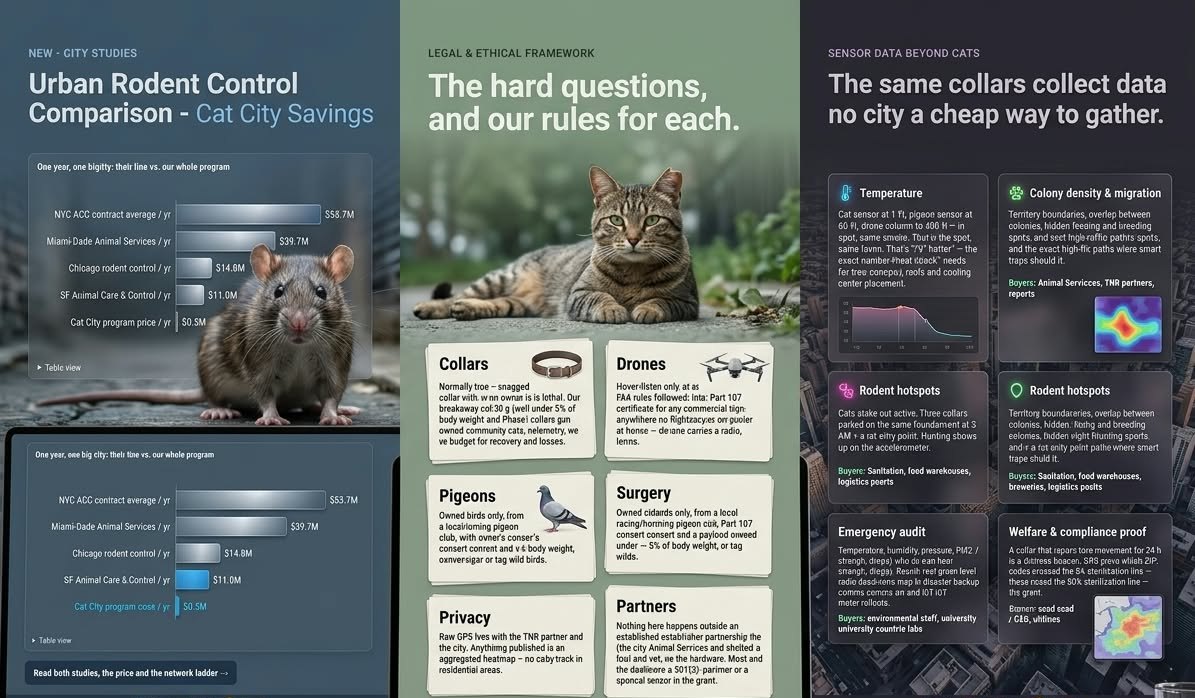
Two studies with the cities' own numbers: the big cities (NYC, SF) and the problem cities (Miami-Dade's 500,000 strays; Chicago's decade as the rat capital). Then our cost, our price, and why a tracked program finishes where a shelter line never does.
Both cities run open-door municipal shelters, both spend eight or nine figures, and in both the cat problem is flat: intake does not fall year over year because nothing they fund changes the outdoor population. The money buys housing, surgery and euthanasia for the cats that come in; it does not buy fewer cats.
| Item | Value |
|---|---|
| ACC shelter contract, average per year | $53.7M |
| ACC city funding FY2025 | $37.0M |
| Queens shelter (one-time, 2024) | $75.0M |
| Bronx shelter (one-time, 2026) | $92.0M |
| Rat reduction plan (2017, one-time) | $32.0M |
| Harlem rat mitigation zone (FY23) | $3.5M |
| Animal Population Control Program / yr | $0.3M |
| Cat City per-city program / yr | $0.4M |
The 34-year ACC contract is capped at about $1.9 billion, which the Comptroller works out to $53.7 million a year on average, before the $75M Queens and $92M Bronx buildings [1] [2] [3] [4]. Over FY2023-25 the shelters took in 28,168 cats (74 % more cats than dogs) and 16,040 of them were strays; in calendar 2024 ACC euthanized 1,315 cats [1] [5]. The city's own sterilization program is $316,000 a year; the ASPCA contract delivered 6,733 surgeries against a 10,660 target (a 37 % shortfall) at $125 each, while 2,381 private rescuers paid ~$2.9M of their own money for 24,211 TNR surgeries in the same three years [1]. Rats got a $32M plan in 2017, a $3.5M Harlem zone and a $155,000-a-year rat czar in 2023 [6] [7].
| Item | Value |
|---|---|
| Cats entering ACC shelters | 28,168 |
| of which strays | 16,040 |
| Private-rescuer TNR surgeries | 24,211 |
| ASPCA contract surgeries (target 10,660) | 6,733 |
| Cats euthanized, calendar 2024 alone | 1,315 |
Ten-year picture (est.): at the contract average, NYC spends roughly $540M on shelter operations per decade plus $167M of new buildings, and its stray-cat intake is still ~5,300 a year. The volunteers doing the actual population work are unfunded.
| Item | Value |
|---|---|
| Animal Care & Control budget / yr | $11.0M |
| New shelter at 1419 Bryant (one-time, 2021) | $76.4M |
| Homelessness & Supportive Housing / yr | $786M |
| Cat City per-city program / yr | $0.4M |
SF Animal Care & Control runs on about $11 million a year [9] out of a $76.4M building [10]. Its own Q4-2024 report shows 1,960 animals in one quarter: 554 cats, of which 306 were strays; 73 cats euthanized; 111 fostered; officers answered 2,774 emergency calls in 90 days [11]. Annualized that is roughly 8,000 animals, ~2,200 cats and ~1,200 stray cats a year, at ~$1,400 of budget per animal handled.
| Item | Value |
|---|---|
| Animals taken in | 1,960 |
| Cats taken in | 554 |
| Stray cats | 306 |
| Cats euthanized | 73 |
| Emergency calls answered | 2,774 |
Ten-year picture (est.): about $110M of operations plus the $76M building. The stray-cat line does not move because nobody is paid to work the streets; the shelter is paid to receive.
Neither city can answer three questions a council member would ask: how many outdoor cats are there, where are they, and is the number going down? Miami-Dade at least publishes a stray estimate (500,000) and counts TNVR surgeries. NYC and SF count what walks in the door. Cat City's whole product is those three answers, measured, on a map, every month, for less than one percent of the shelter line.
| Series | FY20-21 | FY21-22 | FY22-23 | FY23-24 |
|---|---|---|---|---|
| Total budget | $28.9M | $30.6M | $34.8M | $39.7M |
| Series | FY20-21 | FY21-22 | FY22-23 | FY23-24 |
|---|---|---|---|---|
| TNVR services | 13,234 | 14,747 | 16,000 | 17,000 |
Miami-Dade is the honest case: it names the number (~500,000 stray cats, "holding steady") [15], houses over 20,000 cats a year, returns more than 55 % of them through TNVR, and did 33,548 spay/neuter surgeries in FY23-24 while keeping a 90 %+ save rate for ten straight years [14] [13]. The bill went from $28.9M to $39.7M in three years (general-fund share $16.5M → $27.0M) [13]. That is what "doing it right" costs without tracking: $40M a year to hold 500,000 steady. Steady is the ceiling of untracked TNR because nobody knows which colonies are already done and which are re-breeding.
| Item | Value |
|---|---|
| Animal Services budget FY23-24 | $39.7M |
| General-fund share FY23-24 | $27.0M |
| Grants to outside orgs FY23-24 | $1.3M |
| Cat City per-city program / yr | $0.4M |
| Item | Value |
|---|---|
| Chicago Bureau of Rodent Control, 2024 | $14.8M |
| Chicago Bureau of Rodent Control, 2026 | $12.5M |
| NYC rat reduction plan, 2017 (one-time) | $32.0M |
| NYC Harlem rat mitigation zone | $3.5M |
| Cat City per-city program / yr | $0.4M |
Chicago was Orkin's rattiest city ten years running (2015-2024) and only lost the title in 2025 because Los Angeles overtook it [16] [17]. Its Bureau of Rodent Control got $14.85M in 2024 and $12.5M in 2026, and the city's own audit says the current plan is "unlikely" to fix it [18] [19]. Meanwhile Tree House Humane Society's Cats at Work program has placed more than 1,000 sterilized feral cats at businesses and homes as rodent deterrents and runs a waitlist [20]. That is the whole Cat City rodent thesis, already proven in the rattiest city in America, just without tracking, without a map, and without the city paying for it.
Ten years of Chicago rodent budgets at today's rate is roughly $130-150M (est.) for a problem that got worse every year of the decade. NYC put $35.5M into two rat initiatives on top of routine sanitation and hired a czar. Both cities pay for poison, inspections and fines; neither pays for the one thing that keeps working after the contract ends: a sterilized, fed, tracked cat colony that stays.
| Item | Value |
|---|---|
| Cats entering US shelters, 2025 | 3,000,000 |
| Shelter cats euthanized, 2025 | 277,000 |
| Feral pigeon damage, $ (Pimentel 2005) | 1,100,000 |
Nationally 3.0 million cats entered shelters in 2025 and 277,000 were euthanized [22]. Free-ranging cats kill an estimated 1.3-4.0 billion birds and 6.3-22.3 billion mammals a year in the US, mostly by unowned cats [23]. Feral pigeons cost about $1.1 billion a year in building damage and cleanup [21]. None of that appears in a city budget line, which is why the shelter line looks like the whole cost. It is not.
| Item | Value |
|---|---|
| NYC ACC contract average / yr | $53.7M |
| Miami-Dade Animal Services / yr | $39.7M |
| Chicago rodent control / yr | $14.8M |
| SF Animal Care & Control / yr | $11.0M |
| Cat City program price / yr | $0.6M |
| Cat City program cost / yr | $0.4M |
20 collars, 5 gateways, one neighborhood, a TNR partner, and a report the council can vote on. Our cost ≈ $3,384 in hardware and partner fees plus our own time. Priced to be a rounding error inside any shelter budget.
1,000 tracked cats, 3,000 pigeon nodes, 50 gateways, the dashboard, monthly colony report. Our delivery cost ≈ $406,168 (3 field techs, 1 assembler, half a city lead, hardware, partner fees, and a ~4,000 sq ft warehouse to hold and train the working cats, house the loft and the bench). If the city provides an unused building in-kind, the price drops to $520,000. Big cities own empty buildings; we do not need a fancy one → 32 % gross margin, which pays the engineering/ops core from the fifth city on.
That is the fully loaded delivery cost per tracked animal, warehouse included. SF's shelter line works out to ~$1,400 per animal handled; Miami-Dade's to ~$1,400 per cat and dog; NYC's ACC contract to ~$3,600 per intake. We are not competing with the shelter. We are the thing that makes it smaller.
The base. We run from a cheap Central Valley hub (Modesto or Fresno: ~$3,500/month for 4,000 sq ft, vs ~$7,000 in the Bay) and cover ground with vans. A city that wants the hub inside its limits can foot that bill, or part of it, with a building it already owns. Done right, the warehouse is also the clinic: a supervising DVM with final-year vet students logging their surgical hours neuters on site, and every animal leaves with the basics (rabies and FVRCP shots, flea and worm treatment, ear-tip, microchip) instead of being trucked to a clinic day. See the Clinic page for the staffing and the rules.
Targeted, measured TNR is the only intervention with a published end-state: in the Alachua County study, high-intensity TNR plus adoption in one target area cut shelter cat intake 66 % and euthanasia 95 % in two years [24]. Cities like Miami already do the surgeries; what they cannot do is target, because they cannot see the colonies. A tracked colony tells you when it is done. A done colony is a line item that disappears. Untracked TNR plateaus (Miami's own words: "holding steady"); tracked TNR converges.
Investment framing for a council: a 5-year Cat City contract at $0.60M/yr is $3.0M. Against a $40M/yr animal-services line, a 10 % sustained reduction in cat intake pays for it; the Alachua result was 66 % in the treated area. The contract is written to shrink: year 4-5 are maintenance (gateways, retagging, the map), because the population work is finished.

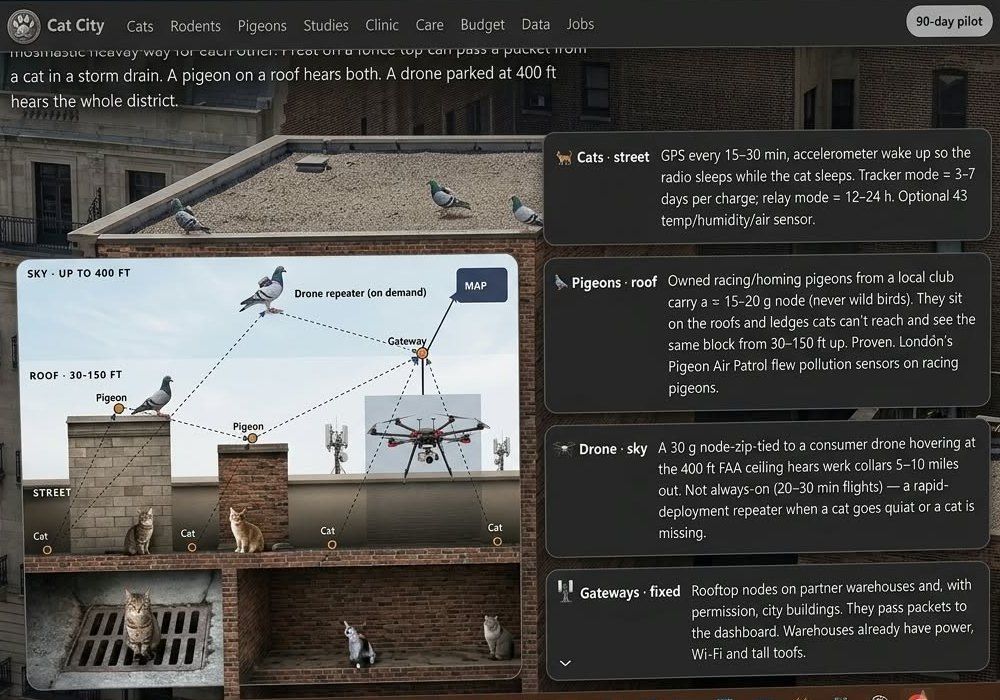
The playbook already staffs Cat City through city job programs. The v2 addition: people who show up and do well in the community meetings and the pilot get first call on the paid roles (tagging, gateway install, cable runs, battery swaps, data entry), and court-ordered community-service hours can be served on infrastructure upkeep and pigeon tagging under a supervised partner. A city that already administers service hours gets a workforce that maintains the network; the network gets people who know the blocks. Rule: no animal handling without the partner's trained lead present.
LoRa moves 1-20 kbit/s, so we never send audio. We send a binary-encoded description of the speech (text plus a few bytes of tone/pace tags, ~1 byte per character) and a small device on the far end, a phone, a $15 node with a speaker, or a PC, speaks it with AI text-to-speech. Today that is a generic voice; a stored voice profile makes it your voice later (a one-time enrolment, a few KB, cached on the receiving device, nothing per message). A 20-word message is ~150 bytes: one LoRa packet, delivered in seconds, spoken instantly. Real audio clips (Codec2, ~700 bytes per 5 s) stay point-to-point and off the shared channel.
Nothing is lost when the link drops. Every message is chunked with sequence numbers; the receiver acknowledges what it has and asks only for the missing chunks; if the sender walks out of range, both sides hold the pieces and resume when a node is back in range, or when a passing cat or pigeon carries the chunks across (delay-tolerant store-and-forward). Play-when-complete is the default; a partial message is never spoken half-way.
Is this internet? No. LoRa is a messaging layer: text, positions, sensor readings, the voice descriptions above. Internet needs Wi-Fi, cellular or satellite. The two combine: a gateway with Wi-Fi or a Starlink dish bridges the mesh to the internet (Meshtastic already does this over MQTT), so one connected roof can serve a whole district's text traffic. That is the model for cities where cell service is expensive or absent, in Africa and anywhere else: residents and small businesses host the $15-$60 nodes and gateways, a local operator runs the map and the message service, and the animals carry the mesh into the blocks no one wired. Text and alerts for the price of a battery, not a phone plan.
Pigeons navigate with a sun compass, a magnetic sense and smell; the magnetic part is still not fully understood. A 6-gram pigeon tag can carry a 3-axis magnetometer and an IMU for about a dollar. Thousands of tagged city pigeons logging heading, magnetic field and turns, for years, is a dataset no lab has. We will not "use" magnetism as a radio (it is not one), but we can publish the first city-scale map of how they actually route, which is the kind of open science that gets a university to co-sign the permits.
Budget figures are the cities' own published numbers for the years stated. "Ten-year" totals are our arithmetic on those rates and are marked est. Cat City costs come from the labor model in the Budget page; prices are our proposal, not a contract.