




Fragments of a Carpet — Met 14.40.719
CA0405 · Visual art · Northern India or present-day Pakistan, Kashmir or Lahore; mid-17th century
Historical / contextual reference
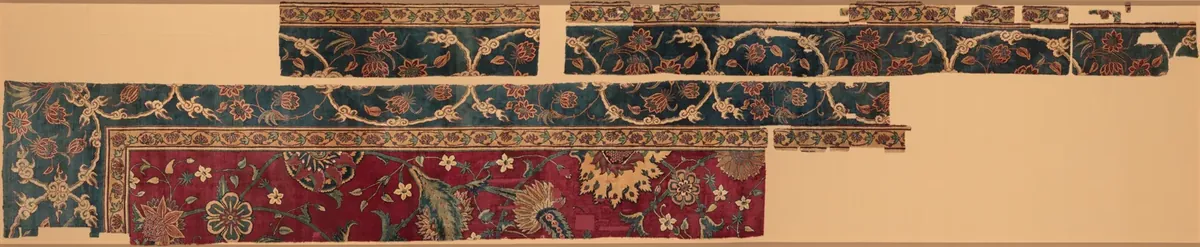
Photograph of the specific selected museum object; identity checked by object ID and accession.
Credit: Unidentified artist / The Metropolitan Museum of Art. Bequest of Benjamin Altman, 1913
Rights: Public domain; Met Open Access
Interwoven flowers and vines remain sharply articulated across these surviving carpet fragments. The Metropolitan Museum identifies a silk foundation and fine wool pile, whose dense knotting permits unusually precise ornamental detail. Its catalogue connects the overall design with Persian carpet traditions while locating the work in a South Asian setting, possibly Kashmir or Lahore. The fragments preserve both accomplishment and incompleteness: what remains can demonstrate technical skill without allowing the entire original furnishing to be reconstructed with certainty. Including them gives Culture Ark a material account of cultural exchange, in which patterns travel but are remade through particular fibres, workshop practices, colour choices, and local circumstances rather than simply copied unchanged.
Why preserve it: Curatorial interpretation: Fragments can preserve technical knowledge and evidence of exchange even when the complete object and its original setting are lost.
Keep in mind: The production location is uncertain between regions named by the museum. Avoid converting stylistic associations into a claim about the maker’s ethnicity, religion, or exact workshop.