




Moon Jar — Met 1979.413.1
CA0406 · Visual art · Korea; Joseon dynasty, second half of the 18th century
Historical / contextual reference
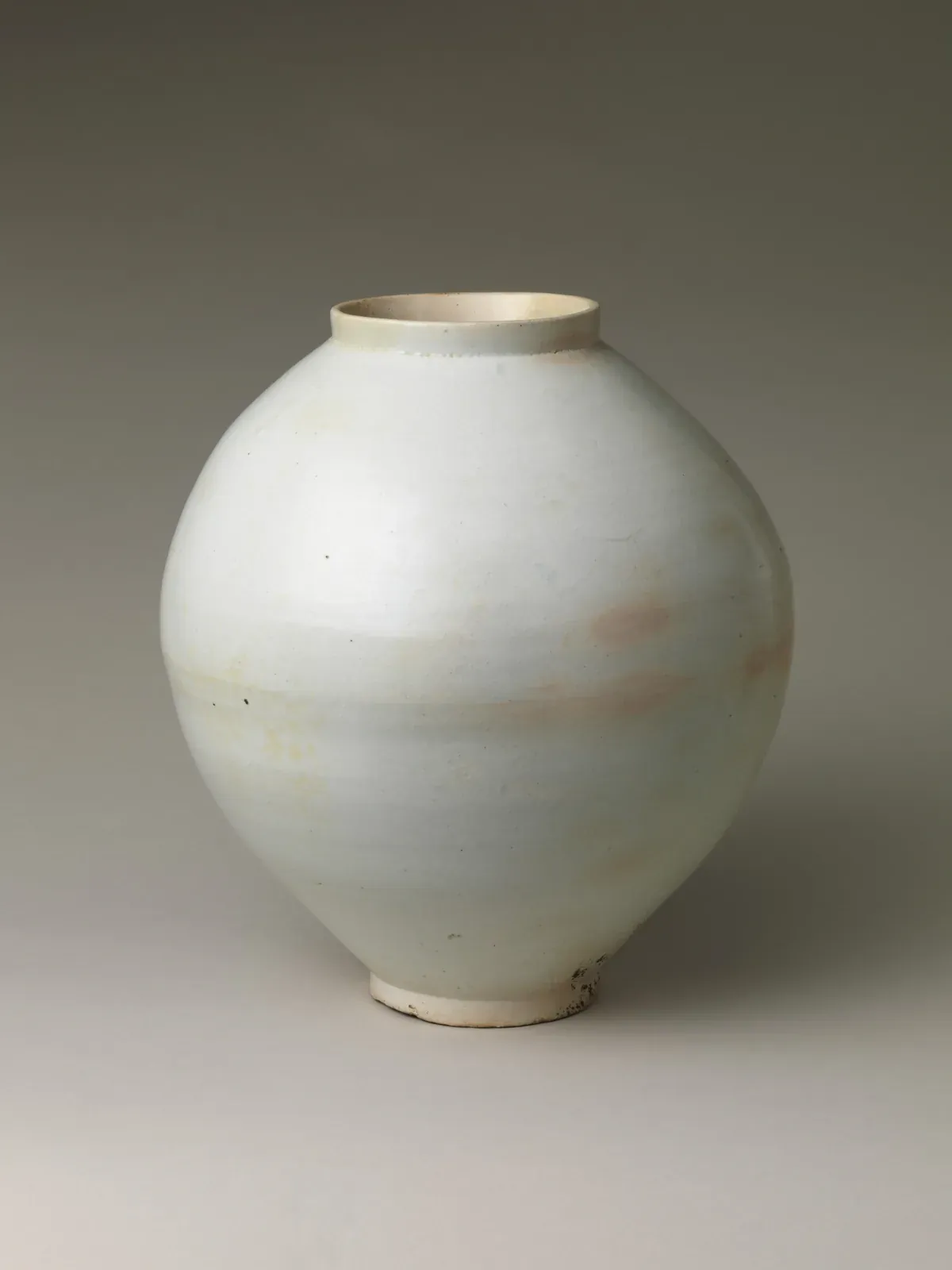
Photograph of the specific selected museum object; identity checked by object ID and accession.
Credit: Korea / The Metropolitan Museum of Art. The Harry G. C. Packard Collection of Asian Art, Gift of Harry G. C. Packard, and Purchase, Fletcher, Rogers, Harris Brisbane Dick, and Louis V. Bell Funds, Joseph Pulitzer Bequest, and The Annenberg Fund Inc. Gift, 1975
Rights: Public domain; Met Open Access
This white porcelain jar has a rounded body whose slight asymmetry and changing surface colour reward looking from more than one side. Moon jars were formed by joining two hemispherical sections, a process that helps explain why their contours do not settle into mechanical regularity. The Metropolitan Museum dates this example to the later eighteenth century. Its archive record can place the vessel beside later responses, including artist Lee Ufan’s appreciation of its openness and imperfection, while keeping that modern reading distinct from the unknown maker’s intentions. The jar offers a concentrated encounter with volume, joining, firing, and attention: ordinary material processes become visible through a form that initially seems very simple.
Why preserve it: Curatorial interpretation: Aesthetic value may emerge from irregularity and making processes, while later artists can give old objects new interpretive lives.
Keep in mind: This is one specific jar, not a generic illustration of all Korean ceramics. Lee Ufan’s comments are a later artist’s interpretation, not direct evidence of eighteenth-century intent or a universal Korean philosophy.