




Slow Sand Water Filter
Knowledge Ark build sheet · history · how it works · parts · step-by-step build · safety
The filter, cut open
A biosand-style filter drawn in cutaway. Water poured in at the top seeps slowly down through sand and gravel and rises out of the outlet pipe into a clean container.
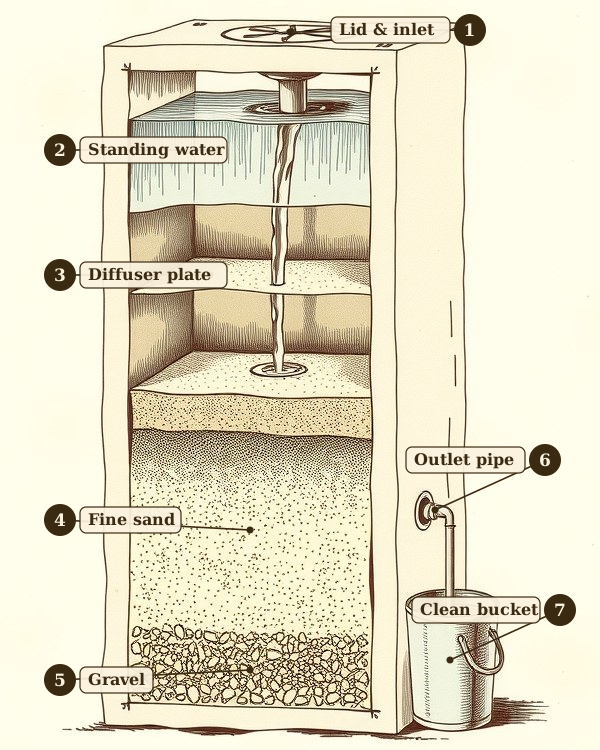
- 1Lid and inlet: dirty water is poured in here; the lid keeps out dust, light and animals.
- 2Standing water: a shallow layer that keeps the sand surface wet so the living layer survives.
- 3Diffuser plate: spreads incoming water gently so the sand surface is not dug up.
- 4Fine sand: the main filtering layer; its top centimetres hold the biological layer that traps and eats germs.
- 5Gravel: supports the sand and lets filtered water reach the outlet without carrying sand with it.
- 6Outlet pipe: rises to just above the sand level so the filter never drains dry.
- 7Clean container: collects the filtered water, which must still be disinfected before drinking.
Illustration: AI-assisted drawing for the Knowledge Ark, layers shown approximately. Filtering alone does not make water safe: boil, chlorinate or use SODIS as the sheet explains.
Knowledge Ark build sheet · Knowledge Ark · Culture Ark · An Artificial Mind Hive project by Austin Little
A slow sand filter is one of the oldest and quietest public-health machines in the world. It has no motor and no moving parts. Dirty water trickles down through a deep bed of fine sand, and a thin living skin on top of the sand, together with the sand itself, catches and eats much of what makes people sick. Cities have used slow sand filters for two centuries, and millions of households now use a small version called the biosand filter. This sheet explains where the slow sand filter came from, how it works, what each layer does, and how to build a household filter from a tall container, washed gravel and sand. It also says plainly what a sand filter cannot do. Filtering alone does not make water safe to drink. Filtered water must still be disinfected: boiled, chlorinated or treated by solar disinfection (SODIS).
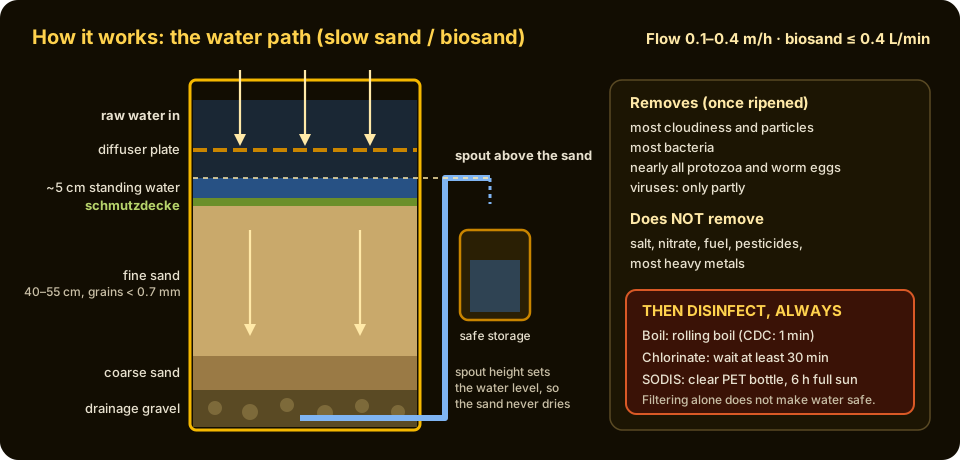
The water path. Raw water rests on top, soaks slowly down through the living "schmutzdecke" and the fine sand, drains through coarser layers and leaves by a pipe that rises higher than the sand, so the bed never dries out. The filter improves water; it does not sterilise it.
Why keep this in the Knowledge Ark
Unsafe water is still one of the largest causes of illness in the world. The World Health Organization estimates that well over a billion people drink water from sources contaminated with faeces, and diarrhoeal disease spread this way kills hundreds of thousands of people every year, many of them young children. If a water system fails, after a flood, a war, an earthquake or simply a long breakdown of supply, the old methods become important again.
The slow sand filter matters because it can be built from materials found almost anywhere: a container, stones, sand and patience. It teaches how particles are strained, how microbes stick to surfaces, and how a community of living organisms can do useful work for people when it is given the right conditions. It also teaches a hard lesson about safety: a tool that makes water look clear does not necessarily make it safe. That lesson cost many lives before it was learned, and it is worth keeping.
History: how it came about
Before filters
People have always tried to clean water. Ancient Sanskrit and Greek medical writings recommended boiling water, exposing it to sunlight, or straining it through cloth. Egyptian wall paintings show settling and decanting of water. The Greek physician Hippocrates, around 400 BCE, is credited with recommending that water be boiled and strained through a cloth bag, which later writers called the "Hippocratic sleeve". Settling in jars, and filtering through porous stone, sand or charcoal, were known in many cultures. What none of these people could know was that the worst danger in water was invisible: bacteria, viruses and parasites far too small to see.
Early experiments with sand
In the seventeenth century the English philosopher Francis Bacon wrote about trying to remove salt from seawater by passing it through sand. It did not work for salt, but the idea of a sand bed for cleaning water stayed alive. Through the eighteenth century, small household filters using sand, sponge or charcoal were sold in France and Britain, mostly to make water look and taste better.
1804: John Gibb in Paisley
The first sand filter known to have supplied water to the public was built in 1804 by John Gibb, the owner of a bleaching works in Paisley, Scotland. Bleaching cloth needs a great deal of clean water, so Gibb built an experimental filter to clean the river water he used. It worked well enough that he had water to spare, and he sold the surplus to people in the town, delivering it by horse and cart. This was a small business rather than a public utility, but it showed that sand filtration could be done at scale and that people would pay for clearer water.
In the following decades Scottish engineers built on Gibb's work. Robert Thom designed filters for the town of Greenock in the late 1820s and later for Paisley, using filters that could be cleaned by reversing the flow of water.
1829: James Simpson and the Chelsea Water Works
The step that created the modern slow sand filter came in London. James Simpson, engineer to the Chelsea Water Works Company, studied existing filters in Britain and then designed a large filter for the company's Thames water. It was completed in 1829 and covered about an acre. Water flowed slowly downward through layers of sand and gravel and was drawn off from drains at the bottom. When the surface clogged, workers scraped off the top layer of sand and the filter was put back into service. Simpson's design, with its slow downward flow, graded layers and surface scraping, is the pattern slow sand filters still follow.
At the time, people believed the filter worked by straining dirt out, like a sieve. Nobody yet understood that its most important work was being done by microbes living in the top of the sand.
1854: cholera and John Snow
In the nineteenth century, cholera spread from South Asia across the world in a series of great outbreaks. The common belief was that cholera came from "miasma", bad air from rotting matter. The London physician John Snow argued instead that cholera was spread by something in contaminated water. He published his ideas in 1849 in On the Mode of Communication of Cholera.
In late August and early September 1854, a severe outbreak struck the Soho district of London, killing several hundred people within a few streets. Snow mapped the deaths and found they clustered around a public water pump on Broad Street (now Broadwick Street). He persuaded the local authorities to remove the pump's handle on 8 September 1854. The outbreak was already declining by then, but Snow's investigation became one of the founding examples of epidemiology. It was later found that the well had been contaminated by a nearby cesspool.
Snow also carried out a larger study, sometimes called his "Grand Experiment". In south London, two water companies supplied homes on the same streets. The Lambeth company had moved its intake upstream on the Thames, above most of London's sewage, in 1852. The Southwark and Vauxhall company still drew water from the tidal Thames in the city. During the 1854 epidemic, households supplied by Southwark and Vauxhall died of cholera at a far higher rate than those supplied by Lambeth. Snow published these findings in the second edition of his book in 1855.
Parliament had already passed the Metropolis Water Act of 1852, which required companies supplying London to move their intakes above the tidal reach of the Thames and to filter the water they supplied, with the requirement taking effect by the end of 1855. Filtration and cleaner sources together helped end the great London cholera epidemics.
1892: Hamburg and Altona
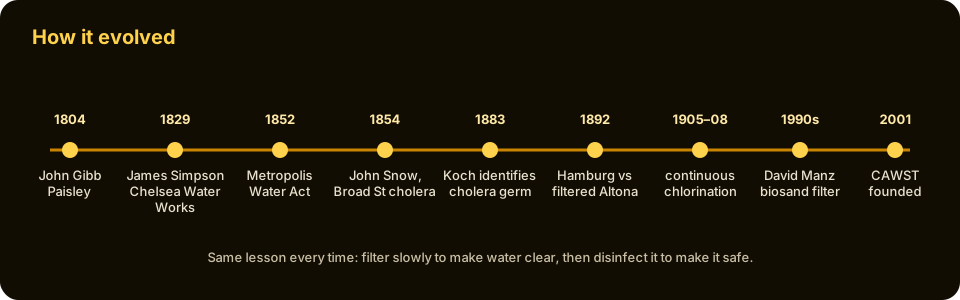
The clearest proof that slow sand filters protect people came in Germany in 1892. Hamburg drew drinking water from the River Elbe with only settling and no filtration. Its neighbouring city, Altona, took its water from the Elbe further downstream, where the river was even more polluted, but treated it through slow sand filters. When cholera struck in 1892, about 8,600 people died in Hamburg, while Altona, on the far side of a street boundary in places, had far fewer cases. The bacteriologist Robert Koch, who had identified the cholera bacterium in 1883 (it had also been described by the Italian anatomist Filippo Pacini in 1854), studied the outbreak. The lesson was taken up across Europe: properly run slow sand filtration could greatly reduce waterborne disease.
Disinfection joins filtration
Even good filters let some germs through. At the end of the nineteenth century and the start of the twentieth, cities began adding chlorine to water to kill what filters missed. Chlorine was used to disinfect a water supply in Maidstone, England, after a typhoid outbreak in 1897, and continuous chlorination of a public supply began in Lincoln, England, in 1905 and in Jersey City, New Jersey, in 1908. Filtration followed by disinfection became the standard approach to safe drinking water, and it remains so today.
At the same time, faster "rapid sand filters", which use chemicals to clump particles together and are cleaned by washing water backwards through them, were developed in the United States from the 1880s. They take up far less land and became common in large cities, but slow sand filters are still used in many places, including London, because they are simple and reliable.
1990s: the biosand filter
In the early 1990s Dr David Manz, at the University of Calgary in Canada, adapted the slow sand filter for use in a single household. The challenge was that a household fills a filter only a few times a day, while a city filter runs all the time. Manz designed a filter in which the outlet pipe rises above the surface of the sand, so that a shallow layer of water always stays on top of the sand even when no one is using it. That keeps the living layer wet and alive between uses. He called it the biosand filter. In 2001 Manz and Camille Dow Baker founded the Centre for Affordable Water and Sanitation Technology (CAWST), which has published open designs and trained people around the world to build biosand filters from concrete or plastic. Hundreds of thousands of these filters have been installed in dozens of countries.
How it works
Slow is the point
A slow sand filter works because the water moves slowly. In a town-sized filter, water typically moves down through the sand at about 0.1 to 0.4 metres per hour. That is equal to 100 to 400 litres per square metre of sand per hour. A household biosand filter is often designed to deliver no more than about 0.4 litres per minute (roughly 24 litres an hour) when it is freshly filled. At these speeds water stays in contact with the sand for a long time, and the processes that clean it have time to act.
The schmutzdecke
The most important part of a slow sand filter is not the sand itself but a thin layer that grows on top of it. Engineers call it by its German name, schmutzdecke, which means "dirt cover" or "dirt blanket". It is a sticky biological film made of bacteria, algae, protozoa, fungi, tiny worms and the organic matter and particles they trap. It forms naturally within days to weeks after a new filter starts receiving water. A new filter is not fully effective until this layer and the biofilm deeper in the sand have grown; this is called ripening and usually takes two to four weeks.
Inside the schmutzdecke and the top few centimetres of sand, several things happen at once. Larger particles are strained out. Microbes from the water stick to the sticky surfaces. Predatory organisms such as protozoa eat bacteria. Some disease-causing organisms simply die because they are far from their host and do not have the food or warmth they need. Below the top layer the biofilm thins out, but fine sand continues to trap particles.
Physical processes in the sand
Fine sand grains are small, but the spaces between them are much larger than bacteria. Filtering is therefore not only straining like a sieve. As water winds through the pores, particles settle onto grain surfaces, are pushed against them by the flow, or are drawn to them by electrical forces, and then stick. Each grain becomes coated over time with a biofilm that makes it even better at catching particles.
What a sand filter removes, and what it does not
Field and laboratory studies of well-run slow sand and biosand filters typically report that, once ripened, they remove most turbidity (cloudiness), most bacteria, and nearly all protozoan cysts such as Giardia and Cryptosporidium and the eggs of parasitic worms. They remove viruses less reliably, because viruses are so small. Performance drops if the filter is new, is disturbed, dries out, is overloaded, or receives very dirty water.
Sand filters do not reliably remove dissolved chemicals, including salts, nitrates, fluoride, pesticides, fuel and most heavy metals. Some designs can reduce iron or, with added iron nails, arsenic, but a household should not count on this without testing.
Why filtered water must still be disinfected
No household sand filter makes water reliably safe on its own. Removal is partial, it varies from day to day, and a single pathogen that gets through can be enough to cause disease. The World Health Organization's Guidelines for Drinking-water Quality recommend a "multiple barrier" approach: protect the source, settle and filter the water to make it clear, then disinfect it, then store it safely. Filtering first makes disinfection work much better, because chlorine and sunlight both struggle with cloudy water. But the disinfection step is not optional. The three household methods are:
- Boiling. Bring the water to a rolling boil. WHO guidance is that a rolling boil is enough to kill disease-causing microbes; the United States Centers for Disease Control and Prevention (CDC) recommends boiling for one minute, or three minutes above about 2,000 metres of altitude. Let it cool covered and store it in a clean, closed container.
- Chlorination. Add unscented household bleach or chlorine tablets at the dose stated on the product or by public-health guidance, mix and wait at least 30 minutes before drinking. CDC guidance for bleach containing about 6 per cent sodium hypochlorite is roughly 2 drops per litre (8 drops per US gallon) of clear water, doubled for cloudy water. WHO aims for at least 0.5 milligrams per litre of free chlorine remaining after 30 minutes. The water should smell faintly of chlorine; if it does not, repeat the dose and wait again.
- Solar disinfection (SODIS). Fill clear, clean plastic (PET) bottles of 2 litres or less with filtered water, close them and lay them in full sun for at least 6 hours, or for two full days if the sky is more than half cloudy. Ultraviolet light and warmth kill most pathogens. SODIS needs clear water; very cloudy water must be filtered first, which is one more reason a sand filter is useful.
Parts and what each one does
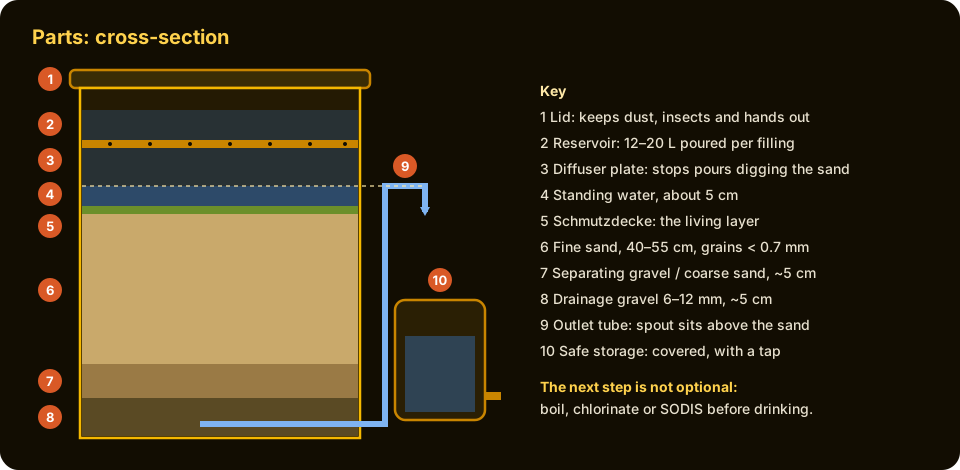
- Lid. Keeps dust, insects, animals and hands out of the filter. The top of the filter should always be covered.
- Reservoir. The space above the sand where you pour raw water. In a household filter it usually holds 12 to 20 litres per filling.
- Diffuser plate. A plate with many small holes that sits above the sand. It spreads poured water gently so it does not dig a hole in the schmutzdecke. Without it, each pour would damage the living layer.
- Standing water layer. About 5 centimetres of water that stays above the sand at all times, kept there by the height of the outlet. It protects the biofilm from drying out while still letting oxygen reach it. Much deeper standing water can starve the living layer of oxygen.
- Schmutzdecke (biological layer). The living film on top of the sand, the most important cleaning layer.
- Fine sand. The main filter bed, usually 40 to 55 centimetres deep in a household filter and more in a town filter. Grains are typically smaller than about 0.7 millimetres, with town filters often specifying an effective grain size of about 0.15 to 0.35 millimetres.
- Coarse sand or separating gravel. A layer of grains a few millimetres across. It stops the fine sand from washing down into the drainage gravel.
- Drainage gravel. A bottom layer of gravel about 6 to 12 millimetres across, around 5 centimetres deep, that lets water flow freely to the outlet and stops sand reaching the pipe.
- Outlet tube. A pipe that starts at the very bottom, inside the gravel, and rises up the outside or inside of the container to a spout slightly higher than the sand surface. Because water finds its own level, the spout height sets the standing water level. This is the key idea of the biosand filter.
- Safe storage container. A clean, covered container with a tap or narrow neck, where filtered water is collected and then disinfected. Never collect filtered water in an open bucket.
Build it: a household biosand-style filter
This build makes a household filter about the size of a tall dustbin, able to treat several fillings of 12 to 20 litres a day. It follows the principles of the open biosand design. It does not replace disinfection.
Materials
- Container: a clean, food-grade plastic barrel or tall bucket, about 80 to 100 centimetres tall and 30 to 45 centimetres across, with a lid. It must never have held chemicals, fuel or pesticides. Concrete filters, cast in a mould, are another proven option.
- Outlet tube: about 1.5 metres of food-grade plastic tube or 12–15 mm plastic pipe, with elbows, and a waterproof fitting where it passes through the wall of the container.
- Diffuser: a plastic plate or lid that fits inside the container, drilled with holes about 3 millimetres across every 2 to 3 centimetres.
- Drainage gravel: about 5 centimetres of depth, of clean gravel 6 to 12 millimetres across.
- Separating gravel or coarse sand: about 5 centimetres, of grains about 1 to 6 millimetres.
- Fine sand: enough for 40 to 55 centimetres of depth, crushed rock or river sand, with grains smaller than about 0.7 millimetres. Avoid beach sand, which may be salty and too uniform, and sand from polluted sites.
- Sieves (kitchen sieves or mesh of about 0.7 mm, 6 mm and 12 mm), several buckets for washing, clean water for washing, a ruler, marker, drill and silicone or a sealing fitting.
- A clean, covered container with a tap for storing treated water, and a chosen disinfection method: fuel to boil, chlorine bleach or tablets, or clear PET bottles for SODIS.
Step 1: sieve and wash the media
Sieve the sand and gravel into three sizes: fine sand that passes the 0.7 mm mesh, separating gravel between about 1 and 6 mm, and drainage gravel between 6 and 12 mm. Wash each one in a bucket, stirring and pouring off the cloudy water, until the rinse water runs nearly clear. The fine sand should still contain a little very fine material; over-washing it until it is perfectly clean can make the filter run too fast. Washing is tedious but it is the single biggest factor in getting a filter that works on day one.
Step 2: fit the outlet tube
Drill a hole low on the side of the container, a few centimetres above the base, and fit the waterproof connector. Inside, attach a short perforated pipe or a tube end covered with mesh that will lie in the drainage gravel. Outside, run the tube upward to a spout. Mark the container: the spout must end up about 5 centimetres higher than the final surface of the fine sand. Seal and test for leaks with water before adding any gravel.
Step 3: fill with water first, then add the layers
Always add media to a container that already has some water in it, so trapped air can escape and layers settle evenly. Pour in about 10 centimetres of water. Add the drainage gravel and level it to about 5 centimetres deep. Add the separating gravel or coarse sand on top, another 5 centimetres. Then add the fine sand slowly, a little at a time, keeping the water level always above the sand. Level the top of the sand carefully. Check that the sand surface is about 5 centimetres below the spout height; add or remove sand until it is.
Step 4: install the diffuser and lid
Fix the diffuser plate a few centimetres above the standing water level, resting on a ledge, supports or a ring, so that water poured in falls onto the plate and drips gently onto the surface. Put on the lid.
Step 5: check the flow rate
Fill the reservoir to the top with clear water. Once water is running from the spout, catch it in a measuring jug for one minute. For a household biosand design the aim is no more than about 0.4 litres per minute when the reservoir is full. If it flows much faster, the sand is too coarse or was over-washed; add a layer of finer sand on top or rebuild. If it flows very slowly, the sand contains too much fine silt; remove the top few centimetres and swirl it clean (see maintenance below).
Step 6: let it ripen
Pour in the water you intend to treat once or twice every day, ideally at the same times. The schmutzdecke and biofilm need two to four weeks to grow. During this period the filter is not yet working well, so water from it must be treated as untreated and disinfected with extra care, even more than usual.
Step 7: use it the same way every day
Pour raw water through the diffuser in steady fillings. Collect filtered water in the safe storage container. Let the filter rest between fillings so the water inside has time to stay in contact with the biofilm; continuous over-use reduces performance. Then disinfect the filtered water by boiling, chlorinating or SODIS before drinking.
First water: test and adjust
- Look and smell. After ripening, filtered water should be visibly clearer than the raw water. Cloudy output means the filter is too fast, too new, disturbed or overloaded.
- Keep the level right. When the filter stops dripping, the water should rest about 5 centimetres above the sand. If the sand is exposed, the biological layer will dry and die. If the water stands much deeper, the layer can run short of oxygen.
- Do not let it dry out. If the filter must be left unused, keep feeding it at least every couple of days. If it dries out, treat it as a new filter and allow it to ripen again.
- Clean when it slows. Over weeks or months the flow will fall as the top layer clogs. When it becomes too slow for daily needs, use the "swirl and dump" method recommended for biosand filters: with water above the sand, gently swirl the top centimetre or two of sand by hand (wearing a glove or washing hands well afterwards), scoop out the dirty water, and repeat a few times until the flow recovers. The filter will need a few days to recover full performance afterwards. Town filters are cleaned by scraping off the top 1 to 2 centimetres of sand.
- Test if you can. Simple field test kits for E. coli and for chlorine residual exist. Any detection of E. coli in drinking water means the treatment chain has failed somewhere.
- Troubleshooting. Muddy raw water clogs a filter fast: let it settle in a separate bucket for several hours or overnight and pour off the clearer water before filtering. Pre-straining through clean cloth also helps.
Safety
- A sand filter does not make water safe on its own. Always disinfect filtered water by boiling, chlorinating or SODIS before drinking, cooking with it, making baby formula or brushing teeth. Treat water from a new or recently cleaned filter as completely untreated.
- Chemicals are not removed. Do not rely on any sand filter for water that may contain fuel, industrial waste, pesticides, mine drainage, seawater or flood water from chemical sites. Find another source.
- Containers matter. Use only food-grade containers that have never held chemicals. Clean and cover storage containers, use a tap or narrow neck, and do not dip cups or hands into treated water.
- Bleach is dangerous if misused. Use only plain, unscented bleach. Never mix bleach with acids or ammonia-based cleaners, which give off toxic gas. Store it out of children's reach.
- Boiling burns. Supervise children around boiling water and fires, and let water cool covered.
- Hygiene during cleaning. The top layer of the filter is full of trapped germs. Wear gloves or wash hands thoroughly with soap after cleaning, and dispose of the wash water away from water sources.
- Follow local health advice. During outbreaks such as cholera, follow public-health instructions, which may require stronger treatment.
Where slow sand filters are used now
Slow sand filtration is still part of water treatment for cities and towns around the world, including several of London's water works, where large slow sand beds are still scraped and re-sanded, and many smaller communities that value its low running costs. The biosand filter is used in households across Asia, Africa and Latin America. The same biological principle, cleaning water by letting living films work on it slowly, appears in riverbank filtration, constructed wetlands and the trickling filters of sewage works. In every case, safe drinking water also needs a final disinfection barrier.
Words to know
- Schmutzdecke: the thin biological layer that forms on top of the sand and does much of the cleaning.
- Ripening: the weeks needed for the biological layer to grow before a filter works well.
- Filtration rate: how fast water moves through the sand, measured in metres per hour or litres per minute.
- Turbidity: cloudiness of water, caused by suspended particles; measured in NTU.
- Pathogen: a disease-causing organism, such as a bacterium, virus or parasite.
- Disinfection: killing or inactivating pathogens, by boiling, chlorine or sunlight. Filtration is not disinfection.
- Multiple barriers: protecting the source, filtering, disinfecting and storing safely, so that no single failure makes people ill.
Related in the Knowledge Ark
The Knowledge Ark keeps 6,000 packages for rebuilding, from water and sanitation to medicine and measurement. Browse them, search by category and open any package at the Knowledge Ark. Its sister, the Culture Ark, keeps 2,000 things people should still be able to see in 2,000 years.
Where to learn more
- World Health Organization: Guidelines for Drinking-water Quality and guidance on household water treatment and safe storage.
- CAWST (Centre for Affordable Water and Sanitation Technology): open biosand filter construction manuals and training materials.
- United States Centers for Disease Control and Prevention: guidance on making water safe in an emergency by boiling and disinfecting.
- Eawag / SODIS: guidance on solar water disinfection.
- Histories of John Snow and the 1854 Broad Street cholera outbreak, and of the London water companies.
Knowledge Ark build sheet. An Artificial Mind Hive (AMH) project. AMH is owned by Austin Little.