




Mihrab from the Madrasa Imami, Isfahan
CA0402 · Visual art · Isfahan, Iran; dated 755 AH/1354–55 CE
Historical / contextual reference
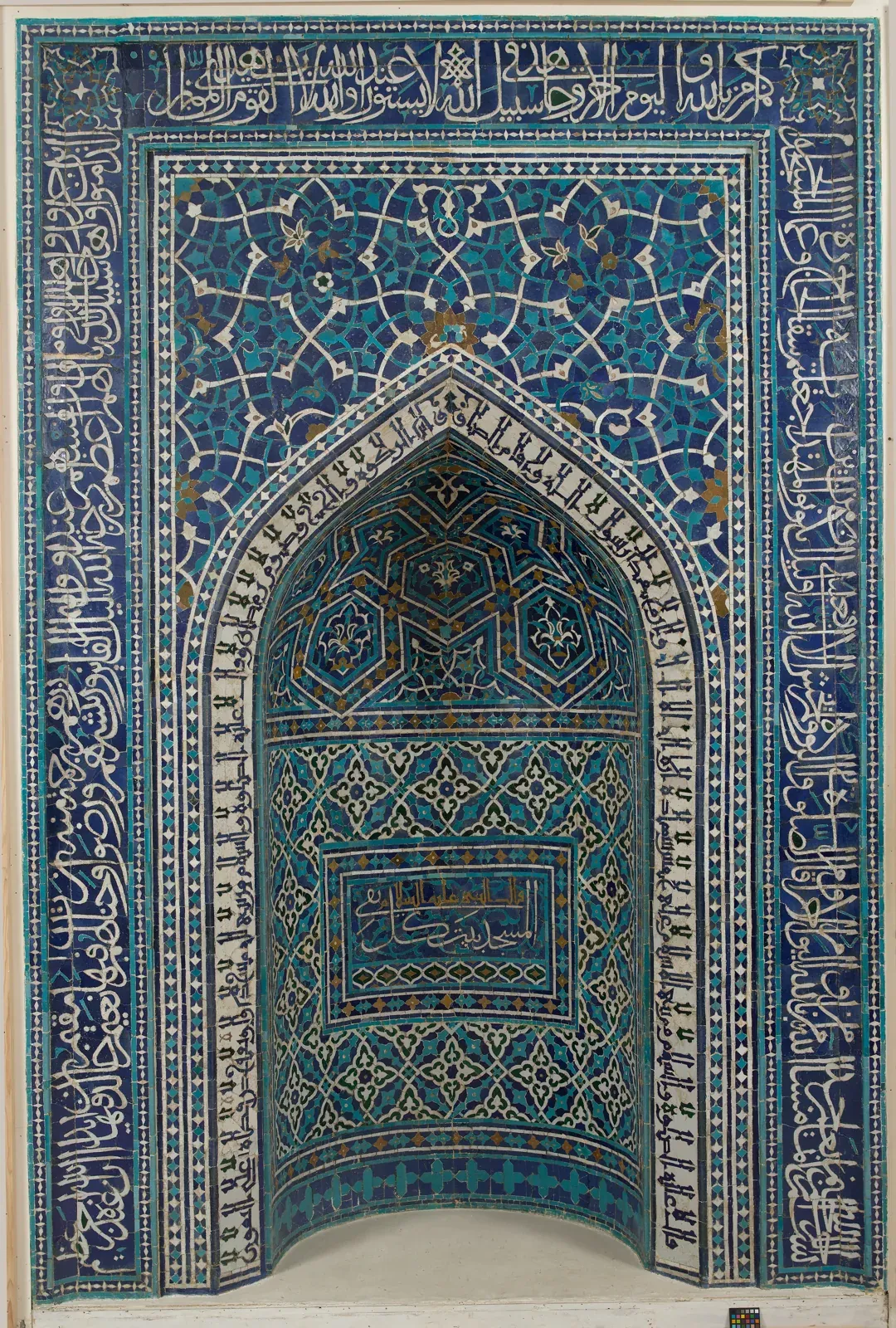
Photograph of the specific selected museum object; identity checked by object ID and accession.
Credit: Unidentified artist / The Metropolitan Museum of Art. Harris Brisbane Dick Fund, 1939
Rights: Public domain; Met Open Access
Cut pieces of glazed tile form an architectural niche surrounded by calligraphy and interlacing ornament. Originally part of a religious school in Isfahan, this mihrab directed attention toward the direction of prayer rather than functioning as a freestanding sculpture. Its blue, turquoise, and white surfaces bring readable religious language into an elaborate material structure. The Metropolitan Museum dates it to 1354–55 and identifies the technique as mosaic assembled from individually cut tiles. Culture Ark should preserve a view of the whole niche, details of the joins and inscriptions, and an explanation of its original architectural function. Detached from its wall, the object remains visually powerful but no longer supplies its own complete setting.
Why preserve it: Curatorial interpretation: Architecture, text, skilled fabrication, and bodily orientation can form one artwork; removal changes how that work communicates.
Keep in mind: The museum installation is not the original madrasa setting. Religious inscriptions should be translated accurately and not treated solely as abstract ornament. Do not infer the names or social identities of unrecorded makers.