




To'o ritual image, Met 1979.206.1481
CA0362 · Visual art · Tahiti, Society Islands; eighteenth century
Historical / contextual reference
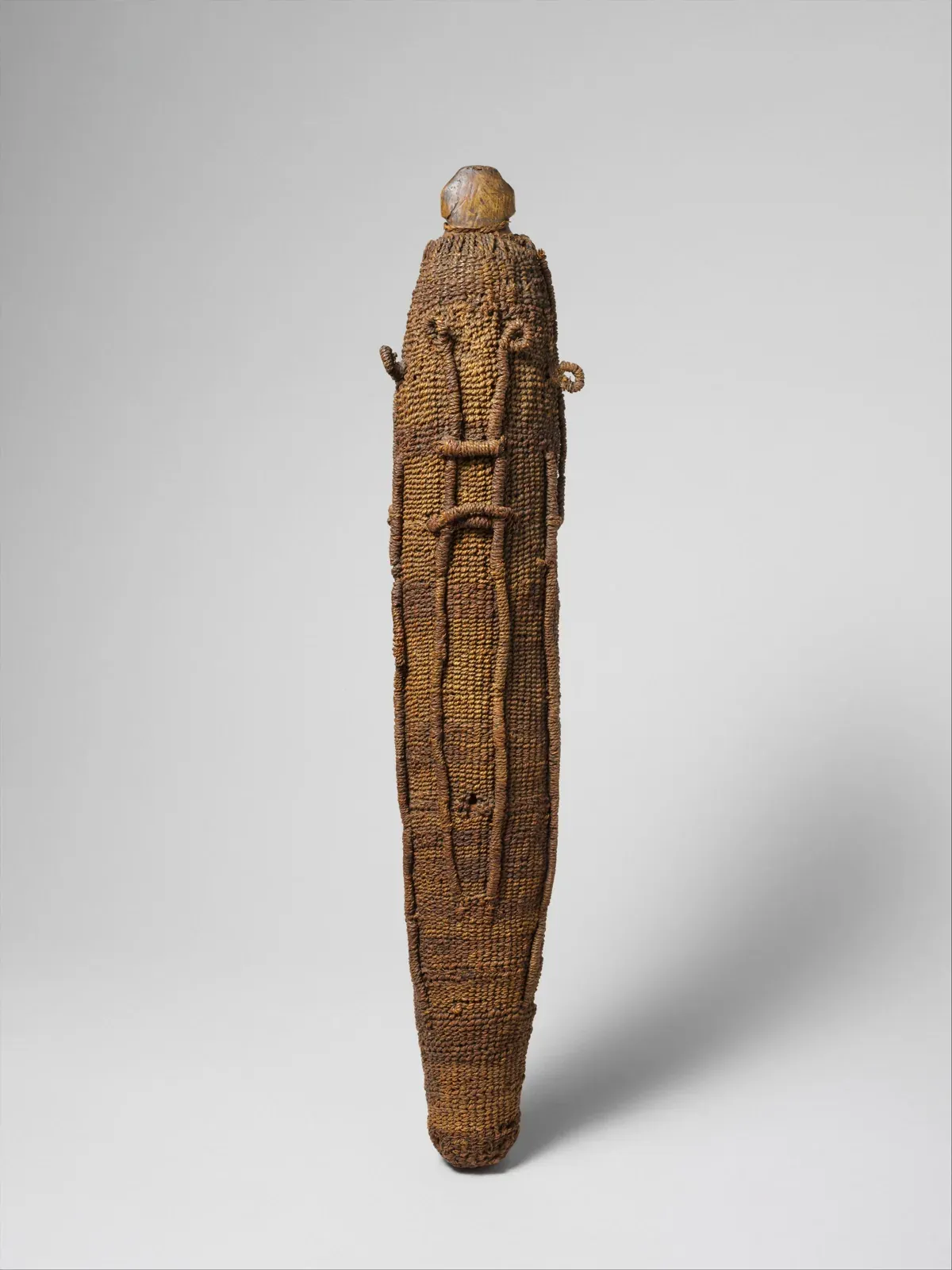
Photograph of the specific selected museum object; identity checked by object ID and accession.
Credit: Mā'ohi artist / The Metropolitan Museum of Art. The Michael C. Rockefeller Memorial Collection, Bequest of Nelson A. Rockefeller, 1979
Rights: Public domain; Met Open Access
A wrapped wooden form presents a body through tightly worked coconut fibre rather than anatomical modelling. The Metropolitan Museum identifies loops that suggest facial features and a depression associated with the navel. Its explanation connects the binding process, accompanied by words and actions, with making a temporary dwelling for a deity. Wood, fibre and feathers therefore belong to a meaningful material relationship, not merely to a list of ingredients. Future viewers can learn from the work's restraint without stripping away its religious significance. The selection challenges an archive to preserve what an object was understood to do as well as what a modern photograph makes visible, especially when the original ceremonial setting is absent.
Why preserve it: Curatorial interpretation: It shows that a minimally described body can carry dense religious and material meaning.
Keep in mind: This is one eighteenth-century Tahitian object, not a universal Pacific deity image. Do not claim restricted ritual knowledge or treat it only as a precursor of modern abstraction.