




Solar Still
Knowledge Ark build sheet · history · how it works · parts · step-by-step build · safety
The still, cut open
A ground pit solar still drawn in cutaway. Sunlight warms the damp pit, water evaporates, condenses on the underside of the cool plastic sheet and runs down to drip into the cup.
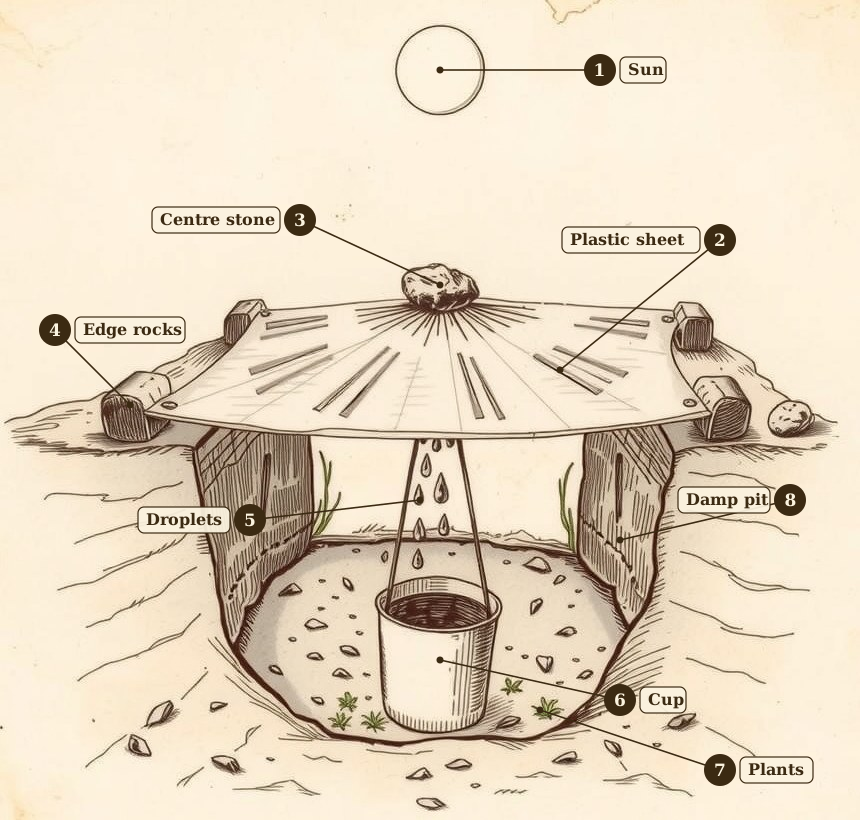
- 1Sun: the only energy source; a still makes far more water on clear, hot days.
- 2Clear plastic sheet: lets sunlight in and gives vapour a cooler surface to condense on.
- 3Centre stone: weights the sheet into a cone so droplets run to one point above the cup.
- 4Edge rocks: seal the sheet to the ground so moist air cannot escape.
- 5Droplets: condensed water running down the underside and falling into the cup.
- 6Collecting cup: catches the drips; a tube to drink from saves lifting the sheet.
- 7Green plants: cut plants placed in the pit add moisture that evaporates out of them.
- 8Damp pit: the walls and floor hold the moisture that the sun drives off.
Illustration: AI-assisted drawing for the Knowledge Ark, parts shown approximately. Expect only about half a litre to a few litres per square metre per day.
Knowledge Ark build sheet · Knowledge Ark · Culture Ark · An Artificial Mind Hive project by Austin Little
A solar still copies the way the world makes rain. Sunlight warms dirty, salty or brackish water under a clear cover; pure water evaporates, leaving salt and most dirt behind; the vapour meets the cooler cover, condenses into drops and runs down into a channel where it can be collected. It is slow and it does not make much water, but it needs no fuel, no electricity and no moving parts, and it can turn water no one could drink into water people can. This sheet explains where solar distillation came from, how it works, the two main kinds of still, what each part does, and how to build a simple box still. It is also honest about the numbers: a good solar still makes only about 0.5 to 3 litres of water per square metre per day, depending on the sunshine.
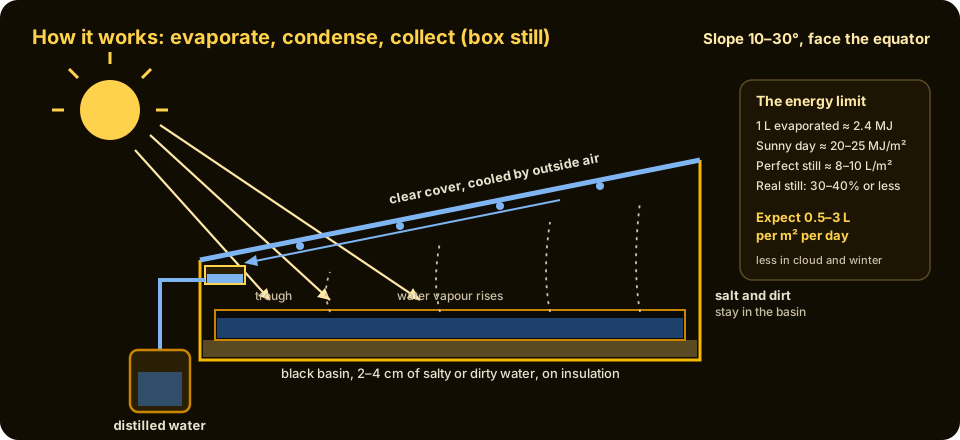
The water path. Sunlight passes through the cover and is absorbed by the dark basin. Warm water evaporates; the vapour condenses on the cooler cover, the drops run down the slope into a trough, and clean distilled water drains out. Salt and dirt stay behind in the basin.
Why keep this in the Knowledge Ark
Almost all the water on Earth is salty. Seawater, brackish wells and salty desert lakes are useless for drinking as they are, and drinking seawater makes thirst worse, because the body must spend more water getting rid of the salt than the seawater provides. Boiling and filtering do not remove salt. Distillation does, and solar distillation does it with free energy.
A solar still is also a clear lesson in physics. It shows how sunlight becomes heat, why black surfaces get hot, how evaporation separates water from what is dissolved in it, how much energy it takes to turn water into vapour, and why that energy sets a hard limit on how much water a still can make. Anyone who has to rely on one needs to know that limit, because the difference between a realistic expectation and a hopeful one can matter a great deal in a desert, on a coast or on a boat.
History: how it came about
Rain, the first still
The water cycle is a solar still the size of a planet. The Sun evaporates water from the sea, leaving salt behind, and the vapour falls as fresh rain. People noticed this long before anyone built a machine to copy it.
Aristotle and the sweetness of vapour
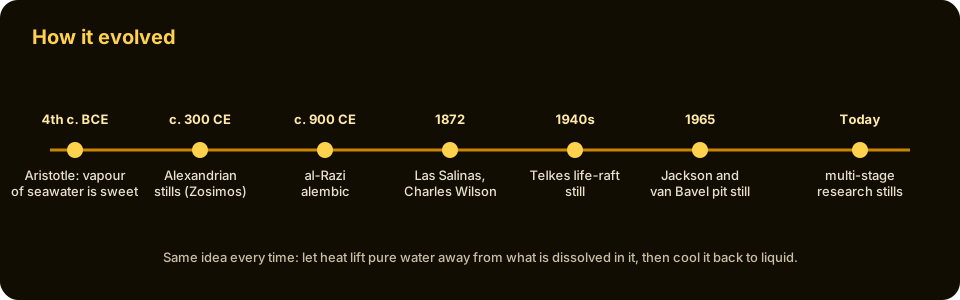
In the fourth century BCE the Greek philosopher Aristotle discussed in his Meteorologica why the sea is salty and observed that seawater, when it turns to vapour, becomes sweet, and that the vapour does not form salt water again when it condenses. This is one of the earliest recorded statements that evaporation separates fresh water from salt.
Distillation in the ancient and medieval world
Distillation as a craft developed in the Hellenistic world, especially in Roman Egypt. Alchemists in Alexandria in the first centuries CE used vessels with a still-head, later called an ambix, to heat liquids and collect the vapour after it condensed. Writings attributed to Zosimos of Panopolis, around 300 CE, describe and illustrate such apparatus.
Scholars of the Islamic world refined these methods. The Persian physician and chemist Abu Bakr Muhammad ibn Zakariya al-Razi (known in Latin as Rhazes, about 865 to 925 CE) described laboratory apparatus including the alembic and its use for distillation in his chemical writings, among them the Kitab al-Asrar (Book of Secrets). The word "alembic" itself comes into European languages through Arabic, al-anbiq, from the Greek ambix. Distillation was used for perfumes, medicines and later spirits, and sailors tried to make fresh water from seawater by boiling it in stills heated by fire. All these stills used fire for heat. The idea of letting the Sun do the heating came later.
Sun-powered distillation
Renaissance and early modern writers experimented with using concentrated sunlight from lenses and mirrors to heat distillation vessels. These remained curiosities. The idea of a large, practical still heated simply by sunlight falling on a shallow basin of water under glass belongs to the nineteenth century.
1872: Las Salinas and Charles Wilson
The first large solar still on record was built in 1872 at Las Salinas, in the Atacama Desert in what is now northern Chile, to supply drinking water at a nitrate mining operation. The engineer Charles Wilson designed it. The available water was brackish and salty, and the region is one of the driest places on Earth, so fresh water was precious for workers and for the animals that hauled ore.
The Las Salinas still was a field of long, shallow, blackened wooden basins covered by sloping glass roofs, covering roughly 4,700 square metres. Accounts give its output as on the order of 20,000 litres of fresh water a day in good weather, which works out to roughly 4 to 5 litres per square metre per day. That is at the very top of what simple basin stills achieve, and only possible in the intense, cloudless sunshine of the Atacama. It is reported to have operated for about forty years. Its design, a shallow black basin under a sloping glass cover with condensate troughs, is still the basis of most simple solar stills.
The twentieth century: research and life rafts
Interest in solar distillation grew in the twentieth century. During the Second World War the chemist and solar-energy pioneer Mária Telkes developed a small inflatable solar still for life rafts, so that airmen and sailors adrift at sea could make drinking water from seawater. It was supplied to the US armed forces. In the 1950s and 1960s, research groups in the United States, Australia, Greece, India and elsewhere built and tested many basin stills, measuring their output carefully and establishing the realistic yields that are still quoted.
1965: the ground pit still
In 1965 Ray D. Jackson and Cornelius H. M. van Bavel of the United States Department of Agriculture described a very simple "survival still" in the journal Science: a hole dug in the ground, covered by a sheet of clear plastic with a stone in the centre, and a cup placed under the low point. The Sun warms the soil and any plants put in the pit, moisture evaporates and condenses on the underside of the plastic, and drops run to the low point and fall into the cup. The pit still became a standard item in military and outdoor survival manuals. Later field tests showed that in many conditions it produces much less than hoped, often only a few hundred millilitres a day, and survival manuals now warn that digging one can cost more sweat than it returns.
Solar stills today
Today solar stills are used in small numbers for remote homes, islands, research stations and emergency kits, and as teaching tools. Large-scale desalination uses other methods, such as reverse osmosis and multi-stage distillation powered by fuel or electricity. Researchers continue to work on stills with better materials, multiple stages that reuse heat, and wicks and fabrics that evaporate water faster, but every solar still is still governed by the same energy limit.
How it works
Evaporation separates water from what is in it
When water evaporates, only water molecules leave as vapour. Dissolved salts, metals, sediment and most microbes stay behind in the liquid. When the vapour cools and condenses, it becomes almost pure water. This is distillation, and it removes things that boiling and filtering cannot: salt above all.
The greenhouse box
A solar still is a sealed box with a clear top. Sunlight passes through the glass or plastic cover and is absorbed by a black basin and the water in it. The warm basin gives off heat as infrared radiation, which glass largely blocks, and the warm air is trapped under the cover. The water inside can reach 50 to 70 degrees Celsius on a hot sunny day. Warm water evaporates far faster than cool water, and the air under the cover becomes very humid.
Condensation on the cover
The cover is cooled by the outside air and by radiating heat to the sky. When the humid air inside touches the cooler cover, water vapour condenses into drops on its underside. If the cover slopes, the drops run downhill along it, as long as they cling to the surface rather than falling back. At the bottom edge they drip into a collecting trough, which slopes towards an outlet and a clean container.
Why the output is small: the energy limit
Turning water into vapour takes a great deal of energy. At the temperatures inside a still, evaporating one litre of water takes about 2.4 megajoules of heat. On a clear summer day in a sunny region, the sunlight falling on one square metre of ground adds up to roughly 20 to 25 megajoules. Even if every bit of it went into evaporating water, which is impossible, one square metre could evaporate only about 8 to 10 litres a day.
Real simple stills lose much of the heat: some sunlight reflects off the cover, heat leaks out through the sides and base, some vapour condenses and drips back into the basin, and the cover itself is warmed. Well-made single-basin stills convert roughly 30 to 40 per cent of the sunlight into distilled water in good conditions, and often less. That is why the realistic figure is about 0.5 to 3 litres per square metre per day, with the higher figures in hot, clear, sunny weather and the lower ones in winter, cloud or when the still is poorly built. A person needs at least 2 to 3 litres of drinking water a day in mild conditions and much more in heat or with hard work, so a still for one person needs at least one to two square metres of well-built basin in strong sun.
What helps
- Black, shallow water. A thin layer, a few centimetres deep, warms quickly. Black paint, black plastic or a dark lining absorbs sunlight best.
- Insulation. Insulating the base and sides keeps heat in the water instead of the ground.
- An airtight seal. Every leak lets out warm, wet air and the water in it.
- A clean cover at a good slope. Dust and salt on the cover block sunlight. A slope of roughly 10 to 30 degrees lets drops run down to the trough instead of falling back. A steeper slope can catch more winter sun in high latitudes.
- Facing the Sun. In the northern hemisphere a single-slope still faces south; in the southern hemisphere, north.
Two kinds of still
The ground or pit still is the simplest: a hole in the ground covered with a plastic sheet. It needs almost no materials but makes very little water, depends on moisture already in the soil or in plants and wastewater placed in the pit, and is mainly a last-resort survival tool.
The box or basin still is a built container with a black basin of water, insulated sides, a sloping cover and a collection trough. It takes more work and materials but makes far more water, can be filled with seawater or brackish water, and can be used day after day. The build below is a box still.
Parts and what each one does
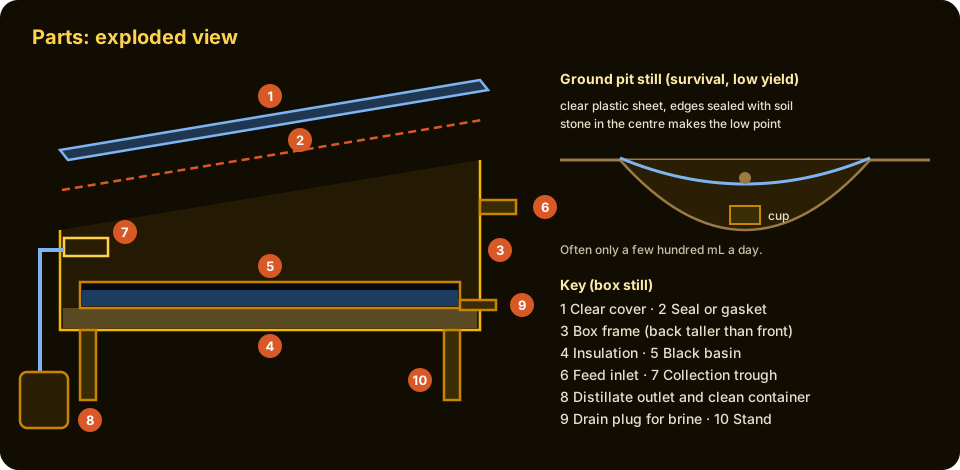
- Clear cover. Glass or clear, heat-tolerant plastic sheet, sloped. It lets sunlight in, traps heat and provides the cool surface where vapour condenses. Glass lasts longer and drops slide on it more evenly; many plastics fog with small drops that fall back.
- Seal or gasket. Silicone, rubber strip or putty around the edges of the cover. It keeps warm, wet air inside.
- Box frame. Wood, metal or masonry walls that hold everything. The back wall is taller than the front so the cover slopes.
- Insulation. A layer of dry insulation such as foam board, straw, wool, sawdust or dry sand under and around the basin, kept dry.
- Black basin. A shallow watertight tray, black on the inside, that holds the feed water and absorbs sunlight. Black-painted metal, black butyl or EPDM rubber sheet, or heavy black plastic all work, as long as they tolerate heat and do not release chemicals.
- Feed inlet. A pipe or capped opening for adding salty or dirty water without opening the cover.
- Collection trough. A clean channel along the low edge of the cover, sloping slightly to one end, that catches the drops running down the glass.
- Distillate outlet and container. A tube from the low end of the trough to a clean, covered container outside the box.
- Drain plug. An outlet at the bottom of the basin for flushing out the concentrated salty water left behind.
- Stand. A level, sturdy base that tilts the box to face the Sun and lifts it off cold, wet ground.
Build it: a one-square-metre box still
This build makes a single-slope box still with a basin of about 1 square metre. In strong sun it may produce around 1 to 3 litres a day; in cloud or cold, much less. Several stills side by side make more.
Materials
- Cover: a pane of glass about 1.1 by 1.1 metres and 3 to 4 millimetres thick, or a sheet of clear polycarbonate or UV-resistant clear plastic film on a frame. Glass is better if it can be handled safely.
- Frame: timber planks or plywood. The back wall about 45 centimetres tall and the front about 15 centimetres, giving a slope of roughly 15 to 20 degrees over a depth of 1 metre.
- Basin: a shallow tray about 1 metre square and 5 to 8 centimetres deep, from black-painted galvanised sheet, or a timber tray lined with a sheet of black EPDM or butyl pond liner rated for drinking water or food contact where possible. Avoid materials that soften or smell when hot.
- Insulation: 3 to 5 centimetres of foam board, or a thick layer of dry straw, wool or sawdust, beneath and around the basin.
- Trough: a length of clean plastic or stainless channel, such as half of a food-grade pipe, about 1 metre long.
- Food-grade tubing, a clean covered container, silicone sealant suitable for glass, screws, a drill, a saw, black heat-resistant non-toxic paint if using metal, and a level.
Step 1: choose the site
Pick a place that gets full sun from mid-morning to late afternoon, away from trees and buildings that cast shadows. Plan for the low front of the still to face the equator: south in the northern hemisphere, north in the southern hemisphere.
Step 2: build the box
Cut the side walls as wedges, tall at the back and low at the front, so the top edges give the slope you want. Screw the front, back and sides together on a solid base. Seal the joints. If you use timber, paint the outside to protect it from weather. The box must be square so the cover sits flat on its rim.
Step 3: insulate and fit the basin
Lay insulation on the floor of the box and up the inside of the walls. Set the black basin on top, level, so water lies evenly a few centimetres deep across it. Fit the drain plug through the lowest corner and out through the wall, and seal it. Fit the feed inlet through the back wall so water can be poured in above the basin.
Step 4: fit the collection trough
Fix the trough inside the front wall, just under where the lower edge of the glass will sit, so that drops running down the underside of the cover fall straight into it. Give it a slight slope, a centimetre or two along its length, towards one end. Fit the outlet tube at the low end, out through the wall, to a clean covered container. The trough must catch condensate but never basin water: keep its rim well above the basin water level.
Step 5: seal on the cover
Clean the glass thoroughly. Run a bead of silicone or a rubber gasket around the rim of the box and lay the cover on it. Hold it in place with wooden strips or clips. The seal is what makes a still work: if you can feel warm, wet air leaking out, you are losing water.
Step 6: fill and wait
Pour 2 to 4 centimetres of salty or dirty water into the basin through the feed inlet. Cap the inlet. On the first sunny day, the cover should mist over within an hour or so, then drops will begin to form and run down. Collection is usually highest in the afternoon. Some stills keep producing a little into the evening as the cover cools faster than the water.
Step 7: run it day after day
Top up the basin each morning, before it gets hot. Every few days, or when salt crust starts to form, drain the concentrated brine through the drain plug and refill with fresh feed water, so the basin does not become thick with salt. Clean the outside of the cover often; dust and salt spray block light.
First water: test and adjust
- Discard the first output. The first day or two of distilled water rinses the trough, tubing and container and may carry traces of sealant, paint or dust. Throw it away or use it for washing.
- Taste and check. Distilled water should taste flat, with no salt. A salty taste means basin water is splashing or wicking into the trough, or the trough is too low: raise it or add a lip.
- Measure the yield. Record how much you collect each day and note the weather. This tells you how many stills you need. Expect much less in winter and in cloud.
- Look for leaks. Steam escaping round the edges, or a dry-looking cover on a hot day, points to a gap in the seal.
- Drops falling back. If drops fall from the middle of the cover back into the basin instead of running down, the slope is too shallow or the cover surface is too water-repellent. Steepen it, or clean the glass so drops spread and slide.
- Building a pit still for an emergency. Dig a hole about 1 metre across and 50 to 60 centimetres deep in damp ground in full sun, put a clean container at the centre bottom, add green non-poisonous plant material around it if available, cover the hole with clear plastic sealed by soil around the edges, and place a small stone in the centre so the plastic dips over the container. A drinking tube from the container to the outside saves opening the still. Expect little water; do the digging in the cool of the morning or evening.
Safety
- Use clean, safe containers and materials. Never build a still from, or collect water in, containers that have held fuel, pesticides, solvents or other chemicals. Hot water and sunlight can draw chemicals out of unsuitable plastics, paints and sealants; use materials meant for food or drinking water where possible.
- Distillation does not remove everything. Chemicals that evaporate easily, such as petrol and other fuels, solvents, alcohols including methanol, and some pesticides, can evaporate with the water and end up in the distilled water. Never try to make drinking water from water contaminated with fuel or chemicals, from antifreeze or radiator coolant, or from industrial waste.
- Keep the clean side clean. Distillation separates salt and most microbes, but the trough, tube and collection container can be contaminated by dirty hands, dust, splashes or insects. Keep them covered and clean, and if in doubt, disinfect the collected water.
- Distilled water lacks minerals. It is safe to drink as part of a normal diet with food, but relying on it as the only source of water and minerals for long periods is not ideal; people living on distilled water usually get minerals from food, and some add minerals back. Follow local health advice.
- Glass and heat. Handle glass with gloves and protect edges. The inside of a still gets hot enough to scald; open it with care.
- Pit stills. Mark and cover pits so people and animals cannot fall in, and remember that digging in the heat can cost more water through sweat than the pit will give back. Do not rely on a pit still to keep a person alive.
- Never drink seawater or urine directly. Both contain salt and waste the body must spend water to remove. Only the distilled output is drinkable.
Where solar stills are used now
Solar stills are used for small remote supplies on islands, in deserts and at research stations, in some emergency and life-raft kits, and as teaching tools in schools and universities. The same principle runs through the whole water cycle and through industrial distillation and desalination, which use fuel or electricity instead of direct sunlight. Engineers continue to test multi-stage stills that recycle the heat released by condensation, which can raise output well above a single basin, but every design is still limited by the energy it takes to evaporate water.
Words to know
- Distillation: separating a liquid from what is dissolved in it by evaporating it and condensing the vapour.
- Condensation: water vapour turning back into liquid on a cooler surface.
- Distillate: the clean water collected from a still.
- Brine: the concentrated salty water left behind in the basin.
- Latent heat of vaporisation: the energy needed to turn liquid into vapour, about 2.4 megajoules per kilogram of water at the temperatures in a still.
- Solar irradiation: the total solar energy falling on a surface over a day, measured in megajoules or kilowatt-hours per square metre.
- Brackish water: water saltier than fresh water but less salty than the sea.
Related in the Knowledge Ark
The Knowledge Ark keeps 6,000 packages for rebuilding, from water and energy to shelter and medicine. Browse them, search by category and open any package at the Knowledge Ark. Its sister, the Culture Ark, keeps 2,000 things people should still be able to see in 2,000 years.
Where to learn more
- Histories of distillation and of early chemistry in Alexandria and the Islamic world, including the work of al-Razi.
- Technical reviews of solar distillation, which describe the Las Salinas still and decades of measured basin-still yields.
- Jackson and van Bavel, "Solar distillation of water from soil and plant materials: a simple desert survival technique", Science, 1965.
- Military and civilian survival manuals for the pit still and its limits.
- World Health Organization guidance on drinking-water quality and on safe household water storage.
Knowledge Ark build sheet. An Artificial Mind Hive (AMH) project. AMH is owned by Austin Little.