




Pendulum Clock
Knowledge Ark build sheet · history · how it works · parts · step-by-step build · safety
Knowledge Ark build sheet · Knowledge Ark · Culture Ark · An Artificial Mind Hive project by Austin Little
A clock is a machine that counts something steady. The something has changed over the centuries: a moving shadow, dripping water, a swinging weight, a coiled spring flexing back and forth, a vibrating crystal, and finally the inner beat of an atom. But every clock ever made has the same three parts: a source of energy, something that swings or vibrates at a regular rate, and a way of counting those swings and showing the count as a time of day. This sheet explains where clocks and watches came from, how each kind works, why a pendulum is such a good timekeeper, and how to build a working weight-driven pendulum clock with a single hand-cut escape wheel and an escapement made from plywood or sheet metal. Everything here is meant to be rebuilt from scratch if it ever had to be.
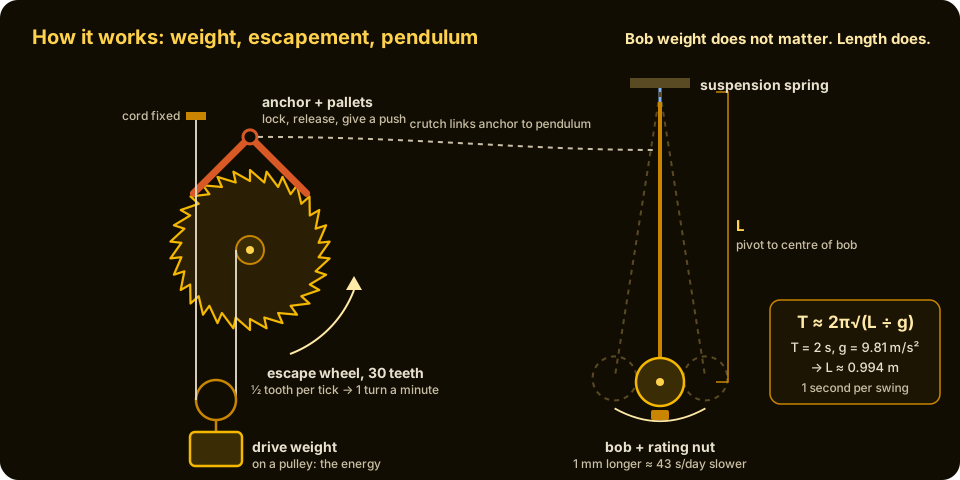
The heart of a mechanical clock. The weight wants to spin the escape wheel freely; the anchor, rocked by the pendulum, lets it move only half a tooth per swing and gives the pendulum a tiny push each time. The pendulum's length alone sets how fast that happens.
Why keep this in the Knowledge Ark
Keeping time is not a luxury. Farmers use it to plan the year, sailors to find their longitude, doctors to count a pulse and time a dose, engineers to coordinate work, and every network on Earth, from railways to power grids to satellite navigation, depends on clocks that agree. A pendulum clock also teaches a great deal in one object: how stored energy can be released slowly, how a gear train divides motion, how a simple physical law fixes a period, and how a small, regular push can keep an oscillator going almost indefinitely. If modern electronics were lost, a pendulum clock is one of the most accurate timekeepers a small workshop could build again, good to within a minute a week with care and better with a lot of care.
History: how it came about
Shadows and water
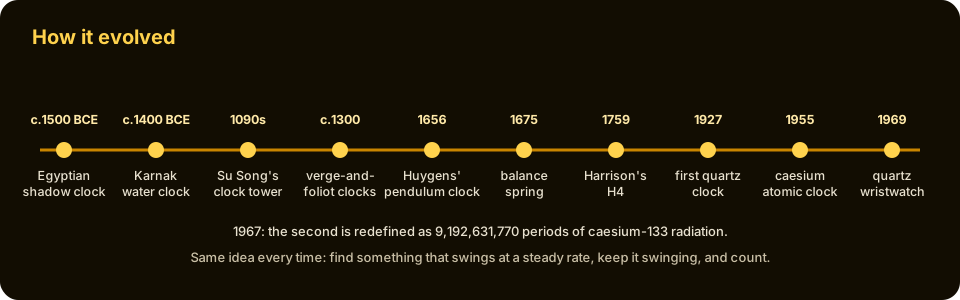
The oldest timekeepers followed the Sun. Egyptian shadow clocks, L-shaped bars that cast a shadow across marked steps, survive from around 1500 BCE, and simple upright sticks, or gnomons, were used across the ancient world. They had an obvious weakness: they did nothing at night or under cloud.
Water clocks filled that gap. The oldest surviving example is an alabaster vessel from the temple at Karnak in Egypt, made in the reign of Amenhotep III around 1400 BCE. It was a bowl with a small hole near the bottom and marks inside; as water drained out, the falling level showed the passing hours. The Greeks called such devices clepsydrae, "water thieves", and Athenian courts used them to limit the length of speeches. In the third century BCE Ctesibius of Alexandria improved the water clock by keeping the supply tank at a constant level, so the flow stayed steady, and by driving a float that moved a pointer. Water clocks were built across the Islamic world, India and China for many centuries. The most famous was the great astronomical clock tower designed by Su Song at Kaifeng in China and completed in the 1090s, a water-driven machine about ten metres tall that turned an armillary sphere and a celestial globe and struck the hours. It used a water wheel that advanced one bucket at a time, a kind of escapement worked by water instead of a pendulum.
The first mechanical clocks, around 1300
Somewhere in Europe at the end of the thirteenth century, someone invented a purely mechanical way of letting a falling weight run down slowly and evenly. This was the verge and foliot escapement. A crown-shaped wheel, driven by a weight on a cord, pushed alternately against two small flags (pallets) on an upright rod, the verge. At the top of the verge sat a horizontal bar with small weights on it, the foliot. The wheel pushed the foliot one way until one pallet slipped off a tooth, then the other pallet caught the next tooth and pushed it back. The foliot swung to and fro, and each swing let the wheel advance a little.
These clocks first appear in the written record in the late 1200s and early 1300s, mostly in cathedrals, monasteries and town towers. Many did not even have dials; they struck a bell to call the hours. Richard of Wallingford, abbot of St Albans in England, designed an elaborate astronomical clock around the 1330s, and Giovanni de Dondi of Padua completed his planetary clock, the Astrarium, in 1364. The clock at Salisbury Cathedral, usually dated to about 1386, is often described as the oldest working mechanical clock in the world. Early verge-and-foliot clocks probably drifted by a quarter of an hour or more a day, because the foliot has no natural rate of its own; its speed depends on how hard the weight pushes and how much friction there is.
Springs and portable clocks, 1400s–1500s
In the fifteenth century clockmakers began using a coiled steel spring, the mainspring, in place of a hanging weight. A spring can drive a clock lying on a table or carried in a pocket. Because a spring pushes hard when fully wound and weakly when nearly run down, makers added compensating devices such as the fusee, a cone-shaped pulley wound with a chain that evened out the pull. Nuremberg in Germany became a centre for small spring-driven clocks in the early 1500s, and the locksmith Peter Henlein is often credited with some of the first portable timepieces there. These early "watches" were worn on a chain or carried, kept time poorly, and usually had only an hour hand.
Galileo notices the pendulum
The Italian scientist Galileo Galilei studied pendulums from the early 1600s. He reported that a pendulum's swing takes almost the same time whether it swings widely or narrowly, a property called isochronism, and that the period depends on the length of the pendulum, not on the weight of the bob. He was right that it is nearly true for small swings, though not exactly for large ones. Late in his life, in 1641, by then blind, Galileo described a design for a clock controlled by a pendulum to his son Vincenzo. It was not completed in his lifetime.
1656: Huygens builds the pendulum clock
The Dutch scientist Christiaan Huygens made the first working pendulum clock in 1656, and the clockmaker Salomon Coster of The Hague built clocks to his design under a patent granted in 1657. Huygens described the clock in a short book, Horologium, in 1658. The improvement was enormous. A pendulum has a natural period of its own, set by its length, so the clock no longer depended mainly on how hard it was pushed. Good pendulum clocks soon kept time to within about a minute a day, and later to within seconds. In 1673 Huygens published Horologium Oscillatorium, a major work of mathematics and physics in which he analysed the pendulum, showed that a bob following a curve called a cycloid would be exactly isochronous at any swing, and derived the relationship between a pendulum's length and its period.
The anchor and the long-case clock
Huygens' clocks still used a verge, which forces the pendulum to swing through a wide arc. Around 1670 English clockmakers introduced the anchor escapement, named for its shape. Its invention is variously credited to Robert Hooke or the London clockmaker William Clement. The anchor lets the pendulum swing through only a few degrees, which makes it more regular and allowed a long pendulum beating once per second, about a metre long. That pendulum needed a tall case to protect it, and so the long-case clock, later nicknamed the grandfather clock, was born. Around 1715 George Graham, who had worked with the great London maker Thomas Tompion, perfected the deadbeat escapement, a refinement of the anchor that does not push the escape wheel backwards at each beat. The deadbeat became the standard for precision clocks in observatories for about two hundred years.
Temperature was the next enemy. A metal pendulum rod grows longer in warm weather, so the clock slows. Graham built a pendulum with a jar of mercury as the bob in 1721; as the rod lengthened downward, the mercury rose in its jar and kept the centre of swing in the same place. John Harrison developed the gridiron pendulum in the 1720s, using parallel rods of brass and steel arranged so that their different expansions cancelled.
1675: the balance spring and the true watch
Portable clocks cannot use a pendulum, because every movement of the carrier would disturb it. The answer was to give the small balance wheel in a watch its own natural rate by attaching a fine coiled spring to it. The spring pulls the balance back towards the centre whenever it swings away, so the balance oscillates back and forth at a steady rate, just as a pendulum does under gravity. Huygens published the balance spring in 1675; Robert Hooke claimed he had the idea first, and the dispute was bitter. Either way, the balance spring transformed watches from rough hour-tellers into instruments good to a few minutes a day, and the minute hand became common on watches soon after. In the 1750s the English watchmaker Thomas Mudge invented the detached lever escapement, which touches the balance only briefly at each swing. Refined over the following century, the lever escapement is still in nearly every mechanical watch made today.
Harrison and the longitude problem
At sea, knowing the time is a matter of life and death. A navigator can find local time from the Sun, and if he also knows the time at his home port, the difference gives his longitude: every hour of difference is 15 degrees east or west. But no clock of the early 1700s could keep accurate time on a rolling, damp, cold-and-hot ship for weeks. After a string of shipwrecks, the British Parliament passed the Longitude Act in 1714, offering up to £20,000 for a practical method of finding longitude at sea to within half a degree.
John Harrison, a self-taught carpenter and clockmaker from Lincolnshire, spent most of his life on the problem. His first marine timekeeper, H1, was completed in 1735 and tested on a voyage to Lisbon. H2 and H3 followed. Then he changed course completely and made H4, finished in 1759, a large watch about 13 centimetres across. On a trial voyage from England to Jamaica in 1761–62 it lost only a few seconds, far within the limits of the Act, and a second trial to Barbados in 1764 confirmed it. Harrison was paid in stages and only received the bulk of his reward in 1773, after an appeal to King George III and Parliament. A copy of H4 made by Larcum Kendall, called K1, went with Captain James Cook on his second voyage of 1772–75, and Cook praised its performance. Marine chronometers became standard navigating instruments, and ships carried them until radio time signals and satellite navigation took over in the twentieth century. Harrison's H1 to H4 are preserved at the Royal Observatory, Greenwich.
Railways and standard time
Until the nineteenth century, every town kept its own local time based on the Sun. Railways made that impossible to live with, because timetables needed a single time along a line. British railways adopted London time, "railway time", during the 1840s. In North America the railways introduced standard time zones on 18 November 1883, and the International Meridian Conference in Washington in 1884 chose Greenwich as the prime meridian from which the world's longitudes and time zones are counted. Wristwatches spread widely in the early twentieth century, especially during and after the First World War, when soldiers needed to read the time without reaching into a pocket.
1927–1969: quartz
A crystal of quartz bends very slightly when a voltage is put across it, and produces a voltage when it is bent. Cut and shaped correctly, it vibrates at a very steady frequency. Warren Marrison and J. W. Horton at Bell Telephone Laboratories built the first quartz clock in 1927. Quartz clocks quickly became the most accurate timekeepers in observatories, beating the finest pendulum regulators. On 25 December 1969 the Japanese company Seiko released the Astron, the first quartz wristwatch sold to the public. Within about fifteen years quartz watches had become cheap, accurate to a few seconds a week, and dominant worldwide.
1949–1967: atomic clocks and the new second
Atoms of a given element absorb and emit radiation at exactly fixed frequencies, the same everywhere in the universe. The US National Bureau of Standards demonstrated a clock referenced to the ammonia molecule in 1949. In 1955 Louis Essen and Jack Parry at the National Physical Laboratory in England built the first accurate caesium atomic clock. In 1967 the world's measurement authorities redefined the second itself: it is now the duration of 9,192,631,770 periods of the radiation from a particular transition of the caesium-133 atom. Since 1972 civil time has been kept as Coordinated Universal Time (UTC), based on atomic clocks with occasional leap seconds added to keep it close to the Earth's rotation. Satellite navigation systems such as GPS work by comparing signals from atomic clocks carried on the satellites. The best modern optical clocks would neither gain nor lose a second over a span longer than the age of the universe.
How it works
Three jobs: power, regulate, count
Every mechanical clock has three systems. The power comes from a falling weight or a wound spring. The regulator, a pendulum in a clock or a balance wheel and spring in a watch, swings at a steady natural rate. Between them sits the escapement, which releases the power in small, equal steps, one step per swing, and passes back a tiny push to keep the regulator swinging. A gear train then counts those steps and turns the hands at the right speeds.
The pendulum and its period
A pendulum is a weight, the bob, hanging from a pivot. Pull it aside and let go, and gravity pulls it back through the bottom and out the other side. For small swings, the time for one complete back-and-forth swing, called the period, is given by:
T ≈ 2π √(L ÷ g)
Here T is the period in seconds, L is the length of the pendulum in metres, measured from the pivot to the centre of oscillation (for a simple rod with a heavy bob, close to the centre of the bob), and g is the acceleration of gravity, about 9.81 metres per second per second. Notice what is missing: the weight of the bob. A heavy bob and a light bob of the same length keep the same time. Only length and gravity matter.
Clockmakers like a pendulum that swings from one side to the other in exactly one second, so that each tick is one second. That means a full period of two seconds. Rearranging the formula, L = g × (T ÷ 2π)². With T = 2 and g = 9.81, L comes out at about 0.994 metres. This is the famous seconds pendulum, just under a metre long, which is why long-case clocks are so tall. A half-second pendulum, beating twice a second, needs only a quarter of that length, about 0.248 metres, because length goes with the square of the period.
Why small changes matter
The square root means a pendulum is forgiving but not careless. If the length changes by a small fraction, the period changes by half that fraction. Lengthening a seconds pendulum by just 1 millimetre slows the clock by about 0.05 percent, which is about 43 seconds a day. That is why every pendulum has a rating nut under the bob: turning it moves the bob up or down a fraction of a millimetre to set the rate. It is also why temperature matters. A steel rod expands by about 12 millionths of its length for each degree Celsius, so a 10 degree change in room temperature changes a steel-rod clock's rate by roughly 5 seconds a day. Wood, cut with the grain and sealed against damp, expands much less than steel along its length, which is why many fine regulators used straight-grained wooden rods.
The formula is only exact for small swings. Large swings take slightly longer, an effect called circular error. If the arc stays constant the clock can still be set right, but if the arc changes, because the weight is wound up, the oil thickens or the case is knocked, the rate changes too. So good clocks swing a small arc, only a few degrees either side, and keep that arc as steady as possible.
The escapement
Left alone, a falling weight would spin the clock's wheels in a few seconds. The escapement stops that. The last wheel of the train, the escape wheel, has specially shaped teeth. Above it, an anchor pivots back and forth with the pendulum, connected by a fork called the crutch. Each end of the anchor carries a pallet. As the pendulum swings one way, one pallet lifts out of the teeth and releases the wheel; the wheel jumps forward until a tooth lands on the other pallet, which has moved into its path. That landing is the "tick". On the return swing the other pallet releases and the first pallet catches: the "tock". Each tick and tock, the wheel advances half a tooth.
As each tooth slides off a pallet, it pushes on the pallet's sloped face, called the impulse face. That push travels through the crutch to the pendulum and replaces the small amount of energy the pendulum lost to air friction and flexing on the last swing. So the weight keeps the pendulum alive, and the pendulum keeps the weight in check.
In the simple anchor or recoil escapement, the locking faces of the pallets are not curved around the anchor's pivot, so as the pendulum swings on after the lock, the pallet pushes the escape wheel slightly backwards. You can see the seconds hand of such a clock jerk back a little at each beat. In Graham's deadbeat escapement, the locking faces are arcs of circles centred on the anchor's pivot. While a tooth rests on such a face, the pallet slides past it without pushing the wheel either way, so the seconds hand stops dead between beats. The deadbeat disturbs the pendulum less and keeps better time, but its pallets must be shaped and polished more accurately. Both can be cut from hardwood, plywood or sheet brass.
The gear train
In a standard long-case clock with a seconds pendulum, the escape wheel has 30 teeth. It advances one tooth per two-second period, so it turns once a minute and can carry the seconds hand directly. A chain of gears then slows the motion. In one common arrangement, the centre wheel, which turns once an hour and carries the minute hand, has 64 teeth and drives a pinion of 8 leaves on the third wheel; the third wheel has 60 teeth and drives a pinion of 8 leaves on the escape wheel. The ratios multiply: 64 ÷ 8 = 8, and 60 ÷ 8 = 7.5, and 8 × 7.5 = 60, so the escape wheel turns 60 times for each turn of the minute hand. A small set of gears behind the dial, the motion work, gives a 12-to-1 reduction for the hour hand, for example 12 to 36 and then 6 to 24. The weight hangs from a cord wound on a barrel attached to the slowest wheel, the great wheel, so it descends only slowly and can run a clock for eight days on a drop of a metre or so.
How a watch keeps time
A watch replaces the pendulum with a balance wheel, a small ring on a pivot, and a fine coiled hairspring. The hairspring always pulls the balance back towards its centre position, so it oscillates at a rate set by the stiffness of the spring and the mass and size of the wheel, and gravity plays no part. Most modern mechanical watches beat between 5 and 10 times a second. The power comes from a mainspring coiled in a drum called the barrel. The lever escapement lets the escape wheel advance one tooth each time the balance swings through the centre, and gives the balance a tiny push as it does so; the rest of the time the balance swings free. Jewels, originally ruby and now synthetic sapphire or ruby, serve as hard, smooth bearings for the fastest-moving pivots. Self-winding watches add a weighted rotor that winds the mainspring as the wrist moves.
A quartz watch keeps time with a tiny tuning fork of quartz crystal that vibrates 32,768 times a second. That number is 2 to the power of 15, so an electronic counter can divide it in half fifteen times to get exactly one pulse per second. Each pulse drives a tiny stepping motor that moves the hands, or updates a digital display. A battery supplies the power. Because the crystal vibrates so steadily, an ordinary quartz watch gains or loses only a few seconds a week; the crystal is cut at a chosen angle to the crystal structure so that temperature changes affect it as little as possible.
An atomic clock takes the idea to its limit. It tunes a microwave or laser signal until atoms of caesium, rubidium or another element respond most strongly, which only happens at their exact natural frequency, then counts the cycles of that signal. Radio-controlled clocks and phones set themselves from atomic time sent by radio stations, the internet or satellites.
Parts and what each one does
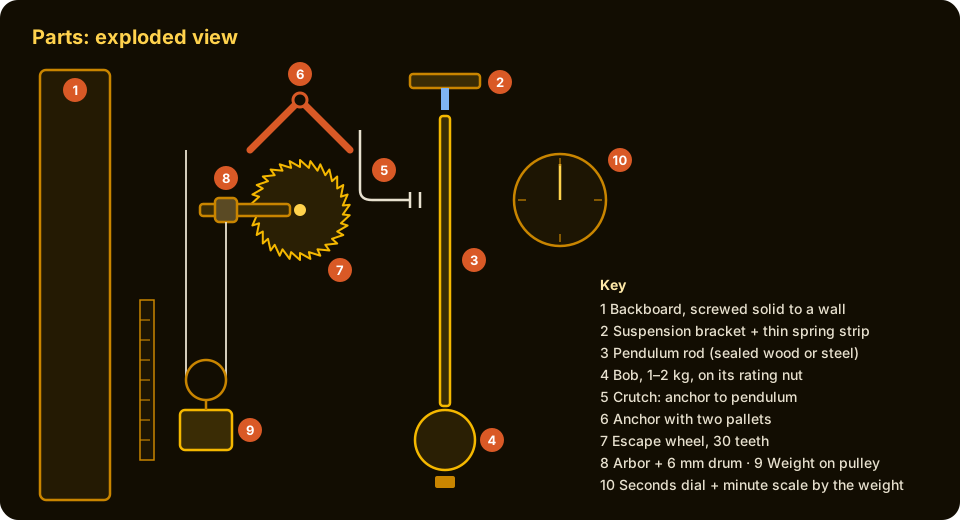
- Backboard. A stiff, flat board screwed firmly to a wall. Everything mounts to it. If it flexes, the pendulum loses energy into the wall and the clock stops.
- Suspension bracket and spring. A short, thin, flexible strip of spring steel clamped at the top, from which the pendulum hangs. It bends a tiny amount at each swing instead of rubbing like a hinge, so there is almost no friction.
- Pendulum rod. Straight-grained, sealed hardwood or a metal rod. Its length, together with the bob, sets the rate.
- Bob and rating nut. A heavy weight near the bottom. The nut beneath it moves the bob up or down to adjust the timekeeping.
- Crutch. A wire or slim arm fixed to the anchor that reaches down and loosely grips the pendulum rod, carrying the impulse from anchor to pendulum.
- Anchor and pallets. The rocking part of the escapement, pivoted above the escape wheel. Its two pallets lock and release the teeth.
- Escape wheel. The toothed wheel the weight tries to turn. In this build, 30 teeth, cut from sheet metal or plywood, turning once a minute.
- Arbor and drum. The axle of the escape wheel, with a small drum or spindle where the weight cord winds. A seconds hand fixed to the front end of the arbor turns once a minute over a dial.
- Drive weight and pulley. A weight hung on a pulley so that it falls half as fast as the cord unwinds. Its slow descent past a scale marks the minutes.
- Dial and time scale. A seconds dial around the arbor, and a vertical scale beside the falling weight, marked in minutes.
Build it: a one-wheel weight-driven pendulum clock
This build makes a real escapement-controlled pendulum clock without cutting a full gear train. There is only one toothed wheel, the escape wheel, and it carries the seconds hand. Instead of an hour train, the clock shows elapsed minutes by the steady fall of its weight against a scale, the same trick water clocks used thousands of years ago. It runs for a few hours per winding, keeps a seconds beat you can check against any other clock, and teaches every important part of horology. The last step explains how to add a gear train to turn it into an eight-day clock with ordinary hands.
Materials
- Backboard: 18 mm plywood or a straight hardwood board about 1,300 mm tall and 250 mm wide.
- Escape wheel: a piece of 1–1.5 mm sheet brass or aluminium, or 6 mm birch plywood, about 120 mm square.
- Anchor: the same material, about 140 × 60 mm. Brass gives the longest-lasting pallets; hardwood pallets work if faced with a thin strip of brass or a smooth hard plastic.
- Arbors: two lengths of 4–6 mm steel or brass rod about 100 mm long, and brass tube or ball bearings to fit them. Small skate or model bearings make the clock much easier to get running.
- Pendulum rod: a straight, knot-free strip of hardwood, about 15 × 6 mm and 1,000 mm long, sealed with varnish, or a 5–6 mm steel rod threaded at the bottom end.
- Bob: about 1–2 kg. A round tin filled with sand or lead shot and sealed, or a disc of steel or concrete.
- Suspension spring: a 30 mm length of thin spring steel, such as a piece of a fine hacksaw blade with its teeth ground off, or feeler-gauge stock 0.1–0.2 mm thick.
- Crutch: stiff wire about 2 mm thick.
- Drive weight: a container you can add sand to, so the weight can be adjusted, typically 0.5–2 kg; a small pulley, and strong braided cord or fishing line.
- A threaded rod end and nut for rating; card for dials; wood glue, screws, epoxy.
Tools
Fine saw or jeweller's saw, files, drill and bits, compass (for drawing circles), protractor, ruler, square, sandpaper, a small vice, and a phone or watch with a seconds display for testing.
Step 1: lay out and cut the escape wheel
Draw a circle 100 mm across on the sheet. Mark 30 equally spaced points around it, 12 degrees apart. Each tooth is a sharp point at the rim with a straight front face pointing roughly toward the centre and a sloping back running down to the root of the next tooth, like a saw tooth, so that the wheel looks like a circular saw blade. Make the teeth about 6–8 mm deep. Drill the centre hole to fit the arbor exactly. Cut the wheel slowly, file every tooth tip to the circle, and check by eye that all the tips touch the circle evenly. A wheel that wobbles or has uneven teeth will make an uneven beat.
Step 2: make the anchor
This build uses a classic layout in which the anchor spans seven and a half teeth, which is 90 degrees of the wheel. Draw the escape wheel circle full size on paper. Draw two lines from the wheel centre, 45 degrees either side of vertical, and where they meet the rim draw tangent lines. The two tangents meet above the wheel at a point about 1.41 times the wheel's radius from its centre, which for a 100 mm wheel is about 71 mm. That point is the anchor's pivot. The pallets sit where the tangents touch the rim. Draw the anchor as an arch from pivot to pallets, cut it out, and shape the two pallet faces so each slopes by roughly 2 to 3 degrees of anchor movement: this slope is the impulse face.
For a deadbeat, shape the locking faces of the pallets as arcs of circles drawn from the pivot point, one slightly inside the other, so a tooth resting on them does not push the wheel back. For a simpler recoil anchor, leave the faces straight. Either works; start with recoil if this is your first clock, because it is more forgiving.
Step 3: mount the arbors
Fix the escape wheel tightly on its arbor and the anchor tightly on its arbor, using epoxy or a soldered brass collar. Mount bearings in a small wooden frame or bracket so that the arbors are exactly parallel and at the right distance apart, about 71 mm for this wheel. Allow a little sideways play, about half a millimetre, so nothing binds. Turn the escape wheel slowly by hand while rocking the anchor and check that each tooth drops onto a pallet, rather than passing straight through or jamming. If it jams, the pallets are too deep; file them. If teeth slip through, they are too shallow; move the anchor pivot slightly closer.
Step 4: make the drum and the drive
Wrap and glue a short collar of wood or tube on the escape wheel's arbor behind the frame to form a drum about 6 mm across. The cord winds on this. With a 30-tooth wheel turning once a minute, a 6 mm drum unwinds about 19 mm of cord per minute. Hang the drive weight from a small pulley on the cord, with the far end of the cord fixed high on the backboard; the weight then falls about 9.5 mm a minute, about 570 mm an hour. A drop of 1.2 metres gives a little over two hours of running. Wind the cord in a single neat layer so the drum's effective diameter, and therefore the weight's speed, stays constant.
Step 5: make the pendulum
Fix the suspension spring into a slot at the top of the pendulum rod with epoxy and a small pin, and clamp its other end in a bracket at the top of the backboard so the rod hangs freely. Measure from the bending point of the spring and set the centre of the bob about 994 mm below it to start. Fit the bob so it slides on the rod, resting on the rating nut at the bottom. Keep the rod and bob from twisting, because a pendulum that rotates or wobbles sideways wastes energy.
Step 6: fit the crutch
Bend the crutch wire and fix it to the anchor arbor so that it reaches down to the pendulum rod a little below the suspension. Form a loose fork at the end, or a pin that sits in a slot in the rod, with only the slightest play. When the pendulum hangs still, the anchor should sit at the centre of its travel.
Step 7: set it in beat
Wall-mount the backboard and check that it is truly vertical. Hang the weight, push the pendulum gently, and listen. The ticks and tocks must be evenly spaced, like a heartbeat with no limp. If it goes "tick-tock ... tick-tock", the clock is out of beat. Gently bend the crutch a little toward the side with the longer gap, or adjust the angle of the backboard, until the beat is even. An out-of-beat clock wastes power and soon stops.
Step 8: find the right weight
Start with a light drive weight and add sand until the pendulum keeps swinging steadily at about 2 to 4 degrees either side. Then add about 20 percent more for reliability. Too much weight wears the pallets and increases the swing, which can change the rate through circular error. Note the final weight on the backboard.
Step 9: add the dials
Mount a card dial behind the seconds hand marked from 0 to 60. Fix a vertical scale beside the weight's path. To calibrate it, start the clock, note the weight's position against the scale every 5 minutes by a reliable watch, and mark the scale. Because the drum turns exactly once per 30 teeth, these marks will be evenly spaced if the cord winds in a single layer.
Step 10: rate the clock
Compare the seconds hand against an accurate clock over an hour. If it gains, the pendulum is too short: lower the bob by turning the rating nut. If it loses, raise the bob. As a guide, raising or lowering a seconds pendulum by 1 mm changes the rate by about 43 seconds a day, or close to 2 seconds per hour. With a nut of 1 mm thread pitch, one full turn is 1 mm. Make small changes and wait each time for the clock to settle.
Making it run longer: adding a gear train
To turn this into a full clock, the weight must hang from a slower wheel. Add a centre arbor that turns once an hour carrying a 64-tooth wheel, a third arbor with an 8-leaf pinion and a 60-tooth wheel, and an 8-leaf pinion on the escape arbor, as described above. Move the drum to the centre arbor, give it a larger diameter, and the same 1.2 metre drop will last a day or more; making the great wheel slower still, with one more reduction, gives an eight-day run. Add motion work for the hour hand. Gears can be cut from plywood with a scroll saw from carefully printed or drawn patterns, or salvaged from old clocks.
Test and adjust
- It stops after a few swings. Check the beat first. Then check for any binding: every arbor should spin freely with a gentle breath. Check that the backboard is solid against the wall.
- The wheel races through. The pallets are not catching. Move the anchor pivot slightly closer to the wheel, or deepen the pallets.
- It locks up. The pallets are too deep or a tooth is bent. File gently and recheck each tooth.
- The rate wanders. Look for a wobbling suspension, a loose bob, draughts, or a drive weight that is too heavy or too light. Keep the clock away from heaters and sunny windows.
- Keep a log. Write down the error each day for a week. A good home-made pendulum clock can keep within a minute a week once rated, and in a steady room, much better.
Safety
- Falling weights. A drive weight or bob of several kilograms can crush fingers and toes or break a floor tile. Anchor the backboard into wall studs or masonry, never just plasterboard, and use cord rated well above the load.
- Cords and children. Hanging cords and chains are a strangulation hazard for small children. Keep the clock high or enclosed in a case.
- Sharp edges. Cut sheet metal and filed teeth are sharp. Deburr every edge, wear gloves while cutting, and wear eye protection when drilling or grinding the suspension spring.
- Old clocks and watches. Mainsprings in old clocks store a lot of energy and can cause injury if released; let a spring down only with a proper let-down key, or leave it to a clock repairer. Do not use mercury in a pendulum; it is toxic. Many dials and hands made before about the 1960s were painted with luminous paint containing radium: do not scrape, sand or open them.
- Batteries. Small button cells from quartz watches are dangerous if swallowed, especially by children. Store and dispose of them safely.
Where clocks are used now
Pendulum clocks still hang in homes, churches and town halls, and a few observatory-grade regulators are kept running by enthusiasts. Mechanical watches have become craft objects as much as tools. Almost everything else now depends on quartz and atomic time: phones, computers, power grids that keep their alternating current in step, stock exchanges that time-stamp trades, mobile networks, and satellite navigation, which finds a position by comparing signals from atomic clocks in orbit. Behind every one of them is the same idea Huygens put into a wooden case in 1656: find something that swings at a steady rate, keep it swinging, and count.
Words to know
- Escapement: the mechanism that releases a clock's power in steps and keeps the regulator swinging.
- Escape wheel: the toothed wheel locked and released by the pallets.
- Anchor / pallets: the rocking part of the escapement and its two contact faces.
- Crutch: the arm that connects the anchor to the pendulum.
- Period: the time for one complete back-and-forth swing.
- Seconds pendulum: a pendulum about 0.994 m long whose each swing takes one second.
- Beat: the evenness of tick and tock; a clock "in beat" ticks evenly.
- Rating: adjusting a clock so it neither gains nor loses.
- Balance spring (hairspring): the fine spring that gives a watch's balance wheel its steady rate.
- Chronometer: a precision timekeeper, especially one built for navigation at sea.
Related in the Knowledge Ark
The Knowledge Ark keeps 6,000 packages for rebuilding, from measuring and timekeeping to records and navigation. Browse them, search by category and open any package at the Knowledge Ark. Its sister, the Culture Ark, keeps 2,000 things people should still be able to see in 2,000 years.
Where to learn more
- Royal Observatory and National Maritime Museum, Greenwich: John Harrison's H1 to H4 and the history of longitude.
- The British Museum and the Science Museum, London: early mechanical clocks and watches.
- Museum Boerhaave, Leiden: Christiaan Huygens and early pendulum clocks.
- National Institute of Standards and Technology (NIST) and the National Physical Laboratory (NPL): how atomic clocks and UTC work.
- Any introductory physics textbook covering simple harmonic motion and the pendulum.
Knowledge Ark build sheet. An Artificial Mind Hive (AMH) project. AMH is owned by Austin Little.