




Magnetic Compass
Knowledge Ark build sheet · history · how it works · parts · step-by-step build · safety
Knowledge Ark build sheet · Knowledge Ark · Culture Ark · An Artificial Mind Hive project by Austin Little
A compass is a sliver of magnetised steel that is free to turn. That is all. Yet that sliver lets a person find direction under cloud, at night, in fog, in a forest or in the middle of an ocean, with no Sun, no stars and no landmarks. It carried ships across open water, laid out roads and property lines, guided miners underground and led explorers to the poles. This sheet explains where the compass came from, how a needle becomes a magnet, why it points roughly north, why it never points exactly north, what each part of a compass does, and how to make two working compasses: a floating needle on a cork, and a pivoted dry compass with a direction card. Everything here is meant to be rebuilt from scratch if it ever had to be.
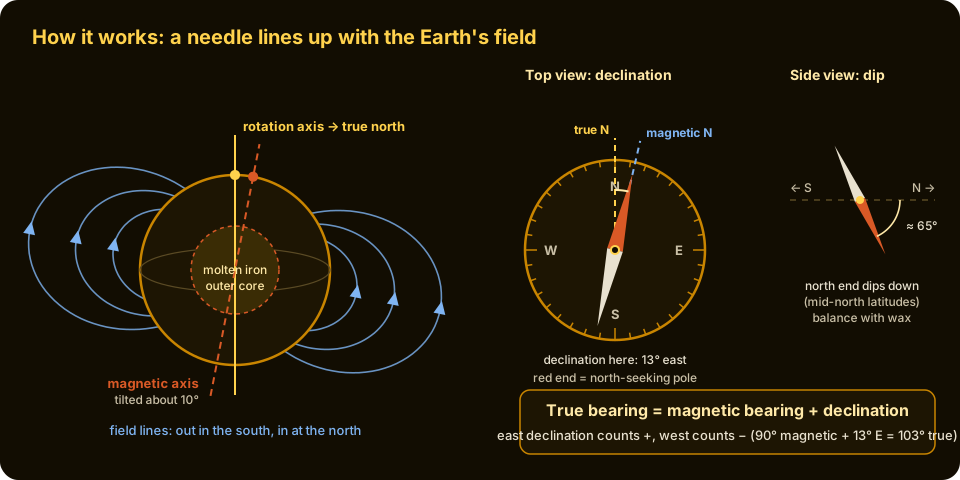
The key idea. The Earth's core generates a magnetic field whose lines run roughly from the southern hemisphere to the northern. A magnetised needle that is free to turn swings until it lies along those lines. Because the magnetic poles are not at the geographic poles, the needle points to magnetic north, which differs from true north by an angle called declination.
Why keep this in the Knowledge Ark
A compass is one of the most useful tools a person can make with almost nothing. A sewing needle, a magnet or a piece of lodestone, a cork and a bowl of water are enough to find north. With a compass and a way of measuring distance, people can make maps, follow a route through country they have never seen, lay out buildings square to the land, and find their way back. It is also a gateway to a deep piece of science: magnetism, the Earth's interior, and the long human effort to understand forces that act across empty space. The compass is a reminder, too, that every instrument has errors, and that a skilled user knows them and corrects for them.
History: how it came about
Lodestone: the stone that pulls iron
Some pieces of the iron ore magnetite are naturally magnetised strongly enough to pick up iron. These are lodestones, a name that comes from an old English word meaning "way stone" or "leading stone". Why a few pieces of magnetite become strong magnets while most do not is still studied; a leading explanation is that they were magnetised by the huge currents of lightning strikes.
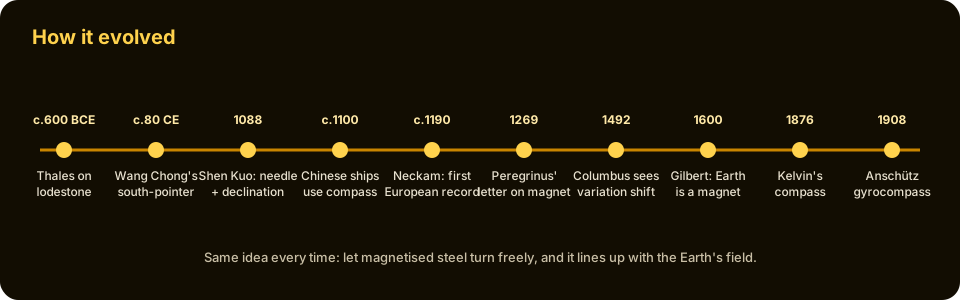
People noticed lodestone very early. Aristotle reported in the fourth century BCE that the Greek philosopher Thales of Miletus, two centuries earlier, had said the stone must have a soul because it moves iron. The word "magnet" probably comes from Magnesia, a region of ancient Greece where such stones were found. Chinese texts of the third century BCE also describe lodestone drawing iron to it. For centuries, though, lodestone was a curiosity and a subject for philosophers and diviners, not a tool for finding the way.
China: the south-pointer
Chinese tradition names the direction a compass points as south, not north, and the earliest Chinese direction-finders were called "south-pointers". The Han dynasty writer Wang Chong, in his book Lunheng of around 80 CE, mentions a south-pointing ladle that, when placed on the ground, comes to rest facing south. Many historians have read this as a spoon carved from lodestone, balanced on a smooth bronze diviner's board, and a working reconstruction of such a spoon was made in China in the 1940s. Others think the passage is too brief to be sure. Either way, early Chinese magnetic devices were used chiefly in geomancy, the art of siting buildings and tombs in harmony with the land, rather than for travel.
The Song dynasty: the magnetised needle
By the eleventh century, Chinese technicians had learned to make iron and steel into magnets. A military manual, the Wujing Zongyao, compiled in 1044, describes a thin leaf of iron cut in the shape of a fish, heated red hot and then cooled with its tail pointing north, which leaves it weakly magnetised; floated on water, it pointed south. This method works because hot iron that cools in the Earth's field keeps some of that field when it is cold.
In 1088 the scholar and official Shen Kuo completed his Dream Pool Essays (Mengxi Bitan), a remarkable book of observations on science and technology. In it he described needles rubbed on lodestone so that they point south, and he compared four ways of mounting them: floating on water, balanced on a fingernail, balanced on the rim of a bowl, and hung from a single fibre of new silk fixed to the middle of the needle with a little wax. He judged the silk thread the best, because the needle turned freely and steadily. He also recorded that the needle does not point exactly south but slightly to the east of it. That is the first known written description of magnetic declination, the difference between magnetic and true direction, more than four hundred years before any European record of it.
Soon after, the compass went to sea. Zhu Yu's book Pingzhou Ketan, written around 1111–1117, describes ships sailing between Guangzhou and the lands to the south in the years around 1100. Their pilots knew the coastlines by the stars at night and the Sun by day, and in dark or cloudy weather they looked at the south-pointing needle. This is among the earliest known records of a compass used for navigation anywhere in the world.
The Islamic world and Europe: the mariner's compass
The magnetic compass appears in European writing at the end of the twelfth century. Around 1190 the English scholar Alexander Neckam described sailors who, when the Sun was hidden by clouds and they could not tell which way the ship was heading, touched a needle to a magnet so that it would turn round and point north. A French poem by Guyot de Provins of about 1205 mentions sailors using a needle rubbed on an ugly brown stone and floated on a straw in water. Whether the compass reached Europe from China along trade routes, or was invented again independently, is not known; no clear chain of transmission has been found.
Writers in the Islamic world described it in the same period. The Persian author Muhammad al-Awfi, around 1232, told of a fish-shaped leaf of iron rubbed with a magnet and used to find direction at sea. The Egyptian writer Baylak al-Qibjaqi, in a book of 1282, described sailors on a voyage he made in the eastern Mediterranean in 1242 floating a magnetised needle on a cross of wood or reed in a bowl of water to find their heading.
In 1269 the French scholar Petrus Peregrinus de Maricourt, serving in an army besieging the town of Lucera in southern Italy, wrote a letter on the magnet, the Epistola de magnete. It is the earliest surviving work in Europe devoted to magnetism based on experiments. He explained how to find the two poles of a lodestone, showed that like poles repel and unlike poles attract, and that a broken magnet becomes two magnets each with two poles. He also described an improved floating compass and a pivoted compass with a needle on an axle inside a box with a graduated scale.
The dry compass and the compass card
By around 1300, Mediterranean sailors had moved from a floating needle to a dry compass, a needle balanced on a pin, and had fixed it beneath a card, the compass rose, painted with the directions of the winds. Because the card turns with the needle, the helmsman can read the ship's heading directly against a mark on the bowl, the lubber line, that stays fixed in line with the ship's bow. Cards were later divided into 32 points, and sailors learned to "box the compass", reciting all 32 in order. Together with sea charts drawn with straight compass courses, known as portolan charts, which survive from the late thirteenth century, the dry compass made it practical to sail directly between distant ports in any weather.
Discovering the errors
Sailors on long voyages found that the compass did not point to true north everywhere. On his first voyage across the Atlantic, in September 1492, Christopher Columbus noticed that his compass needles shifted in their direction relative to the Pole Star as he sailed west. In 1510 the German instrument maker Georg Hartmann measured the declination at Rome, and in 1544 he described in a letter that a magnetised needle free to tilt does not lie level but dips downward. The English compass maker Robert Norman studied this dip, or inclination, carefully and published his results in 1581 in The Newe Attractive.
In 1600 William Gilbert, physician to Queen Elizabeth I, published De Magnete. Experimenting with a small sphere carved from lodestone, which he called a terrella or little Earth, he showed that a compass needle moved over it behaves just as needles do across the real world, pointing towards the poles and dipping more steeply near them. He concluded that the Earth itself is a great magnet, a conclusion that has stood ever since. In 1635 Henry Gellibrand in London showed that declination at one place changes slowly over the years, which is called secular variation. In 1701 Edmond Halley, after voyages in the Atlantic, published a chart showing lines of equal declination over the ocean, one of the first maps of a physical quantity ever made.
Iron ships and new compasses
When ships began to carry iron, and later were built of it, their own magnetism pulled the compass aside, an error called deviation. In the early 1800s Matthew Flinders, mapping the coast of Australia, studied how a ship's iron affected the compass, and a vertical iron bar placed near the binnacle to correct this is still called a Flinders bar. In 1838 the Astronomer Royal, George Airy, worked out how to correct the compass of an iron ship with fixed magnets and iron pieces after experiments on the iron steamer Rainbow. In 1876 William Thomson, later Lord Kelvin, patented a dry compass with a very light card and several short needles that was steadier and easier to correct, and it was widely adopted. From the 1860s, liquid-filled compasses, in which the card floats in alcohol or oil that damps its swinging, became standard at sea and are now standard in hand compasses too.
In 1831 the British explorer James Clark Ross reached the north magnetic pole, then on the Boothia Peninsula in northern Canada. Since then it has wandered a long way, and in recent decades it has moved tens of kilometres a year from the Canadian Arctic towards Siberia. Navigators keep up with this through models of the Earth's field, such as the World Magnetic Model, which is updated every five years.
Beyond the needle
In 1908 the German engineer Hermann Anschütz-Kaempfe patented a practical gyrocompass, which uses a fast-spinning wheel and the Earth's rotation to find true north without magnetism, and Elmer Sperry produced one in the United States in 1911. Large ships and aircraft came to rely on gyrocompasses and, later, on satellite navigation. But the magnetic compass needs no power and cannot be jammed, so it remains a required backup on ships and aircraft and in every hiker's pocket. Modern phones also contain a tiny electronic magnetometer that does the job of the compass needle.
How it works
Magnets and poles
Every magnet has two poles. Like poles repel and unlike poles attract. If a magnet is broken, each piece has its own pair of poles; there is no such thing as a single pole on its own. Around a magnet is a magnetic field, which can be pictured as lines running out of one pole and curving back into the other. A small magnet free to turn in that field swings until it lies along the field lines.
Why steel can be magnetised
Iron, steel, nickel and cobalt are made of countless tiny regions called domains. Within each domain, the atoms' own small magnetic effects all point the same way, so each domain is a tiny magnet. In an unmagnetised needle the domains point in every direction and cancel out. Stroking the needle repeatedly in one direction with a strong magnet turns more and more of the domains to line up, so their effects add together and the whole needle becomes a magnet. Hardened carbon steel, like that in a good sewing needle, holds its domains in place and stays magnetised for a long time. Soft iron loses it quickly. Heat above about 770 degrees Celsius destroys the magnetism of iron, and so do hard knocks; this is why the Song dynasty method of heating iron and letting it cool lying north–south works, because the domains set in line with the Earth's field as the metal cools.
The Earth's magnetic field
The Earth has a magnetic field because its outer core, a layer of molten iron and nickel nearly 3,000 kilometres below the surface, is moving. Currents flowing in the moving metal generate the field, a process called the geodynamo. At the surface the field is weak, roughly 25 to 65 microtesla, far weaker than the field right beside a small household magnet. But it is everywhere, and a light needle on a low-friction pivot feels it easily.
The field is roughly like that of a bar magnet inside the Earth, tilted about ten degrees from the axis of rotation. The end of a compass needle that points north is called its north-seeking pole, or simply its north pole. Because unlike poles attract, the magnetic pole near the geographic North Pole is, strictly speaking, a south magnetic pole. This sounds confusing, but in practice everyone calls it the north magnetic pole and the north end of the needle points to it.
Declination: magnetic north is not true north
True north is the direction to the geographic North Pole, where the Earth's axis comes out. Magnetic north is the direction a compass points at a given place. The angle between them is the declination, sometimes called magnetic variation. It is called east if the needle points east of true north and west if it points west. Depending on where you are, it can be zero or more than twenty degrees, and much more near the poles. It changes slowly year by year as the field changes. Up-to-date values are printed on good topographic maps and charts, together with the year and the annual change, and are available from national geological and geophysical surveys.
To convert, with declination counted positive for east and negative for west:
True bearing = magnetic bearing + declination
For example, where the declination is 13 degrees east, a compass reading of 90 degrees magnetic is 103 degrees true. Sailors used the rhyme "east is least, west is best" for the reverse step, from true to magnetic: subtract an east declination, add a west one.
Deviation: the compass's own surroundings
The compass also responds to iron and magnets nearby. A steel belt buckle, a knife, a car, a wire fence, a power line, a loudspeaker or a phone can pull the needle by many degrees. On a ship or vehicle the error from its own metal is called deviation, and it changes with the heading. Ships "swing" the compass, turning through every heading while comparing it against known bearings, then fix small correcting magnets near it and write the remaining errors on a deviation card. On land, the simple rule is to hold the compass level and away from metal, and step a few metres away from vehicles and fences when taking a bearing.
Dip: the needle wants to tilt
The Earth's field lines are not level. Except near the magnetic equator, they slope down into the ground, steeply near the poles and at around 60 to 70 degrees in many mid-latitude places. A free needle tries to follow them, so its north end dips downward in the Northern Hemisphere and its south end in the Southern. Compass makers balance the needle with a small weight on the high end, and hand compasses are often sold balanced for a particular zone of the world. A home-made needle must be balanced the same way or it will drag on its pivot or touch the card.
Damping
A light needle on a frictionless pivot swings back and forth many times before settling. Floating the needle on water, or filling the compass with liquid, slows the swinging so the needle settles quickly. That is why liquid-filled compasses replaced dry ones at sea and on land.
Parts and what each one does
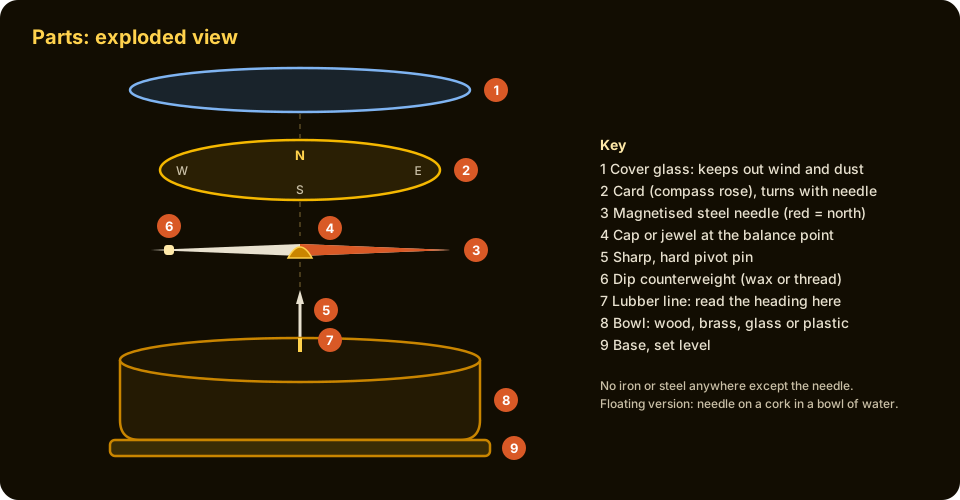
- Cover glass. A clear lid that keeps out wind, dust and fingers, which would all disturb the needle.
- Card (compass rose). A light disc marked with the directions, glued to the needle so that it turns with it. North on the card sits over the north end of the needle.
- Needle. The magnetised steel that does the work. A long, thin, straight needle has a strong, clear direction.
- Cap or jewel. A small hollow cup at the needle's balance point that rests on the pivot. Its smooth hard inside lets the needle turn with very little friction.
- Pivot pin. A sharp, hard point standing up from the base, on which the cap rests.
- Dip counterweight. A little wax, thread or wire on the high end of the needle so it hangs level.
- Lubber line. A fixed mark on the bowl or case that lines up with the direction of travel or the front of the vehicle. The heading is read against it.
- Bowl or case. A non-magnetic housing: wood, brass, glass, ceramic or plastic. Never iron or steel.
- Base and bezel. A flat bottom so the compass can be set level, and on hand compasses a turning ring marked in degrees for taking and following bearings.
Build it: two compasses from a sewing needle
Materials
- Needles: two or three plain steel sewing needles about 35–50 mm long. Test that they are steel by checking a magnet pulls them; some stainless steel needles are barely magnetic.
- A magnet: a fridge magnet will work weakly; a bar magnet, a magnet salvaged from a loudspeaker or a hard drive, a neodymium magnet or a lodestone works much better.
- For the floating compass: a thin slice of cork about 5 mm thick cut from a bottle stopper, or a leaf or a piece of thin card coated in wax, and a non-metal bowl of water: glass, ceramic, wood or plastic.
- For the dry compass: a flat cork, a small wooden block or a jar lid made of plastic or wood for the base; a pin for the pivot; a cap made from a small brass eyelet or rivet, a press stud's socket, or a glass bead with a hole closed at one end with glue; thin card for the compass rose; glue; a little candle wax; a clear plastic or glass lid, such as the top of a small food container or a jar.
- A pencil, a fine pen, scissors, a protractor and a craft knife.
Tools
Pliers, a small file or fine sandpaper, a ruler, and a source of known direction for checking: the Sun at local noon, Polaris, a shadow stick, a map with a north arrow, or another compass.
Step 1: magnetise the needle
Hold the needle by its eye on a table. Take one end of the magnet and stroke it firmly along the needle from the eye to the point. At the end of each stroke, lift the magnet well away in a wide arc and bring it back to the eye before the next stroke. Always stroke in the same direction, with the same end of the magnet. Do this 40 to 60 times. Never rub back and forth, which undoes the work. Test it: the needle should now pick up a pin or a small staple, or at least be attracted to and repelled by different ends of another magnet.
If no magnet is available, there are slower ways. A needle or nail heated to red hot with pliers over a flame and then cooled in water while pointing north–south and tilted downward along the dip will be weakly magnetised, as in the 1044 Chinese method, though the result is weak. A needle wrapped in a coil of insulated wire whose ends are touched for a second or two to a battery will also be magnetised; see the safety section first.
Step 2: make the floating compass
Cut a thin disc of cork about 15–20 mm across. Lay the needle across the top of the cork, or push it carefully through the side so it runs horizontally through the middle. Fill the bowl with still water, well away from metal. Float the cork in the centre. It will slowly turn and settle with the needle lying north–south. If it drifts to the edge of the bowl, which happens because the water surface curves up at the rim, use a wider bowl or fill it right to the brim so the surface is flat or slightly domed.
Step 3: find which end is north
The needle now lies north–south, but which end is which depends on how you stroked it. Check against a known direction. In the Northern Hemisphere at local midday, the Sun is due south; at night, Polaris is due north. Or use a shadow stick: mark the tip of a stick's shadow, wait twenty minutes, mark it again; the first mark is west and the second is east. Once you know, mark the north end of the needle with a dab of paint or a tiny paper flag. This floating compass is exactly the instrument Shen Kuo described in 1088 and the one medieval Mediterranean sailors used.
Step 4: build the pivot
For the dry compass, push the pin up through the centre of the base so its point stands about 10–15 mm high and exactly vertical. File or sand the point smooth and sharp. The finer and harder the point, the less friction there will be.
Step 5: make and fit the cap
Find the needle's balance point by resting it across a knife edge. Glue the cap to the needle at exactly that point, with its hollow facing down. A small brass eyelet or the socket of a press stud works well; a glass bead sealed at one end with glue is smoother still, like the jewelled caps on good compasses. The cap should be large enough that the needle sits on the pin without the pin passing through.
Step 6: make the card
Cut a disc of thin card a little shorter across than the needle is long, about 40 mm across for a 45 mm needle. Mark it with a protractor: north, east, south and west, and if you wish the intermediate points and degree marks every 10 degrees, increasing clockwise from 0 at north. Make a hole in the middle for the cap and glue the card under or on top of the needle, with the card's north exactly over the north end of the needle. Keep the card light; every gram adds friction on the pivot.
Step 7: balance against dip
Set the needle and card on the pivot. In the Northern Hemisphere it will probably tilt north end down; in the Southern, south end down. Add tiny pieces of wax or wrap a few turns of fine thread on the high side until the card sits level. It must not touch the base anywhere as it turns.
Step 8: house it
Fit the base into a short round case, a ring of card, wood or plastic, and draw a lubber line on the inside rim. Cover it with the clear lid, leaving enough space above the card. Keep every part non-magnetic; do not use steel screws, steel lids or tin cans.
Step 9: correct for declination
Look up the declination for your area from a recent map or survey. Either mark a second, offset north arrow on the base showing true north, or remember to add east declination and subtract west declination when you convert compass bearings to true bearings.
Test and use it
- Settling. Turn the compass gently and let it settle several times. A good pivoted needle should come back to the same reading within a degree or two every time. If it sticks, the pivot is blunt or the cap is rough.
- Check against a known direction. Compare with a shadow stick, the Sun at local noon, Polaris, a map with a north arrow or a good commercial compass, well away from metal. Remember the declination.
- Check for deviation. Bring a knife or a phone near the compass and watch the needle move. That is why bearings must be taken away from metal.
- Take a bearing. Hold the compass level, point the lubber line at a landmark, and read the card at the lubber line. To walk a bearing, turn until the card shows that number at the lubber line and walk towards a distant object in that direction.
- Re-magnetise. If the needle weakens over months, stroke it again the same way.
Safety
- Strong magnets. Neodymium magnets can snap together with enough force to pinch skin and shatter. If a child swallows two magnets, or a magnet and a piece of metal, they can pull together through the walls of the intestine and cause life-threatening injury; get emergency medical help immediately. Keep strong magnets away from small children entirely.
- Medical devices and electronics. Keep strong magnets well away from pacemakers and other implanted devices, and from bank cards, hard drives and mechanical watches.
- Needles and pins. Sewing needles and pivot pins are sharp. Handle them with pliers, and keep the finished compass away from small children.
- Batteries and coils. If magnetising with a coil and battery, use a single small cell and only touch the wires for a second or two. Shorting a battery makes the wires and battery very hot, can burn fingers and can cause the battery to leak, swell or catch fire. Never use a mains supply or a car battery.
- Heating needles. If heating a needle in a flame, hold it with pliers, work over a non-flammable surface and let it cool fully.
- Water and children. Supervise small children around bowls of water.
- Do not trust your life to it alone. A home-made compass is a real instrument, but check it against other directions often, carry a proper compass and map in wild country, and remember that iron rocks, vehicles and power lines can deflect any compass.
Where compasses are used now
Magnetic compasses are still carried on every ship and aircraft as backups that need no power. Hikers, soldiers, surveyors, foresters, geologists, cavers and orienteering runners use liquid-filled hand compasses with a baseplate and a turning bezel. Smartphones, cars and drones contain electronic magnetometers that sense the Earth's field and serve as digital compasses. Geologists use the magnetism frozen into ancient rocks to show how continents have moved and how the Earth's field has reversed many times in the past. All of these rest on the same simple fact that Shen Kuo wrote down in 1088: a magnetised needle, free to turn, points along the Earth's field, and not quite at the true pole.
Words to know
- Lodestone: a naturally magnetised piece of the iron ore magnetite.
- Magnetic domains: tiny regions inside iron or steel that each act as a small magnet.
- North-seeking pole: the end of a compass needle that points towards magnetic north.
- True north: the direction to the geographic North Pole.
- Magnetic north: the direction a compass points at a given place.
- Declination (variation): the angle between true north and magnetic north.
- Deviation: compass error caused by iron or magnets on the ship, vehicle or person carrying it.
- Dip (inclination): the downward tilt of the Earth's magnetic field and of a free needle.
- Lubber line: the fixed mark on a compass that shows the direction of travel.
- Bearing: a direction measured in degrees clockwise from north.
Related in the Knowledge Ark
The Knowledge Ark keeps 6,000 packages for rebuilding, from measuring and mapmaking to records and navigation. Browse them, search by category and open any package at the Knowledge Ark. Its sister, the Culture Ark, keeps 2,000 things people should still be able to see in 2,000 years.
Where to learn more
- Royal Museums Greenwich: the history of the mariner's compass, deviation and Kelvin's compass.
- The British Geological Survey and the US National Oceanic and Atmospheric Administration (NOAA): the World Magnetic Model and current declination calculators.
- Joseph Needham's Science and Civilisation in China, volume 4: the history of the Chinese compass and Shen Kuo's observations.
- William Gilbert's De Magnete (1600), available in English translation.
- Any introductory physics textbook covering magnetism and magnetic fields.
Knowledge Ark build sheet. An Artificial Mind Hive (AMH) project. AMH is owned by Austin Little.